
c. 1135 – 1187·Feast July 1
St. Nicasius of Sicily
Hospitaller Knight Beheaded Before Saladin
Overview
Nicasius of Sicily — called Nicasio, Nicaise, Nicasio Burgio or Nicasius of Jerusalem — was a Sicilian knight of the Hospitaller Order who died a martyr's death in the Holy Land in 1187. Born around 1135, probably in Palermo, to Roberto de Burgio and his wife Aldegonda, he carried Norman blood on his mother's side and Saracen descent on his father's, a heritage proper to the mixed Christian and Muslim island of his birth. With his brother Ferrandino he entered the Order of the Knights of St John of Jerusalem as a lay brother, taking vows of poverty, chastity and obedience, together with a fourth undertaking: never to lay aside their weapons, so that the poor might be guarded and the Christian land defended. In 1185 he answered the call of Grand Master Roger de Moulins and sailed for the Holy Land, where the brothers cared for pilgrims and patients within the hospital of St. John at Jerusalem. Serving as a captain in the army, Nicasius was taken captive at the battle of Hattin and, on his refusal to convert to Islam, was decapitated in the presence of Saladin; another tradition places his capture and beheading at the defense of Acre in the same year. The city of Caccamo honors him as its patron.
The Complete Life
A Son of Two Peoples
Nicasius was born around 1135 in Sicily, probably in Palermo, into the family of the Kameti, afterwards known as de Burgio, one of the noble houses of the island. His father was Roberto de Burgio and his mother Aldegonda, and through them the boy inherited the two great streams of Sicilian society: Saracen descent on the father's side and Norman on the mother's. Sicily in the twelfth century was the meeting place of Latin Christians, Greek Christians and Muslims under the Norman kings, and Nicasius' very parentage embodied that mixture. With his brother Ferrandino he grew up in a family that chose the vocation of the military orders, and both young men joined the Hospitaller Order of the Knights of St John of Jerusalem. They became lay brothers, a rank that joined the religious state to the profession of arms, and their choice set the direction of their lives toward the hospital and the battlefield of the Holy Land at once, in an age when the Christian kingdom of Jerusalem stood in ever greater need of both.
§ Life
Vows of a Lay Brother in Arms
On entering the Order of St John, Nicasius and his brother Ferrandino took the three traditional religious vows of poverty, chastity and obedience. To these the Hospitallers added a fourth, distinctive of their charism: a vow to remain under arms, sworn so that the poor would always have defenders and the Christian land of the East a guard. The formula is a theology in miniature, for it made the sword itself an instrument of mercy: the knight fought not for conquest but so that pilgrims might reach the holy places and the poor of the kingdom might be defended. Nicasius lived this double vocation fully. Within the order he was a religious, bound to the common life and the liturgy; in the world he was a soldier and, by the end, a captain in the army of the kingdom. When Roger de Moulins, the grand master of the Hospital, called for reinforcements in 1185, Nicasius and Ferrandino answered and traveled to the East, where they took up the twofold service of their profession: ministering to pilgrims and the ill within the hospital of St. John at Jerusalem, while keeping themselves armed for the defense of the Christian land.
§ Life
Service in the Hospital and the Catastrophe of Hattin
In the Holy Land the brothers from Sicily served in the hospital of St. John of Jerusalem, washing and feeding the pilgrims and the sick who came to the house of the Hospital, the work of mercy that gave the order its name. But the summer of 1187 brought the catastrophe that ended the Christian kingdom's greatness: the battle of Hattin, in which Saladin destroyed the army of Jerusalem. Nicasius went into that battle as a captain, an officer responsible for the men under his command, and when the Christian host collapsed he fell into the hands of the victors. What followed fixed his memory forever. Called before Saladin himself, the knight was summoned to convert to Islam, and on his refusal he was decapitated in the sultan's presence. He had kept the fourth vow of his profession to the end, remaining in arms for the defense of Christ's poor, and he paid the price that vow could carry. A second tradition tells the story differently: it says that Nicasius assisted in the defense of Acre, the great siege that began in the aftermath of Hattin, and was captured and beheaded there in 1187. Either way, his blood was shed in the same year, for the same refusal, in the same cause.
§ Life
The Cult of the Martyr
The Church received Nicasius among its martyrs without any formal canonization, his cult arising where his memory was kept alive by family, city and order. Veneration of the Sicilian knight took root early: by 1305 an altar dedicated to him existed in the church of Saint Peter in Trapani, evidence that his cult had spread across his native island within little more than a century of his death. The true center of his devotion, however, proved to be Caccamo, the town in the Sicilian interior whose people formally proclaimed him the city's patron on May 31, 1625. How the cult reached Caccamo was explained by Fr. Vincent Venuti writing in his Discorso storico-critico of 1762, who reasoned that it grew there gradually either because the Burgio family held dominions near the town, or because the Cabrera family practiced devotion to St. Nicasius, or from both causes together. His feast day is kept on July 1, and the faithful have long invoked him against scrofula, the disease of the neck and lymph glands that medieval piety laid at the feet of martyr-saints. In art he appears in military attire, the knight-brother who shed his blood for the name of Christ.
§ Veneration
Patron of Caccamo and Image on Canvas
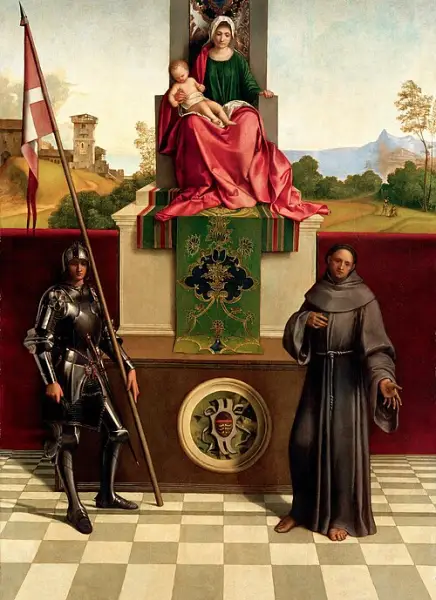
Nicasius' lasting monument is the city that took him for its own. Caccamo's declaration of 1625 made the twelfth-century Hospitaller the official patron of a Sicilian community he may never have seen, a bond forged, as Venuti suggested, by the lands of the Burgio family in the neighborhood and by the devotion of the Cabrera counts, and it has endured through the centuries in the city's liturgy and identity. The local cult also entered the artistic record of the Renaissance: about 1503, more than three centuries after the martyr's death, an altarpiece painter placed him beside St. Francis in the great altarpiece now known as the Castelfranco Madonna, where the knight of Hattin adores the Virgin and Child in company of the Poverello, a witness to how far the fame of the Sicilian martyr had traveled from Caccamo. In the island itself the memory was kept by altars such as the one in Trapani, by the learned investigations of priests like Venuti, and by the continuing invocation of his name against scrofula. The knight who died before Saladin thus lives on as patron, protector and painted figure, the most celebrated of the Hospitaller saints of Sicily.
§ Veneration
Timeline
- 1135
Is born in Sicily, probably at Palermo, into the Camuto family later known as de Burgio
§ Life
- 1185
Answers the call of Roger de Moulins and travels with his brother to the Holy Land
§ Life
- 1187
Is captured at the battle of Hattin and beheaded before Saladin for refusing to convert to Islam
§ Life
- 1305
An altar dedicated to him exists in the church of Saint Peter in Trapani
§ Veneration
- 1625
Caccamo names him patron of the city, an official act dated May 31
§ Veneration
In Their Own Words
because of the dominions that the Burgio family had near Caccamo. Or because of devotion, which the Cabrera family exercised toward St. Nicasius, or because of both reasons, I figure that, little by little, some what of a cult toward our St Nicasius of Jerusalem, went in Caccamo…
The Record
- Patron of
- patron of Caccamo·invoked against scrofula
- Symbols
- Military attire
- Canonization
- Pre-congregation; venerated as a martyr in the Catholic Church, with an altar recorded in 1305
Prayer
Bibliography
Show 3 sources
- Cassata, Francesco. "San Nicasio Camuto de Burgio", Santi e Beati, July 31, 2002.
- "Saint Nicasius". Order of Malta.
- Venuti, Vincent. Discorso storico-critico (1762).
Profile text adapted from the Wikipedia article, licensed CC BY-SA 4.0.
Pray with this saint every day
Save St. Nicasius of Sicily to your favorites, read the full profile, and get feast-day reminders in the Saints app.
Get the Saints AppFree on the App Store for iPhone and iPad