
died c. 285 (legendary)·Feast October 11
St. Nicasius, Quirinus, Scubiculus, and Pientia
Martyred missionaries of the Vexin legend
Overview
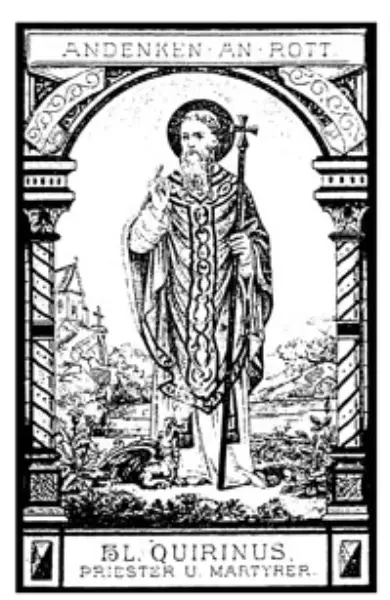
Nicasius, Quirinus, Scubiculus, and Pientia are honored together as martyrs, with a common feast on 11 October. The tradition surrounding them is acknowledged to be legendary: no dependable historical account of the group survives, and Nicasius has been identified by some with Nicasius of Rheims, while several distinct saints bear the name Quirinus. According to one legend, Nicasius was among the first missionaries sent from Rome to preach the faith in Gaul, perhaps serving as a regionary bishop, with Quirinus as his priest and Scubiculus as his deacon; Scubiculus is remembered in France as Egobille. The three men are said to have labored in the pagus Vulcassinus, the Vexin, and to have suffered death there around the year 285. A variant tradition has them sent by Pope Clement in the company of Saint Denis. In it Quirinus destroys a dragon that had ravaged the country around Vaux-sur-Seine, and after the missionaries are beheaded their bodies are recovered and buried by the lady Pientia with the priest Clarus. Quirinus became the most celebrated of the group, honored especially at Malmedy, and has been sought as an intercessor in drought, in fever, in storms, and in assault from the evil one.
The Complete Life
A Mission Sent from Rome
The story of these martyrs begins not in documented history but in pious legend, and the legend itself admits as much by its variations. In its oldest form, Nicasius stands among the first missionaries dispatched from Rome to carry the Christian faith into Gaul, a worker so far from any settled see that he may have functioned as a regionary bishop, moving through territory rather than ruling it. Beside him the tradition places two companions in holy orders: Quirinus, a priest sharing his labors, and Scubiculus, a deacon whose name survives in France in the altered form Egobille. A second version of the tale deepens the antiquity of the mission by attributing its commission to Pope Clement himself, sending the three evangelists to Gaul in the company of Saint Denis, the famed apostle of the Parisians. Whatever the historical reality behind these accounts — and sober judges have found no trustworthy record of the group at all — the memory they preserve is of missionaries who pushed beyond the Roman cities into the pagus Vulcassinus, the rural Vexin between the Seine and the Oise, there to preach, baptize, and die. The grouping of the four names in a single commemoration, with Pientia honored as the one who buried the martyrs, suggests an early local cult that gathered fragmentary traditions around a shared shrine.
§ Legends
The Dragon and the Beheading
The legend gives the missionaries a martyr's passion colored with the familiar imagery of early hagiography. Sent out to evangelize the Vexin, Quirinus encountered at Vaux-sur-Seine a dragon that had laid waste to the countryside and poisoned a well; he fought the creature and overcame it, a victory that made him the especial hero of the group. The preaching of the missionaries soon drew the attention of the authorities, and in one version of the story they were seized by soldiers of the emperor Domitian and thrown into prison. There followed the consummation of their witness: the saints were beheaded for the faith. Even death, however, did not end the story. On the night after the execution, the tradition relates, each martyr carried his severed head in his hands and made his way to an islet in the stream of the Epte, where the noblewoman Pientia, together with a priest called Clarus, gave them burial. The date assigned to this passion is around the year 285. Such tales of cephalophores — saints who carry their heads — and of dragon-fighting confessors were common currency in medieval hagiography, and later writers acknowledged that the tale told of Quirinus and his companions drew its stock incidents from such familiar hagiographic patterns and took matter besides from the legends of other saints bearing that name.
§ Legends
Cult at Malmedy and Widespread Remembrance
Among the four, it was Quirinus who came to hold a lasting place in the devotion of the Low Countries and the Rhineland. Around 875, in the reign of Charles the Bald, his relics were translated to the abbey church of Malmedy, and from that moment the abbey became the centre of his cult; the cathedral there still bears his name together with those of Saints Peter and Paul, and his relics are kept today in an ossuary of wood beneath a statue standing along the nave's left side. Abbot Poppo of Stavelot later confirmed the relics as authentic. When Malmedy, until then a dependency of Stavelot, moved toward independence between 1065 and 1071, it needed a patron in heaven strong enough to compete with Stavelot's Saint Remaclus, and the monks elaborated Quirinus' legend for the purpose, weaving in borrowed episodes. Under the title of Saint Quirinus of Malmedy he far outshone his companions Nicasius and Scubiculus in fame. The faithful invoked him against drought, fever, foul weather, and demonic attack, and the cattle-raising farmers of the Münsterland sought his aid against the diseases of their herds. The breadth of his medieval popularity survives in the many family names across Central and Western Europe — Quirini, Krings, Kreins, Kircher, and others — descended from his own.
§ Veneration
Timeline
- 285
By legendary account the missionaries were put to death in the Vexin.
§ Legends
- 875
Quirinus' relics were transferred to the abbey church of Malmedy under Charles the Bald.
§ Veneration
- 1065
Malmedy began its rise to independence from the abbey of Stavelot.
§ Veneration
The Record
- Patron of
- invoked against drought·invoked against fever·invoked against bad weather·invoked against demons·farmers of the Münsterland asked his help against cattle diseases
- Symbols
- dragon (Quirinus)
- Canonization
- Pre-congregation; venerated as martyrs since late antiquity, though their historicity is uncertain
Prayer
Bibliography
Show 3 sources
- Baring-Gould, Sabine (1898). "The Lives of the Saints". The Lives of the Saints.
- "CATHOLIC ENCYCLOPEDIA: Sts. Quirinus". www.newadvent.org.
- "Startportal des Bistums Aachen". www.bistum-aachen.de.
Profile text adapted from the Wikipedia article, licensed CC BY-SA 4.0.
Pray with this saint every day
Save St. Nicasius, Quirinus, Scubiculus, and Pientia to your favorites, read the full profile, and get feast-day reminders in the Saints app.
Get the Saints AppFree on the App Store for iPhone and iPad