
1030 – 1108·Feast January 31
St. Nicetas of Novgorod
Hermit of the Kiev Caves and bishop
Overview
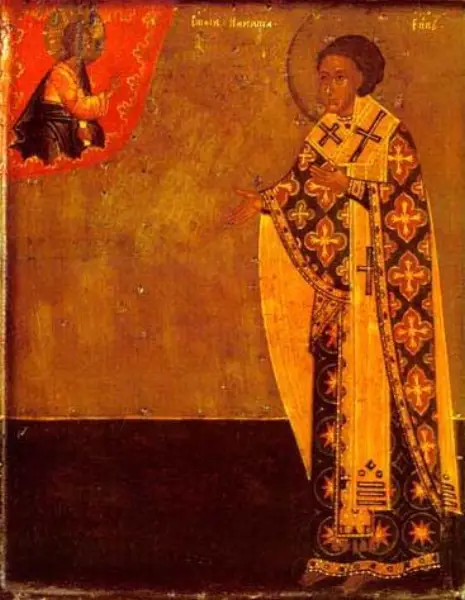
Nicetas of Novgorod, also spelled Nikitas, was a monk of the Kiev Pechersk Lavra who rose from a famously chastened hermit to the episcopal throne of Novgorod. Born at Kiev on 25 May 1030, he embraced the solitary life while still young, against the objections of Nikon, abbot of the Caves, and withdrew to a cave in solitude. There, according to the tradition, he fell into spiritual delusion: the evil one presented himself under an angel's appearance and persuaded the ascetic to lay prayer aside, promising to plead on his behalf, while feeding him news of the world, so that the deceived hermit astounded visitors with his command of the Old Testament while refusing even to hear the Gospel read. The elders of the monastery recognized his condition, broke into the cave, drove the demons out by their prayers, and dragged him to safety. Nicetas lost his uncanny knowledge and even his ability to read, and was taught again from the beginning — a humbling that bore lasting fruit. Restored with the elders' blessing, he took up his hermitage anew in humility, and God was believed to have rewarded him with the gift of miracle-working. In 1096 he was named Bishop of Novgorod. His intercessions were credited with ending a severe drought and extinguishing a fire in the city. He reposed on 31 January 1108 after thirteen years as bishop, and was glorified as a saint in 1558.
The Complete Life
Delusion in the Cave, Deliverance by the Brethren
As a young monk of the Kiev Pechersk Lavra, Nicetas burned for the solitary life. Abbot Nikon objected — experience had taught the Caves fathers what dangers awaited the untried hermit — but the young man would not be dissuaded and embraced the life of a solitary. Alone in his cave, he was tormented heavily by demons. The worst assault came disguised as grace: the devil appeared to him in the form of an angel of light, and the ascetic bowed down before him. The false angel advised him to give up praying, promising that he would pray in his place, and stood near the hermit in the posture of prayer, reassuring the deceived man hour after hour. The effects were uncanny and seductive. in his grasp of the Old Testament's writings Nicetas now outstripped every brother of the monastery, yet of the Gospel he would say nothing and would not suffer it to be read aloud to him. The evil spirit fed him information about happenings in the world, and visitors who came for guidance marveled at his prophecies. But the elders of the monastery were not deceived. They recognized that their brother had fallen into prelest, the ancient spiritual delusion of the desert fathers. Breaking into the cave, they drove the demons away with their prayers and dragged the hermit bodily out of his solitude. In the deliverance Nicetas lost everything the impostor had given him: the knowledge of the Old Testament vanished, and he even forgot how to read, so that the brethren had to teach him his letters again.
§ Spiritual delusion
Bishop of Novgorod and Wonderworker
The catastrophe of the cave became, in the hands of God, the making of the saint. Nicetas realized how far he had gone wrong, and he repented with great sadness, humility, and fasting. With the blessing of the monastery's elders he returned to his hermitage, taking up again the life he had ruined, but now with the addition of humility — the virtue whose absence had nearly destroyed him. On that foundation a new grace was believed to rest: God blessed the penitent with the gift of working miracles. In 1096 the hermit of the Caves was called to the highest office the Russian Church could give: he was named Bishop of Novgorod, and the intercessions that had once been counterfeited by the devil were now exercised in truth. The people of the city credited him with deliverance in two great calamities. When a severe drought gripped the region, his prayers were believed to have brought the release of rain; and when fire broke out in the city, it was extinguished, again by his intercession. He reposed on 31 January 1108, in his seventy-eighth year, after thirteen years of episcopal service, leaving behind a reputation sanctified not by unbroken brilliance but by fall, repentance, and restoration.
§ Later life
Glorification and the Wanderings of His Relics
Four and a half centuries after his death, the Church of Russia formally recognized the holiness of the fallen and restored hermit: the Church of Russia enrolled the fallen and restored hermit among its saints in 1558, in the days of Tsar Ivan Vasilievich, and the uncovering of his relics was itself kept as a feast on 30 April. His memory took firm root in both the East and the West. The Eastern Orthodox Church keeps his feast three times in the year — on 31 January, when he died; on 30 April, when his relics were uncovered; and on 14 May — while the Catholic Church commemorates him on 31 January. His bodily remains had a long history of their own, moving with the fortunes of the Russian Church through the twentieth century. In 1956 Bishop Sergius Golubtsov transferred the relics from the Sophia Cathedral to the Saint Nicholas Cathedral; when that church was closed in 1962, they were moved again, to the Church of the Apostle Philip. Only after the fall of the Soviet regime were they restored to their ancient home: in 1993 they came home at last to the cathedral of St. Sophia, where the bishop of the Kiev Caves rests once more above the city he served for thirteen years.
§ Legacy and veneration
Timeline
- 25 May 1030
He was born at Kiev.
§ Later life
- 1096
He was named Bishop of Novgorod.
§ Later life
- 31 Jan 1108
He reposed after thirteen years as bishop of Novgorod.
§ Later life
- 1558
He was glorified as a saint in the reign of Tsar Ivan Vasilievich.
§ Legacy and veneration
- 1956
Bishop Sergius (Golubtsov) transferred his relics from the Sophia Cathedral to Saint Nicholas Cathedral.
§ Legacy and veneration
- 1962
When Saint Nicholas Cathedral was closed, his relics were moved to the Church of the Apostle Philip.
§ Legacy and veneration
- 1993
His relics were returned to the St. Sophia Cathedral in Novgorod.
§ Legacy and veneration
The Record
- Canonization
- Glorified in 1558 under Tsar Ivan Vasilievich
Prayer
Bibliography
Show 6 sources
- "Venerable Niketas of the Kiev Caves, Far Caves, Bishop of Novgorod". www.oca.org. Retrieved 2025-08-26.
- Online, Catholic. "St. Nicetas - Saints & Angels". Catholic Online. Retrieved 2025-08-26.
- Rose, Father Seraphim (1981). God's Revelation to the Human Heart (2nd ed.). Saint Herman of Alaska Monastery (published 1987). pp. 16-19. ISBN 978-0938635031.
- Brianchaniov, Bishop Ignatius (1983). The Arena (2nd ed.). Jordanville, New York: Holy Trinity Monastery. pp. 31-34. ISBN 978-0884652878.
- Tserpitsky, His Eminence Lev (2008). "Вновь со святителем Никитой" (PDF). СОФИЯ (in Russian) (3): 8-10.
- (in Greek) Ὁ Ὅσιος Νικήτας ὁ Ἔγκλειστος. ΜΕΓΑΣ ΣΥΝΑΞΑΡΙΣΤΗΣ.
Profile text adapted from the Wikipedia article, licensed CC BY-SA 4.0.
Pray with this saint every day
Save St. Nicetas of Novgorod to your favorites, read the full profile, and get feast-day reminders in the Saints app.
Get the Saints AppFree on the App Store for iPhone and iPad