
died 1186·Feast May 24
St. Nicetas Stylites
Chained pillar ascetic of Kievan Rus'
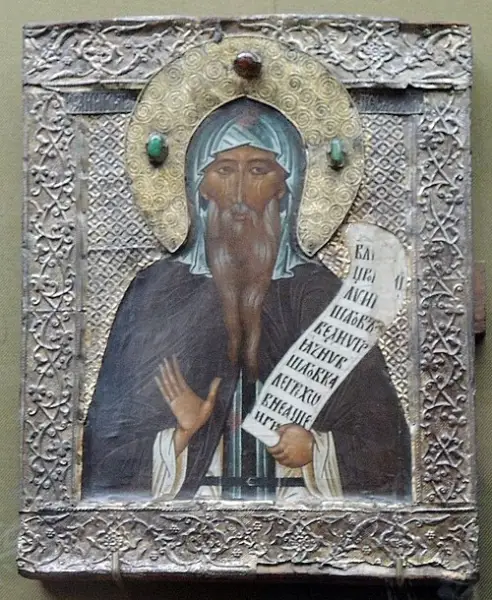
Overview
Nicetas, known in Russian as Nikita, was a monk of twelfth-century Kievan Rus' whose fierce asceticism earned him the title Stylites, the pillar-dweller. His early life gave little promise of sanctity: he lived dissolutely, indifferent to the things of God. The turning point came when he entered a church on a certain occasion and heard the words of the Prophet Isaiah, "Wash you, make you clean" — a rebuke to sin that pierced his soul and effected a profound conversion. Abandoning everything he possessed, he withdrew to the ascetic life near Pereyaslavl, beside Lake Pleshcheyevo in the land of Zalesye. There he founded the Monastery of St. Nicetas on the lake's eastern shore. His self-discipline took a radical form: he bound his body in chains and enclosed himself within a pillar, following the ancient tradition of the stylites, and he became widely known as a healer whose intercession brought relief to the sick. His solitary life ended violently. Robbers, believing the hermit bound in chains of silver, broke in upon him on May 16, 1186, and killed him in the course of their theft. The Eastern Orthodox Church, and with it the Ukrainian Greek Catholic Church, numbers him among the saints and commemorates him on May 24.
The Complete Life
From a Dissolute Youth to the Pillar
The sanctity of Nicetas began in contradiction. He had passed his youth without restraint, living dissolutely and giving no thought to his soul. The change came suddenly and through a single sentence of Scripture. Entering a church on one occasion, he heard read the words of the Prophet Isaiah: "Wash you, make you clean" — the summons of the first chapter of Isaiah to a people steeped in sin. The words seized him, and a profound conversion was wrought in his soul on the spot. What followed was no half-measure. Nicetas left all that he possessed, embracing voluntary poverty in a single stroke, and withdrew to a life of asceticism near the town of Pereyaslavl, in the region of Zalesye north of Kiev. There, on the eastern shore of Lake Pleshcheyevo, he established the Monastery of St. Nicetas, rooting monastic life in that frontier land. But his discipline pressed beyond the common practices of fasting and vigil. Following the example of the ancient pillar-saints of the East, he bound his body in iron chains and shut himself within a pillar, refusing to leave it, and it was from this enclosure that he took the name Stylites. Word of his austerity spread, and crowds began to seek him out, for along with his mortifications God had given him a reputation as a healer.
§ Sainthood
Death at the Hands of Thieves
The enclosure that protected Nicetas from the world could not protect him from the greed of the world. The chains in which he had bound himself, in the eyes of lawless men, told a different story: they took them for silver, and imagined that within the pillar the hermit kept a hoard worthy of his fetters. On May 16, 1186, thieves broke upon his solitude intending robbery. What they found was an old man bound in iron, owning nothing; but the discovery did not stay their hands, and in the violence of the assault Nicetas was killed. Thus the ascetic who had made himself a prisoner for Christ died a martyr's death at the hands of men who coveted a treasure that never existed. His death in such circumstances — slain within his pillar, where he had lived for the sake of prayer — fixed his memory among the venerators of Kievan Rus'. The monastery he had founded on Lake Pleshcheyevo endured after him, and the monk whom the robbers had mistaken for a rich man was honored as one of the true rich of the Church. He is also remembered under the spelling Nikita, and his cult belongs to the common inheritance of the Eastern Orthodox and Eastern Catholic Churches.
§ Sainthood
Commemoration in the Eastern Churches
The Church's judgment on the life and death of Nicetas was rendered in his canonization, by which he was enrolled among the saints of Eastern Orthodoxy. His feast falls on May 24, the day on which the Eastern Orthodox Church keeps his memory each year, styling him in the Greek synaxaria a venerable martyr — holy one of the monastic life slain violently — and a Stylites. The same commemoration is observed in the Ukrainian Greek Catholic Church, so that his veneration bridges the Orthodox and Eastern Catholic traditions that divide much of the Slavic world. Eighteenth-century frescoes depict him in the garb of his asceticism, and he is remembered in connection with the Nikitsky Monastery that grew from his foundation beside Lake Pleshcheyevo. His story has kept its hold on the imagination of the Church partly because of its starkness: a sinner converted by a single verse, a man who chained himself below God's eye, a healer sought out by the suffering, and finally a victim of the very covetousness he had renounced. In the calendar of the East he stands with the small company of Russian pillar-saints, a witness that the desert disciplines of the early Church took root and flowered even in the forests of Zalesye.
§ Sainthood
In Their Own Words
Wash you, make you clean;
The Record
- Major works
- Monastery of St. Nicetas on Lake Pleshcheyevo (founder)
- Patron of
- invoked as a healer
- Symbols
- chains·pillar
- Canonization
- Canonized by the Eastern Orthodox Church; commemorated May 24
Prayer
Bibliography
Show 2 sources
- "Our Holy Father Nikita Stylites". St. Nicholas Russian Orthodox Church (McKinney (Dallas Area) Texas).
- Great Synaxaristes: (in Greek) Ὁ Ἅγιος Νικήτας ὁ Ὁσιομάρτυρας ὁ Στυλίτης. 24 Μαΐου. ΜΕΓΑΣ ΣΥΝΑΞΑΡΙΣΤΗΣ.
Profile text adapted from the Wikipedia article, licensed CC BY-SA 4.0.
Pray with this saint every day
Save St. Nicetas Stylites to your favorites, read the full profile, and get feast-day reminders in the Saints app.
Get the Saints AppFree on the App Store for iPhone and iPad