
died 372·Feast September 15
St. Nicetas the Goth
Gothic soldier burned for the Christian faith
Overview
Nicetas the Goth was a soldier and martyr of the fourth century, venerated with special devotion in the Eastern Orthodox Church and remembered on 15 September. A man of Gothic origin and of the upper class of his people, he made his home in the lands of the Danube on the very fringe of the Eastern Empire, and his life fell within the years of the emperor Constantine the Great's sole rule. He was instructed in the Christian faith by Theophilus of Gothia, a converted bishop who had taken part in the First Ecumenical Council, and he presumably received his Greek name at his baptism from that bishop's hands. When the Goths divided over the new religion, Nicetas sided with the Christians in the civil war between the pagan judge Athanaric and the Christian Fritigern. After Athanaric's defeat he labored among his people, especially once Ulfilas had devised Gothic alphabets for the Scriptures. When Athanaric returned to power and resumed his persecution of the Christians, Nicetas was condemned to death by fire in 372. His Passio records that the devil, shaped like an angel, urged him to sacrifice to the pagan gods to save his life, and that he drove the tempter away by prayer, aided by the archangel Michael. The Christians laid his body to rest in Cilicia, and in later times his remains were carried to Constantinople; part of them reached the Serbian monastery of Visoki Dečani.
The Complete Life
A Noble Goth at the Edge of Empire
Nicetas belonged to a people then standing at the crossroads of two worlds. Born among the Goths of the fourth century, into the upper social class of his nation, he made his home in the Danube region, where the Gothic lands pressed against the frontiers of the Byzantine Empire. Into that borderland the Christian faith had begun to move, and its first great instrument among the Goths was a bishop of their own race: Theophilus of Gothia, a convert who had represented his people at the First Ecumenical Council. Between 325 and 341, in the years of Constantine the Great's sole rule over the Roman world, Theophilus instructed the young nobleman in the Christian religion, and Nicetas received the faith from him. From the same hands, it is presumed, he received the Greek name by which he has been known ever since — Nicetas, a name taken, as such names usually were, at the baptismal font. Thus a Goth by blood and a soldier by calling became a Christian by conviction, at a time when to be both a Goth and a Christian was to stand against the ancient religion of one's own tribe. The tension that would end at the stake was present from the beginning of his new life.
§ Life
Civil War Between Pagan and Christian Goths
The Christianity that Nicetas embraced was splitting his nation in two. As the Gospel spread among the Gothic tribes, the pagan majority began to resist it, and the resistance hardened into internecine strife — a civil war in which religion and politics were inseparable. On one side stood Athanaric, the iudex or judge of the Visigothic tribes, champion of the ancestral gods; on the other Fritigern, leader of the Christian party. Nicetas, soldier that he was, took up arms for Fritigern and the faith. In the course of the struggle Athanaric went down to defeat, and with the war won came a second instrument of grace: Ulfilas devised Gothic alphabets, giving the Goths the Scriptures in their own tongue. In those years Nicetas worked intensely among his people, laboring to root the faith that had cost him so much. The triumph was brief. After a few years Athanaric returned, defeated Fritigern, and resumed the persecution of the Christians with the power of the state behind it. The persecution was fueled, the sources note, by the fear that the native pagan religion was being rejected for the religion of the Roman emperor — Christianity, now counted the creed of the enemy. In that reversal, the victor of yesterday became the hunted confessor of today.
§ Life
The Stake, the Tempter, and the Relics
In the year 372 the persecution reached Nicetas, and he was condemned to die by fire. The account of his passion preserves a last combat before the flames. According to his Passio, the devil appeared to him in the shape of an angel and pressed him to offer sacrifice to the pagan gods and so save his life. The martyr answered not with argument but with prayer, and by that prayer, assisted by the archangel Michael, he put the tempter to flight; then he went to the stake, bearing witness with his body to the faith he had confessed since the days of Theophilus. His death belongs to the great movement by which Christianity took hold among the Gothic tribes, and his memory became one of its monuments. The Christians buried his body in Cilicia, far to the south-east; in later times it was transferred to Constantinople, where the imperial capital honored him among its saints. From there part of his relics was given to the monastery of Visoki Dečani in Serbia, where it remains. The veneration that gathered around his name spread across the whole Orthodox world: in Greece, Russia, Ukraine, Serbia, Macedonia, and Cyprus there stand churches and monasteries dedicated to Saint Nicetas, and the medieval cult gave the Slavic peoples the forms of his name that endure to this day — Nikita, Mykyta, and Mikita.
§ Life
Feast, Patronage, and Remembrance
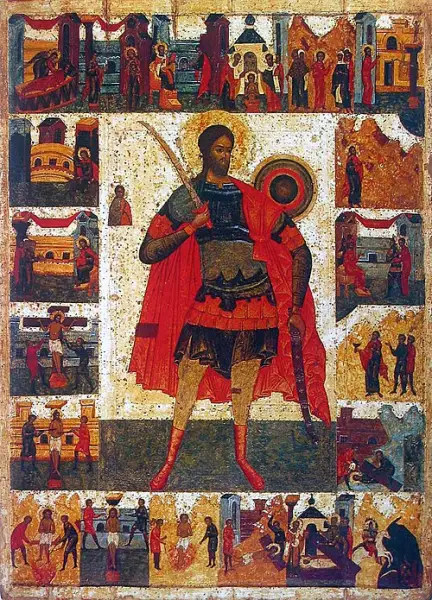
The Church fixed the memory of the Gothic martyr on 15 September, and both the Catholic Church and the Eastern Orthodox Church keep his feast on that day, the East venerating him with particular warmth as a great martyr. From his heavenly honor a tender patronage flowed to earth: the faithful learned to seek his intercession so that little ones might be kept safe from congenital harm, entrusting to the soldier-martyr the weakest and most fragile of Christ's children. His story preserved more than an example of courage; it fixed in language itself the memory of the Gothic mission, for the Slavic forms of his name arose directly from the medieval veneration of the saint, and every Nikita, Mykyta, and Mikita baptized among the Slavs carries, unknowingly, the name of a fourth-century warrior of the Danube. The tensions his life embodied — between the pagan past of the tribes and the Christian empire at their border, between the sword and the confession — have kept his memory alive in the churches of southeastern Europe and the Slavic lands, where painters from the sixteenth century onward, as in the Yaroslavl icon of the martyr, have shown him to the faithful as the type of the soldier who conquered by dying.
§ Life
Timeline
- 325
He was instructed in Christianity by Theophilus of Gothia, the converted bishop, in the years beginning now.
§ Life
- 372
He was condemned to the stake after Athanaric resumed his persecution of the Gothic Christians.
§ Life
The Record
- Patron of
- prayed to for the preservation of children from birth defects
- Canonization
- Pre-congregation; venerated as a martyr in the Catholic and Eastern Orthodox Churches
Prayer
Bibliography
Show 5 sources
- Butler, Alban (1995). Butler's Lives of the Saints. Liturgical Press. ISBN 978-0-8146-2385-5.
- "Greatmartyr Nicetas the Goth", Orthodox Church in America.
- "Saint Nikitas the Great Martyr (15 September)", Orthodox Times.
- "Great-martyr Nicetas the Goth", Russian Orthodox Cathedral of St. John the Baptist.
- "St Nicetas The Goth", Akroasis.
Profile text adapted from the Wikipedia article, licensed CC BY-SA 4.0.
Pray with this saint every day
Save St. Nicetas the Goth to your favorites, read the full profile, and get feast-day reminders in the Saints app.
Get the Saints AppFree on the App Store for iPhone and iPad