
c. 513 – 566·Feast December 5
St. Nicetius of Trier
Fearless sixth-century bishop who excommunicated a Frankish king
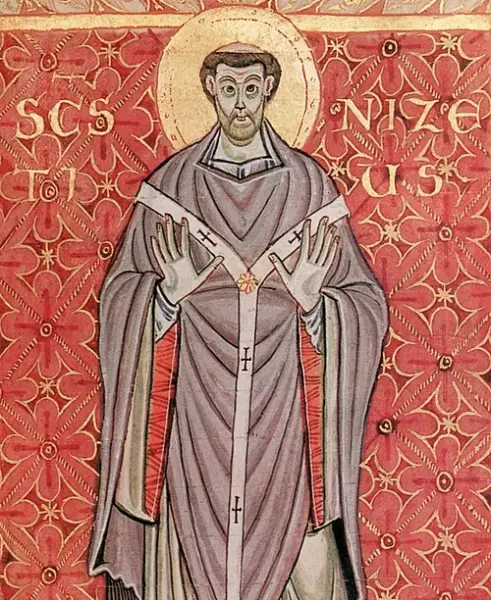
Overview
Nicetius served as bishop of Trier during the troubled generations when Frankish power was replacing Roman rule in Gaul, and he became the most significant occupant of that ancient see. A Gallo-Roman aristocrat from Aquitaine, he embraced monastic life as a young man before King Theuderic I chose him to lead the stricken Rhineland city. From about 527 he labored to restore a community shattered by the upheavals of the Migration era, rebuilding its cathedral, importing Italian craftsmen, planting vines above the Moselle, and founding a school for clergy. He preached every day, rebuked vice in noble and commoner alike, and shrank from no one, excommunicating King Chlothar I for his misdeeds at the cost of banishment in 560. Recalled home after the king's death, he attended the great councils of the Frankish Church, corresponded with Emperor Justinian over the Monophysite controversies, and urged a Lombard queen to win her husband to the Catholic faith. He died at Trier, probably in 566, and was buried in the church of St. Maximin.
The Complete Life
From Aquitaine to the Rhine
Nicetius came of a Gallo-Roman family and was a native of Aquitaine, born in the region of Auvergne at the beginning of the sixth century. From his earliest years he inclined to the religious life, and while still young he entered a monastery, embracing the discipline of prayer and labor that would shape the rest of his days. His gifts did not remain hidden. King Theuderic I, who reigned over the Frankish lands from 511 to 534, had encouraged clerics from Aquitaine to take up ministry in the Rhineland, and he came to esteem the young monk even though Nicetius often reproached him for his faults. Remarkably, the frankness of these admonitions cost him nothing in the king's favor. When Bishop Aprunculus of Trier died, an embassy of clergy and citizens traveled to the royal court to choose a successor. They hoped to secure Saint Gallus, but the king withheld his consent; the choice fell instead on Nicetius through the monarch's own favor, and so the monk was confirmed in the see. Around 527 he took the road to Trier with a royal escort, and the journey itself gave early proof of the firmness with which he would govern his office.
§ Pastoral work
Rebuilding a Broken City
The city of Trier had endured terrible suffering amid the disorders of the great migrations, and the restoration of its material and spiritual fabric became the first charge of its new bishop. Nicetius turned at once to the cathedral church, whose rebuilding the poet Venantius Fortunatus would later celebrate in verse. Archaeological work in the cathedral of Trier has brought to light masonry from the Frankish period that may well belong to this reconstruction. To carry out his building program the bishop brought craftsmen from Italy, importing skills that the war-worn Rhineland could no longer supply. On the banks of the Moselle he raised a fortified castellum with its own chapel, a structure likewise commemorated by the poet. Nor did he neglect the daily bread of his people: he replanted the vineyards on the slopes above the Moselle, restoring the wine business on which the region had lived in Roman times. Through these labors a city that had seemed close to ruin recovered its churches, its commerce, and something of its ancient dignity, and the see of Trier recovered standing under a shepherd who governed as a restorer.
§ Pastoral work
A Bishop Who Rebuked Kings
Nicetius gave himself to his pastoral duty with unrelenting energy. He preached every day, attacked the many evils that disfigured the moral life of both the powerful and the poor, and in his rebukes did not exempt the king and his courtiers. Threats left him unmoved, and he carried out his charge without compromise. The boldest act of his episcopate was the excommunication of King Chlothar I, who for a time ruled all the Frankish dominions, on account of the king's misdeeds; the answer was banishment, imposed on the bishop in 560. Providence reversed the sentence within a year, for Chlothar died, and his son Sigebert I, who ruled Austrasia, allowed the aged prelate to come home. Throughout his episcopate Nicetius took his place in the conciliar life of the Frankish Church: he attended the synod of Clermont in 535, the synod of Orleans in 549, the second council of Clermont, and the synod of Paris in 555, and at the synod of Toul in 550 he presided. His conscience, formed in the monastery and tested in the court, proved equally independent in both.
§ Pastoral work
Ascetic, Correspondent, Teacher
In his personal life Nicetius practiced severe asceticism and self-denial. He fasted often, and while the priests and clerics of his household sat at their evening meal he would withdraw, muffled in a hooded cloak, to pour out prayer in the city's churches. His concern for the Church reached far beyond the Moselle. He kept up a correspondence with churchmen of the highest rank across Europe: letters written to him survive from Abbot Florianus of Romain-Moitier in Switzerland, from Bishop Rufus of Octodurum at Martigny, and from Archbishop Mappinius of Reims. He wrote an urgent letter to the Emperor Justinian at Constantinople concerning the imperial position in the controversies stirred by Monophysitism, and another, preserved to this day, to Chlodoswinda, wife of the Lombard King Alboin, in which he pressed the princess to do all in her power to bring her husband into the Catholic faith. He gathered clerics around him by establishing a school under his own roof in which clergy were formed, and his pupils carried his influence across Gaul; the most famous was Aredius, later Abbot of Limoges, whose testimony preserved the bishop's memory for Gregory of Tours.
§ Correspondence and personal life
Veneration at Trier
Nicetius was never formally canonized, for he belongs to the earliest generations of saints whose cult arose from the devotion of the people they had served. He was buried in the church of St. Maximin at Trier, and in the diocese of Trier he has been revered as a saint since antiquity. His liturgical memory took two forms: the Church of Trier kept his feast on 1 October, while the Roman Martyrology placed his name under 5 December, the date by which he is remembered in the universal calendar of the Latin Church. Gregory of Tours, drawing on the recollections of the bishop's pupil Aredius, composed the oldest life of Nicetius and praised the fearless advocacy with which he had defended his flock. Two treatises attributed to him, on the vigils of the servants of God and on the goodness of psalmody, are of doubtful authenticity, yet the letters and the testimony of his contemporaries preserve a vivid portrait of a bishop whose holiness lay in courageous governance as much as in hidden prayer. The poems of Venantius Fortunatus and the biography by Gregory of Tours stand as the first written monuments of his cult, carrying the memory of his deeds to every later generation of the Frankish Church.
§ Veneration
Memory and Influence
The influence of Nicetius outlasted his death by centuries. He is remembered as the weightiest occupant of the ancient see of Trier during the generations when Frankish power was consolidating its hold on Gaul, and the sources that carry his memory are unusually rich: letters by him and to him, two poems of Venantius Fortunatus, and the account preserved by Gregory of Tours from the recollections of Aredius of Limoges. His school trained clergy for the Churches of Austrasia, and his encouragement drew gifted men north; the young Fortunatus, fresh from the school of Ravenna, found in the bishop of Trier his first great host in Gaul and went on to become bishop of Poitiers and the last notable poet of classical Latin. The vineyards he replanted above the Moselle began a tradition of winemaking on those slopes that endured long after his time. In the annals of the Church he stands as a model of episcopal courage: a man who rebuilt a ruined city, confronted kings without fear, and kept faith with conscience even when conscience led to exile.
§ Veneration
Timeline
- 513
Born into a Gallo-Roman family of Auvergne in Aquitaine.
§ Life
- 527
Set out for Trier as its new bishop, confirmed through the patronage of King Theuderic I.
§ Pastoral work
- 535
Took part in the synod of Clermont among the Frankish bishops.
§ Pastoral work
- 549
Attended the synod of Orleans as part of his service to the Frankish Church.
§ Pastoral work
- 550
Presided over the synod of Toul.
§ Pastoral work
- 555
Joined the synod of Paris of the Frankish episcopate.
§ Pastoral work
- 560
Exiled by King Chlothar I in retaliation for his excommunication of the king.
§ Pastoral work
- 561
Permitted to return to his see by Sigebert I after Chlothar's death.
§ Pastoral work
- 566
Died at Trier after nearly four decades as bishop.
§ Veneration
The Record
- Major works
- De Vigiliis servorum Dei (of doubtful genuineness)·De Psalmodiae Bono (of doubtful genuineness)
- Canonization
- Pre-congregation: revered as a saint in the diocese of Trier since late antiquity
Prayer
Bibliography
Show 6 sources
- Kirsch, Johann Peter. "St. Nicetius." The Catholic Encyclopedia. Vol. 11. New York: Robert Appleton Company, 1911.
- Fletcher, Richard A., The Barbarian Conversion, University of California Press, 1999. ISBN 9780520218598.
- Brennan, Brian. The Career of Venantius Fortunatus, in: Traditio, 1985, p. 57.
- "Nicetius of Trier", The Oxford Dictionary of Saints, 5th ed. (David Farmer, ed.) OUP, 2011. ISBN 9780199596607.
- Andreas Heinz: In Nicetius. Biographic-bibliographic church encyclopedia (BBKL). Volume 6, (Bautz, Herzberg 1993), p.656-657.
- Hubertus Seibert: Nicetius, bishop of Trier. In: Neue Deutsche Biographie (NDB). Volume 19, (Duncker & Humblot, Berlin 1999), p.197.
Profile text adapted from the Wikipedia article, licensed CC BY-SA 4.0.
Pray with this saint every day
Save St. Nicetius of Trier to your favorites, read the full profile, and get feast-day reminders in the Saints app.
Get the Saints AppFree on the App Store for iPhone and iPad