
513 – 573·Feast April 2
St. Nicetius of Lyon
Sixth-century Archbishop of Lyon and revivalist of sacred chant
Overview
Nicetius led the Church of Lyon, the ancient Lugdunum, through the middle decades of the sixth century, holding the archbishopric from about 552 or 553 until his death. Born in 513 into an old and noble Gaulish family of Burgundy, he was raised by virtuous parents in learning and piety, and his priestly ordination came at the hands of Agricola of Chalon-sur-Saone. Sacerdos, who held the see of Lyon, was his uncle, and Nicetius followed him on that throne, and Gregory of Tours, who wrote a supplementary life of him in his Vita Patrum, reckoned him among his own kinsmen. From the pope he received the rank of patriarch, and he governed with a vigor that drew him into conflict with the local count, for he undertook to judge secular causes as well as those of the Church. He breathed new life into ecclesiastical chant in his diocese and attended a council held in his own city at some point between 567 and 570. He died on 2 April 573, was buried as a saintly pastor, and was soon honored with miracles; the church of Saint-Nizier in Lyon still stands dedicated to his memory.
The Complete Life
A Noble House of Burgundy
Nicetius was born in the year 513, descended from an ancient noble family of the Gauls in the land of Burgundy. His parents were virtuous people, and under their care the boy received both a learned and a pious education, an upbringing that joined cultivated intelligence to fervent faith. He was ordained a priest by Agricola of Chalon-sur-Saone and began his service to the Church of Gaul in that generation of Merovingian bishops among whom his own family was already distinguished. Lyon in those years stood among the chief cities of the Frankish world, and its archbishopric carried weight in both spiritual and temporal affairs, a charge the young priest was preparing to bear. His uncle Sacerdos occupied the archbishopric, one of the most venerable sees of Gaul, and when Sacerdos died the nephew was chosen to succeed him, an inheritance of office within a family of saints. This kinship with the episcopate of Lyon reached further still: Gregory of Tours, the great historian of the Frankish Church, referred to Nicetius as his uncle and later added a life of him to his book on the Fathers, preserving the memory of his holiness for posterity.
§ Life
Archbishop and Patriarch
Nicetius took up the government of the archdiocese of Lyon in 552 or 553 and ruled it for roughly two decades. From the pope he received the title of patriarch, an honor that acknowledged the ancient primacy of Lugdunum among the Churches of Gaul. He governed as a man determined that the authority of the Church should extend to the whole of public life: he took it upon himself to decide secular cases as well as ecclesiastical ones, and this breadth of jurisdiction brought him into open conflict with the local count, the royal officer in the city. He took part in the conciliar life of the Frankish Church, attending a council convened in his own city of Lyon at some time between 567 and 570. The succession catalogues of the see confirm the outline of his tenure, placing him between his uncle Sacerdos and his successor Priscus. Amid these labors of governance he did not neglect the worship of God; he set himself to revive ecclesiastical chant throughout his diocese, restoring the sung prayer of the liturgy to vigor and beauty in the churches under his care.
§ Life
Death and Devotion
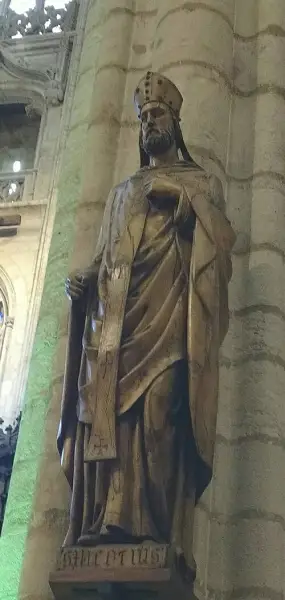
Nicetius died at Lyon on 2 April 573, the very date on which his feast is now kept. He belonged to the company of saints honored before the formal processes of canonization existed, and the devotion that gathered around his tomb arose naturally among the people he had shepherded. Wonders were reported at his tomb, and the early life of Nicetius written in Latin, the Vita Nicetii Episcopi Lugdunensis, preserved in the monuments of Merovingian hagiography and edited by Krusch in the Monumenta Germaniae Historica, handed down the story of his labors; Gregory of Tours supplied a further account in his Lives of the Fathers, and later collections such as Butler's Lives of the Fathers and the Book of Saints of the Monks of Ramsgate carried his story onward. The city kept his memory in stone: the church of Saint-Nizier in Lyon is dedicated to him, and a statue of the archbishop adorns that church, standing over the streets of the city he governed. His feast of 2 April has been observed in the Catholic Church from the earliest tradition down to the present.
§ Veneration
Timeline
- 513
Born into an ancient noble Gaulish family of Burgundy.
§ Life
- 552
Succeeded his uncle Sacerdos as Archbishop of Lyon, taking up office about this time.
§ Life
- 2 Apr 573
Died at Lyon after some twenty years as archbishop.
§ Veneration
The Record
- Canonization
- Pre-congregation: venerated in the Catholic Church, with miracles reported after his death
Prayer
Bibliography
Show 3 sources
- Butler, Alban. "Saint Nicetius, Archbishop of Lyons, Confessor". Lives of the Fathers, Martyrs, and Principal Saints, 1866. CatholicSaints.Info. 2 April 2013.
- Goyau, Georges. "Lyons." The Catholic Encyclopedia Vol. 9. New York: Robert Appleton Company, 1910.
- Monks of Ramsgate. "Nicetius". Book of Saints, 1921. CatholicSaints.Info. 25 March 2016.
Profile text adapted from the Wikipedia article, licensed CC BY-SA 4.0.
Pray with this saint every day
Save St. Nicetius of Lyon to your favorites, read the full profile, and get feast-day reminders in the Saints app.
Get the Saints AppFree on the App Store for iPhone and iPad