
1868 – 1918·Feast July 17
St. Nicholas II
Last Emperor of Russia, passion bearer of Yekaterinburg
Overview
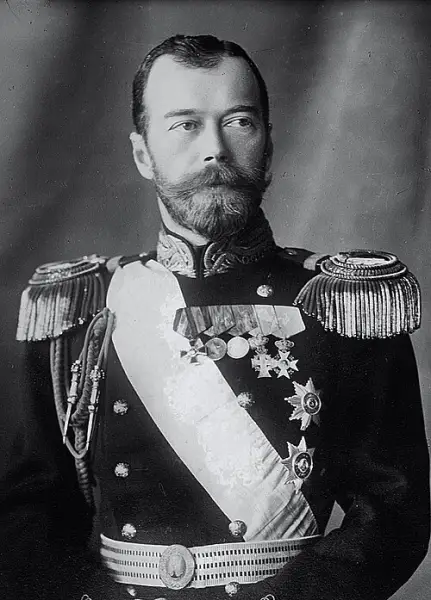
Nicholas II, the final Emperor of Russia, wore the crown from 1 November 1894 until he laid it down in March 1917, closing three centuries of Romanov rule. Born in 1868 at Tsarskoye Selo, he became heir apparent on his grandfather's assassination and succeeded his father Alexander III at the age of twenty-six. Devoted to his family and to the Orthodox faith, he nonetheless clung to the principle of absolute autocracy his tutors had taught him, and his reign was marked by the disastrous Russo-Japanese War, the upheaval of the 1905 Revolution, and the strains of the First World War, in which he took personal command of the army. In March 1917, abandoned by his generals and political allies, he gave up the throne for himself and his son. The new government held him and his family in captivity, first near Tobolsk and then at the Ipatiev House in Yekaterinburg, where before dawn on 17 July 1918 the Bolsheviks put the entire family to death in a half-basement room. Historians have judged him a well-intentioned but weak ruler; the Russian Orthodox Church has honored him as a passion bearer who met death with Christian humility, canonizing him in 1981 and again by the Moscow synod in 2000, with his feast kept on 17 July.
The Complete Life
A Sheltered Heir
Nicholas Alexandrovich Romanov was born on 18 May 1868 in the Alexander Palace at Tsarskoye Selo, south of Saint Petersburg, while his grandfather Alexander II still reigned. The boy's childhood ended abruptly on 1 March 1881, when nihilist assassins of the Narodnaya Volya struck down his grandfather and the boy became heir apparent upon his father's accession as Alexander III. He and his brother George were raised in a deliberately severe, English fashion: they slept on army cots, rose at six, took cold baths, and ate porridge and black bread, an upbringing meant to steel them for rule. Educated alongside his brother by valued professors of the academy of the general staff, Nicholas found his closest teacher in the Englishman Charles Heath. Yet neither his schooling nor his temperament prepared him for the throne he would inherit. His taste ran to military life rather than statecraft, he had little ambition of an intellectual kind, and his imposing father, intolerant of any sign of softness, openly doubted the boy's readiness for responsibility. Under the influence of Konstantin Pobedonostsev he absorbed a Pan-Slavist and mystical conviction that the emperor ruled by the grace of God, a belief that would govern his entire reign.
§ Tsesarevich
The Throne and the Bride
Nicholas's path to the throne ran beside his courtship of Princess Alix of Hesse. In April 1894 he traveled to Coburg for the wedding of Alix's brother and proposed to her there; she at first refused him, reluctant to abandon her Lutheranism, but in time she consented. By autumn Alexander III was dying, and Alix was summoned to Livadia Palace, arriving on 22 October to find the emperor in full uniform urging his son to trust the counsel of Sergei Witte. Alexander died ten days later at forty-nine, and that same evening Nicholas was consecrated as Tsar Nicholas II; the next day Alix was received into the Russian Orthodox Church under the name Alexandra Feodorovna. Their wedding followed on 26 November 1894 at the Winter Palace, held modestly within the mourning period, less than a month after the funeral. Observers whispered of the new empress that she had come to them from behind the coffin. The couple would have five children: Olga, Tatiana, Maria, Anastasia, and the long-awaited heir Alexei, born in 1904, whose haemophilia, inherited through Queen Victoria, the parents concealed until 1912.
§ Engagement, marriage and family
Autocracy on Trial
Crowned on 26 May 1896, Nicholas set his face from the first against any sharing of power. When representatives of the zemstvos came to the Winter Palace proposing reforms, he dismissed their hopes as a senseless dream and vowed to maintain the principle of absolute autocracy as firmly as his father had done. His reign tested that vow relentlessly. Russia suffered defeat in the war against Japan, and the turmoil of 1905 shook the throne to its foundations; his popularity declined further as military losses and economic hardship wore down public confidence once the First World War began. He presided over the tercentenary of the Romanov dynasty in February 1913, a Te Deum sung at Kazan Cathedral, but the dynasty he celebrated would not outlive his own reign. In March 1917 the February Revolution swept the capital, order collapsed, and a Provisional Government formed by the Duma demanded his abdication. Confronted by that demand, echoed by his generals and unsupported by loyal troops, Nicholas yielded the crown for himself and his son, ending more than three hundred years of Romanov rule. Contemporaries described him as shy, gentle, and devoted to his family, yet chronically indecisive and reliant on advisers he chose badly.
§ Reign
Faith in Captivity
Nicholas was a sincere son of the Russian Orthodox Church, and his upbringing under Pobedonostsev left him with a mystical sense of the sacred character of his office. That faith carried a cost, for the conviction that his authority came from God made compromise with constitutional demands feel like betrayal of a divine trust. In his private sufferings the religious note deepened. The hidden illness of his son drew the family into dependence on the Siberian mystic Grigori Rasputin, whose calming effect on Alexei reinforced Alexandra's belief in his God-given gift, whatever the scandal he provoked outside the palace. After the abdication the former emperor's Christianity was refined by humiliation. Captive first near Tobolsk and then in the Ipatiev House at Yekaterinburg, where the prisoners were allowed to speak only Russian and their belongings were inventoried and locked away, the family read scripture and kept their prayers under guard. It was this endurance that the Moscow synod would later cite, a family that strove to live the commands of the Gospel and bore imprisonment with humility, patience, and meekness until their death in the night of 17 July 1918.
§ Sainthood
The House of Special Purpose
The last months of Nicholas's life unfolded under an ever-tightening guard. After the abdication he and his family were moved about the country until, in the spring of 1918, the remaining Romanovs made their way from Tobolsk by river steamer to Yekaterinburg, where they were lodged in the two-story house of the engineer Nikolay Ipatiev, grimly known as the house of special purpose. Sympathetic guards were replaced by men of the Cheka, and Yakov Yurovsky, a former secret policeman, took command of the detachment. Although the Bolshevik leadership in Moscow still spoke of putting Nicholas on trial, the deteriorating military situation changed their calculations, and on 16 July the Yekaterinburg leadership informed Yurovsky that the family was to be murdered as soon as word came from above. In the small hours of 17 July 1918 they were roused, dressed, and led down to a half-basement room, together with their doctor Eugene Botkin and three servants who had chosen to remain with them. Chairs were brought for the empress and the boy; Yurovsky announced the decision of the Ural Soviet; the executioners fired, and Nicholas was the first to die. An official announcement declared the ex-tsar guilty of unforgivable crimes against the nation.
§ Execution
From Reproach to the Altar
For decades after the murders the imperial family's memory was a contested inheritance. Soviet historians and propaganda reviled Nicholas as a callous tyrant, while émigré and church circles increasingly mourned him as a martyr. In 1981 the Russian Orthodox Church Outside of Russia recognized Nicholas and his immediate family as martyred saints, a decision taken even though the church abroad was itself divided over the merits of the emperor as a ruler. The church within Russia hesitated longer, objecting that the family had not been killed for their faith and that the last tsar's failures had helped bring the revolution upon his own people. On 14 August 2000 the synod of the Russian Orthodox Church resolved the question in a different key: it canonized the family not as martyrs but as passion bearers, those who meet death with Christian humility. The synod's statement saw in the last Orthodox monarch and his household people who sincerely strove to embody the commands of the Gospel, whose humble endurance in prison and death at Yekaterinburg revealed the light of Christ that conquers evil. Believers have since attributed healings and conversions to the prayers of the family, and their feast is kept on 17 July.
§ Sainthood
An Uneasy Remembrance
Few modern rulers have left so divided a reckoning. Contemporary witnesses described Nicholas with remarkable agreement as well-meaning but weak: his court chancellery chief judged him intelligent yet incapable of decisive action before others, and his finance minister called him a well-intentioned child governed by poor counselors. Later historians have largely sustained the view of a decent man unfit for the crushing burdens he inherited, though some Russians today remember him more fondly as a symbol of a lost national order. The Church's judgment transformed his memory in a different direction. Pilgrims visit the Church on Blood raised at Yekaterinburg over the place of the murders, his major shrine. Two contrasting icon types depict the imperial family, one in medieval royal vestments and one in their early twentieth-century clothes, a visual argument between myth and history. The Church in Russia has declined to accept the remains found in 1991 as those of the imperial family, standing by accounts that the bodies were destroyed, even after the interment at St. Peter and Paul Cathedral on 17 July 1998, eighty years to the day after the executions. Whatever verdict history renders on his governance, the passion bearer of Yekaterinburg now belongs to the altars of Orthodoxy.
§ Legacy
Timeline
- 18 May 1868
Born at the Alexander Palace in Tsarskoye Selo, south of Saint Petersburg.
§ Birth and family background
- 1 Mar 1881
Became heir apparent, or tsesarevich, after the assassination of his grandfather, Tsar Alexander II.
§ Tsesarevich
- 1 Nov 1894
Succeeded his dying father Alexander III and was consecrated that evening as Tsar Nicholas II.
§ Engagement, marriage and family
- 26 Nov 1894
Married Alix of Hesse, now Alexandra Feodorovna, at the Winter Palace in a modest ceremony during mourning.
§ Engagement, marriage and family
- 15 Nov 1895
His first daughter, Grand Duchess Olga, was born.
§ Engagement, marriage and family
- 26 May 1896
Crowned Emperor of Russia in the coronation of Nicholas II and Alexandra Feodorovna.
§ Coronation
- 12 Aug 1904
His only son and heir, Alexei, was born; he would suffer from haemophilia B.
§ Engagement, marriage and family
- 21 Feb 1913
Presided over the tercentenary celebrations of the Romanov dynasty, opening with a Te Deum at Kazan Cathedral.
§ Reign
- 15 Mar 1917
Abdicated the throne for himself and his son under pressure from the Provisional Government and his generals.
§ Abdication
- 17 Jul 1918
Shot with his family and their loyal servants in the basement of the Ipatiev House at Yekaterinburg.
§ Execution
- 1981
Recognized with his immediate family as martyred saints by the Russian Orthodox Church Outside of Russia.
§ Sainthood
- 17 Jul 1998
His remains and those of his family were interred at St. Peter and Paul Cathedral in Saint Petersburg on the eightieth anniversary of the murders.
§ Sainthood
- 14 Aug 2000
The synod of the Russian Orthodox Church canonized the imperial family as passion bearers.
§ Sainthood
In Their Own Words
In the last Orthodox Russian monarch and members of his family we see people who sincerely strove to incarnate in their lives the commands of the Gospel. In the suffering borne by the Royal Family in prison with humility, patience, and meekness, and in their martyrs' deaths in Yekaterinburg in the night of 17 July 1918 was revealed the light of the faith of Christ that conquers evil.
The Record
- Major works
- Call for the First Hague Peace Conference
- Canonization
- Canonized in 1981 by the Russian Orthodox Church Outside Russia and on 14 August 2000 by the Russian Orthodox Church as a passion bearer
Prayer
Bibliography
Show 5 sources
- Ferro, Marc (1995). Nicholas II: Last of the Tsars. New York: Oxford University Press. p. 2. ISBN 0-19-508192-7.
- Warnes, David (1999). Chronicle of the Russian Tsars. Thames And Hudson. p. 163. ISBN 0-500-05093-7.
- Bing, Edward J., ed. (1937). The letters of Tsar Nicholas and Empress Marie: being confidential correspondence between Nicholas II, last of the Tsars, and his mother, Dowager Empress Maria Feodorovna. London: Nicholson and Watson.
- Radziwill, Catherine (1931) Nicholas II, The Last of the Tsars, London: Cassell and Co., p. 100.
- "Nicholas II: Biography, Wife, Abdication, Death, & Facts", Encyclopaedia Britannica 2024. Accessed on 15 February 2024.
Profile text adapted from the Wikipedia article, licensed CC BY-SA 4.0.
Pray with this saint every day
Save St. Nicholas II to your favorites, read the full profile, and get feast-day reminders in the Saints app.
Get the Saints AppFree on the App Store for iPhone and iPad