
c. 1319 – c. 1392·Feast June 20
St. Nicholas Kabasilas
Byzantine mystical theologian of the sacramental life
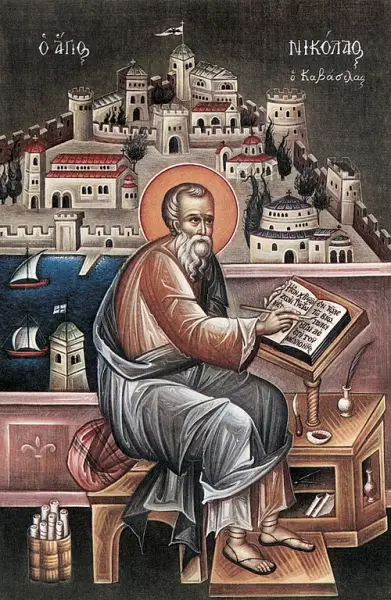
Overview
Nicholas Kabasilas was a Byzantine theological writer and mystic of the fourteenth century, born at Thessaloniki around 1319 or 1323 and dying around 1392. Little of his outward life is recorded with certainty, but the inward shape of his career is unmistakable. He was the nephew of Neilos Kabasilas, theologian and clergyman of Thessalonica, and he moved in the highest circles of the fading empire, on intimate terms with Emperor John VI Kantakouzenos, whose retirement to a monastery he accompanied. Though once thought to have succeeded his uncle as archbishop of Thessalonica, the registers of that see do not show him there; he more likely served as a priest at the Mangana Monastery in Constantinople. In the great Hesychast controversy he ranged himself with the monks of Mount Athos and with Gregory Palamas. His enduring work was theological: the treatise On the Life in Christ, which teaches that union with Christ is accomplished through baptism, chrismation, and the Eucharist, and the Commentary on the Divine Liturgy, a profound meditation on sacramental worship. The Eastern Orthodox Church canonized him in 1983 and keeps his feast on 20 June.
The Complete Life
A Nephew of Thessalonica
Nicholas Kabasilas was born at Thessaloniki in the first half of the fourteenth century, the sources placing his birth between about 1319 and 1323. Of his childhood and schooling almost nothing is known with certainty, and even the dates of his birth and death rest on approximation. What can be said is that he belonged to a family of religious distinction: his uncle Neilos Kabasilas was a theologian and clergyman who served as archbishop of Thessalonica, and from him the nephew inherited both a tradition of learning and a connection to one of the great sees of the Byzantine world. The empire of his youth was convulsed by civil war and theological strife, circumstances that formed the backdrop of his whole career. His own name became linked with that see in later memory, for it was long supposed that he succeeded Neilos on the archiepiscopal throne; the contemporary records of Thessalonica, however, do not list him among its archbishops, and modern scholarship has drawn back from that tradition. His kinship with the episcopate, his education in the classics of Byzantine theology, and his native city's ferment of thought gave him the formation from which his writings would grow.
§ Life
Court, Cloister, and Controversy
The one documented thread of Kabasilas's public life is his closeness to Emperor John VI Kantakouzenos, whose friend and intellectual companion he became in the troubled years of the civil wars. So intimate was the bond that when the emperor withdrew from the throne to end his days as a monk, Kabasilas accompanied him into retirement. The likeliest picture of his mature years places him as a priest at the Mangana Monastery in Constantinople, serving at the altar rather than on a hierarchical throne. That retreat beside the emperor-monk placed him in the company of the ascetics whose cause he would defend, joining contemplative sympathy to theological argument. These were the decades of the Hesychast controversy, when the spiritual tradition of Athonite monasticism and the teaching of Gregory Palamas on the uncreated divine energies came under attack from Westernizing intellectuals. Kabasilas ranged himself decisively on the side of the monks of Mount Athos and of Palamas, lending his pen to the defense of the contemplative theology that would define late Byzantine Orthodoxy. A layman or priest rather than a prelate, he exercised his influence through friendship, writing, and prayer rather than through office.
§ Life
The Mystery of Life in Christ
Kabasilas's theology is contained above all in two works that have never lost their readers. The chief of them, On the Life in Christ, sets forth a complete mystical teaching: the faithful are joined to Christ by way of the three great sacraments, baptism, chrismation, and the Eucharist, and the Christian life, in his teaching, is not an ascent by human effort alone but the reception of the Savior's own life through the sacraments he instituted. Its companion, the Commentary on the Divine Liturgy, displays a profound grasp of the sacramental and liturgical worship of the Eastern Orthodox Church, walking through the rite to disclose the meaning of each movement and prayer. Beyond these monuments among his smaller pieces are assorted homilies and an address condemning usury, both issued among his collected texts in Migne's Patrologia Graeca, and an encomium in honor of the ninth-century nun and saint Theodora of Thessaloniki, a tribute joining him to the hagiographic tradition of his native city. Many more of his works survive only in manuscript, awaiting editors. His writing joined the precision of a trained intellect to the warmth of personal experience of the mysteries he explained.
§ Work
Honored by Both Traditions
Kabasilas's afterlife in the Church has been unusually broad. His treatises circulated for centuries in manuscript copies long before the age of print, and their eventual printing in Migne's Patrologia Graeca placed them in the hands of scholars across Europe. The Eastern Orthodox Church, which had always numbered him among its wise teachers, canonized him in 1983 and fixed his feast on 20 June. The Catholic Church also drinks from his well: extracts from his Life in Christ are read in the Liturgy of the Hours on the Tuesday, Wednesday, and Thursday of the fifth week of Easter in the second year of the Office of Readings, so that clergy and laity of the Latin West pray his sentences on the risen life each spring. Modern editions and translations, beginning with the English rendering of the Commentary on the Divine Liturgy published by St. Vladimir's Seminary Press, have carried his thought far beyond the Greek world, and historians of spirituality rank him among the clearest voices of late Byzantine mysticism. In the catalogues of the bishops of Thessalonica his name still appears in the place tradition assigned it, beside that of his uncle Neilos, a memorial of the family that gave the see two teachers of the mysteries.
§ Legacy
Timeline
- 1319
Born at Thessaloniki in the Byzantine Empire, around this date.
§ Life
- 1392
Died at about the age of seventy, in the last decades of the fading empire.
§ Life
- 1983
Enrolled among the saints of the Eastern Orthodox Church, and 20 June appointed for his memory.
§ Legacy
The Record
- Major works
- On the Life in Christ (Peri tes en Christo zoes)·Commentary on the Divine Liturgy·Homilies on various subjects·A speech against usurers·Encomium on Saint Theodora of Thessaloniki
- Canonization
- Canonized by the Eastern Orthodox Church in 1983, with his feast appointed on 20 June
Prayer
Bibliography
Show 5 sources
- Cabasilas, N. (1960). Commentary on the Divine Liturgy. Translated by Hussey, J. M.; McNulty, P. A. St. Vladimir's Seminary Press. ISBN 0-913836-37-0.
- Cabasilas, N. (1974). The Life in Christ. St. Vladimir's Seminary Press. ISBN 0-913836-12-5.
- Talbot, Alice-Mary Maffry (1996). "Life of St. Theodora of Thessalonike". Holy Women of Byzantium: Ten Saints' Lives in English Translation. Dumbarton Oaks. pp. 159-238. ISBN 978-0-88402-248-0.
- Russell, Eugenia (2010). "Nicholas Kavasilas Chamaetos (c. 1322 - c. 1390): A Unique Voice Among his Contemporaries". Nottingham Medieval Studies. 54: 123-37.
- Krumbacher, Karl (1897). Geschichte der byzantinischen Litteratur. Munich, Germany: C. H. Beck.
Profile text adapted from the Wikipedia article, licensed CC BY-SA 4.0.
Pray with this saint every day
Save St. Nicholas Kabasilas to your favorites, read the full profile, and get feast-day reminders in the Saints app.
Get the Saints AppFree on the App Store for iPhone and iPad