
1417 – 1487·Feast March 21
St. Nicholas of Flüe
Swiss hermit, soldier-peacemaker, and father of his country
Overview
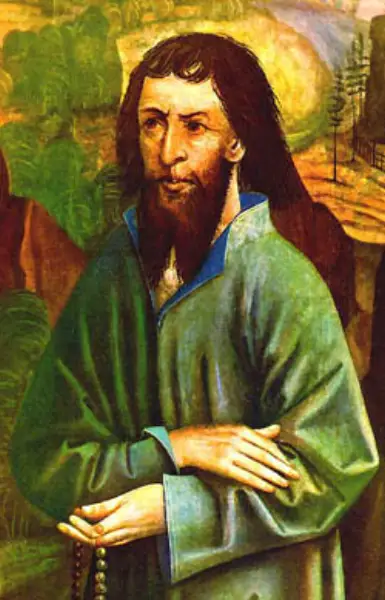
Nicholas of Flüe, invoked widely as Brother Klaus, is the patron saint of Switzerland and one of the most beloved figures of the late medieval world. Born in 1417 at Flüeli near Sachseln in Unterwalden, the eldest son of wealthy peasants, he lived a life of extraordinary variety: farmer, soldier and captain in the wars of the Swiss Confederacy, councillor, judge, husband, and father of ten children, and finally hermit. At twenty-one he took up arms, fought with distinction in the Old Zürich War and at the Battle of Ragaz in 1446, and served again against Archduke Sigismund in 1460, bearing, so the story goes, a blade in one fist and beads in the other. His nine years on the judge's bench and a refusal of the governorship of his canton, a mystical vision convinced him that his worldly cares were swallowing his spiritual life, and in 1467 he left his family with his wife's consent to live as a hermit in the Ranft chine. There he began the famous fast of more than twenty years, received pilgrims from all over Europe, and in 1481, by his secret counsel to the Diet of Stans, helped turn Switzerland back from the brink of civil war. He died at Sachseln on 21 March 1487.
The Complete Life
Peasant, Soldier, Magistrate
Nicholas was born in 1417 at Flüeli, a village near Sachseln in Unterwalden, firstborn child of well-to-do peasants; the family surname von Flüe took its name from a local rock. He was baptized in the church of Kerns, and in 1431 or 1432 he attended the peasants council at his father's side, gaining admission to the ranks of Obwalden's free peasants, the formal start of his public life. At twenty-one he enrolled in the army, and in the Old Zürich War, fought by the rest of the Confederacy against the canton of Zurich, his soldiering drew notice, and he fought at Ragaz in the campaign of 1446. Arms called him once more in the Thurgau war against Archduke Sigismund of Austria in 1460, and it was through his influence that the Dominican sisters of St. Katharinental, whose house had sheltered many Austrians fleeing after Diessenhofen fell, were spared destruction at the hands of the confederate troops. He served in the military until the age of thirty-seven, rising to the rank of captain and fighting, they say, blade in one fist and beads in the other. Once his military days ended he served as a councillor of his canton and from 1459 sat nine years as a judge, declining at last the offer to become Landammann, governor of his canton.
§ Early life
The Lily and the Horse
In 1445 or 1446 Nicholas married Dorothea Wyss, a farmer's daughter then fourteen years of age, and settled with her in a house he had built; a son, Hans, was born the following year, and in time ten children filled the household. The turning point came through a mystical vision of a lily being devoured by a horse, which Nicholas read with perfect clarity: the draft horse pulling the plough, figure of his worldly cares, was swallowing the lily of his spiritual life. He resolved to give himself wholly to contemplation. In 1467 he left wife and children with Dorothea's consent, rescinded his political offices, and set out to join a mystic brotherhood near Basel. At Waldenburg, a few miles along the road, three visions stopped him, convincing him that this aim was not God's will, and he turned back toward the Melchtal, not daring yet to return home. Hunters found him there after some days, and he took up his dwelling at last as a hermit in the Ranft chine, endowing from his own funds a chantry for a priest so that he could assist at mass every day. With the consent of Oswald Yssner, priest of Kerns, he then gave up eating altogether, telling the doubting priest that he received nourishment enough from the Host at the mass he attended.
§ Political mystic
Counsel That Saved the Confederacy
In the Ranft Nicholas became a spiritual guide whose advice was sought and heeded across Europe; notables and clergy came to the hermit's cell from far countries, and the abbot Johannes Trithemius of Sponheim, persuaded by the reports of those who had met him, set the Swiss hermit beside Saint Anthony. The first papal indulgence reached the Ranft sanctuary from Pope Paul II in 1470, and soon the chine was a stopping place for pilgrims on the Way of Saint James, the route to Santiago de Compostela; many who visited the abbey of Einsiedeln made the detour to Ranft as well. His counsel reached beyond private souls to the politics of the Confederacy itself. In 1481, when the antagonism between the rural and urban cantons meeting at the Diet of Stans threatened to break into civil war, the priest Heini am Grund climbed to the hermitage to ask Brother Klaus for his advice, carried it back to the delegates, and the Tagsatzung compromised. What Nicholas said has never been revealed; the chronicler Diebold Schilling the Younger drew the scene, with the messenger holding back the bailiff eager to spread news that remains secret to this day. Though illiterate and little traveled, he is honored by Catholics and Protestants alike as a father of the permanent national unity of Switzerland.
§ Political mystic
Visions of the Face of God
Symbolic visions were the constant furniture of Nicholas's contemplation. The most famous, often reproduced in reduced form as a mystical wheel, placed the Holy Face at a circle's heart: three sword-tips met upon the two eyes and the mouth, while three others radiated outward in a sixfold symmetry recalling the Seal of Solomon. A painted meditation cloth joins the image to six moments of the life of Christ and, through its medallions, to the six corporal works of mercy, from visiting the sick and sheltering strangers to feeding the hungry, ransoming prisoners, clothing the naked, and burying the dead, a summa of peasant piety in which salvation history and love of neighbor were one picture. Another vision, described by the stream, showed the tabernacle of the Paschal Victim standing on a spring whose waters covered the earth, echoing the rivers that flowed from the Temple in the prophecy of Ezekiel. Some visitors were frightened by what they saw: the monk Hans von Waltheim, who came in 1474, and Albrecht von Bonstetten, who arrived before 1478, found the hermit shaken by a vision of a glowing face. Yet his daily religion remained that of the mass he never missed and the prayer he never ceased.
§ Visionary images
Death in the Family Circle
Nicholas died on 21 March 1487 at Sachseln, and the manner of his death rehearsed the reconciliation his life had preached: the hermit who had left his family twenty years before breathed his last surrounded by his wife and children. The funeral drew a great concourse of mourners, and he was buried in the chapel at Sachseln, where his tomb soon became a place of pilgrimage so constant that by 1518 the epitaph and its portrait of him had to be renewed. Archduke Sigismund of Austria, whose gifts to the hermit had included a gilded chalice in 1473 and a hundred guilders in 1481, arranged a memorial service in Vienna at which a hundred priests concelebrated his memory. In 1492 the interior of his burial chapel was painted with his image. The first biography of his life had appeared while he still lived, written in 1479 by Abbot Albrecht von Bonstetten of Einsiedeln, who carefully sorted his witnesses into those who had seen, heard, or heard tell of the hermit; after his death Heinrich of Gundelfingen and then, at the request of the government of Obwalden, the historian Heinrich Wolflin recorded his life, the first state-sponsored biography appearing in Latin in 1501.
§ Veneration
From Beatification to the Altars
The Church raised Nicholas to the altars by stages spread over nearly three centuries. His beatification came in 1669; to honor the new blessed, the town of Sachseln raised a church and translated his remains into it. His canonization came in 1947, when Pope Pius XII enrolled him among the saints, in the very years when Switzerland, ringed by the armies of the Second World War, looked to him as its spiritual savior: in August 1941 the Swiss bishops had promised to go on pilgrimage in his honor if the country were spared the ravages of the war, and the country's preservation fixed his intercession in the national memory. His feast is kept in the Catholic Church on 21 March, the day of his death, though Switzerland and Germany observe it instead on 25 September. In June 1984 Pope John Paul II made pilgrimage to Flüeli Ranft, celebrated mass there, and prayed at the tomb in Sachseln, sealing the bond between the hermit of the Ranft and the papacy. A prayer of his, asking God to take away all that distances us from him and to give all that draws us closer, found its way into paragraph 226 of the Catechism of the Catholic Church.
§ Veneration
Patron of Switzerland
Nicholas of Flüe is the patron saint of Switzerland and of the Pontifical Swiss Guards who defend the pope, and his patronage extends as well to the Katholischen Landvolkbewegung, the Catholic Rural Communities Movement of the German-speaking world. His memorial is written into the landscape of his home country: the hermitage in the Ranft chine still stands on the pilgrim way, the burial church at Sachseln holds his remains, and the village of Flüeli-Ranft remains a place of national pilgrimage. Catholics and Protestants together honor him as an embodiment of the permanent unity of Switzerland, the man whose wordless counsel at Stans taught the cantons that compromise was possible. Writers and thinkers have returned to him again and again: a play by Denis de Rougemont, Nicolas de Flue, was written after the Second World War, and Carl Gustav Jung devoted an essay to Brother Klaus as a study in the union of psychic opposites. The peasant who had been farmer, soldier, judge, husband, father, and hermit remains the complete citizen of his country, proof that the deepest patriotism can be fed by fasting and prayer.
§ Veneration
Timeline
- 1417
Born at Flüeli near Sachseln in the canton of Unterwalden, eldest son of wealthy peasants.
§ Early life
- 1431
Went with his father to the peasants council of his canton and gained standing among the free peasants of Obwalden.
§ Early life
- 1445
Married Dorothea Wyss, a farmer's daughter, at about the age of twenty-nine.
§ Personal life
- 1446
Fought as a soldier at the Battle of Ragaz during the Old Zürich War.
§ Early life
- 1459
Began nine years of service as a judge for his canton, having earlier served as a councillor.
§ Early life
- 1467
Left his wife and ten children with her consent, renounced his political duties, and became a hermit in the Ranft chine.
§ Political mystic
- 1470
The first papal indulgence reached the Ranft sanctuary from Pope Paul II, opening it to pilgrims walking the Way of Saint James.
§ Political mystic
- 1473
Received a gilded chalice as a gift from Archduke Sigismund of Austria.
§ Political mystic
- 1481
His secret counsel to the Diet of Stans averted civil war between the Swiss cantons.
§ Political mystic
- 21 Mar 1487
Died at Sachseln, surrounded by his wife and children.
§ Political mystic
- 1669
Beatified by the Catholic Church.
§ Veneration
- Aug 1941
The Swiss bishops promised a pilgrimage in his honor if the country were spared in the Second World War.
§ Veneration
- 1947
Canonized by Pope Pius XII.
§ Veneration
- Jun 1984
Pope John Paul II celebrated a mass at Flüeli Ranft and prayed at his tomb in Sachseln during his visit to Switzerland.
§ Veneration
In Their Own Words
My Lord and my God, take from me everything that distances me from you. My Lord and my God, give me everything that brings me closer to you. My Lord and my God, detach me from myself to give my all to you.
The Record
- Patron of
- Switzerland·Pontifical Swiss Guards·Catholic Rural Communities Movement (KLB)
- Symbols
- hermit's habit·the mystical wheel vision of the Holy Face
- Canonization
- Beatified in 1669; canonized in 1947 by Pope Pius XII
Prayer
Bibliography
Show 6 sources
- "Blessed Nicholas of Flüe". Catholic Encyclopedia. Retrieved 2008-12-16.
- Signori, Gabriela (2006). "Nikolaus of Flüe († 1487): Physiognomies of a late medieval ascetic". Church History and Religious Culture. 86 (1/4): 235. doi: 10.1163/187124106778787123.
- Blanke, Fritz (1946-1947). "Bruder Klaus von Flüe: seine innere Geschichte während seines Einsiedlerlebens (1467-1487)". Neue Schweizer Rundschau: 708-709. doi: 10.5169/seals-758552.
- Wölflin, Heinrich (1982). Niklaus von Flüe (in German). Zürich: NZN Verlag Buchverlag Zürich. p. 8. ISBN 3858270385.
- Walder, Ernst (1994). Das Stanser Verkommnis: ein Kapitel eidgenössischer Geschichte neu untersucht. Historischer Verein Nidwalden. pp. 208-209. ISBN 978-3-906377-02-5.
- Kuster, Niklaus; Rudolf von Rohr, Nadia (2018). Niklaus und Dorothee; so fern so nah (in German) (1st ed.). Sachseln: Bruder Klausen Stiftung. ISBN 9783905197105.
Profile text adapted from the Wikipedia article, licensed CC BY-SA 4.0.
Pray with this saint every day
Save St. Nicholas of Flüe to your favorites, read the full profile, and get feast-day reminders in the Saints app.
Get the Saints AppFree on the App Store for iPhone and iPad