
venerated since the late Middle Ages
St. Nicholas of Mozhaysk
Sword-bearing defender icon of the Russian frontier
Overview
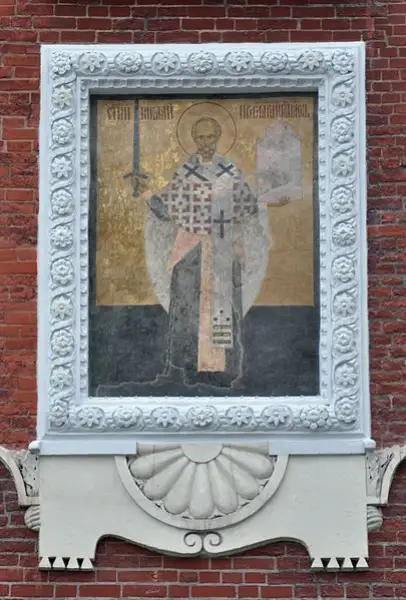
Saint Nicholas of Mozhaysk, or Nikola of Mozhaysk, is a Russian development of the widespread traditions of Saint Nicholas the Wonderworker, known above all through a distinctive iconographic type rather than through a separate biography. According to the legend that gave the image its form, when Mongol forces besieged the city of Mozhaysk in the fourteenth century the townsfolk cried out to Saint Nicholas, and the saint made himself known as a colossal figure, a sword gripped in his right hand and the city of Mozhaisk held safe on the palm of his left. The enemy, terrified by the apparition, withdrew, and the grateful citizens raised a wooden monument to the saint exactly as they had seen him. From that vision arose the popular Russian image of Nicholas as a warrior-defender, standing with the raised sword and the walled city in his hand, a motif that spread through Russian icons and high reliefs and gathered stories of its own, some of them attached to the missionary Abbot Cornelius of Petseri on the Estonian border. The most famous Mozhaysk icon watched over the Nikolskaya Tower of the Moscow Kremlin for centuries, surviving explosions, revolutions, and Soviet concealment, and was uncovered and restored in 2010.
The Complete Life
The Vision at the Walls
Nicholas of Mozhaysk has no earthly biography, for he is a Russian flowering of the cult of Saint Nicholas the Wonderworker of Myra, shaped entirely by a vision said to have taken place at the walls of a small frontier city. In the fourteenth century, as the story tells, Mongol armies laid siege to Mozhaysk, and the residents turned to their bishop-saint with desperate prayer. Their prayer was answered by an apparition: Saint Nicholas announced himself to them as a huge figure, holding a sword upright in his right hand and the city of Mozhaisk itself resting on the palm of his left. At the sight the Mongols broke off the siege and retreated. The citizens, out of gratitude, erected a wooden monument to Saint Nicholas shaped exactly as he had appeared to them, and this armed, city-bearing Nicholas became one of the most recognizable saintly images in all of Russia, copied endlessly by icon painters and carvers in wood and high relief. The tale belongs to legend rather than chronicle, but it fixed forever the meaning of the type: a saint who does not merely pray for a city but stands armed in its defense.
§ Moscow Kremlin
Guardian of the Kremlin Gate
The most celebrated image of Nicholas of Mozhaysk was installed on the wall of the Nikolskaya Tower above the Nikolsky Gate of the Moscow Kremlin, a painting dated to the end of the fifteenth or the beginning of the sixteenth century. From that position over the ceremonial eastern gate of the fortress the saint watched over the capital for four hundred years, and his own history became entwined with the violence of Russian history. When Napoleon's army retreated from Moscow in 1812, the French blew up the tower, destroying its top completely, yet the image above the gate was damaged only slightly, a survival that amazed contemporaries and deepened devotion to the wonderworking defender. In the October Revolution of 1917 artillery fire struck the icon again: the shots destroyed the left hand with its little cathedral of Mozhaisk, but the right hand holding the sword was left intact. After that wound a new icon type appeared, the Wounded Saint Nicholas of Mozhaisk, showing the saint still brandishing the sword but missing the left hand and city, a memorial of the tower's scars under fire.
§ Moscow Kremlin
Folk Devotion on the Frontier
Far from the capital, the Mozhaysk Nicholas lived a quieter life in the folk religion of the borderlands. Folklore researcher Hele Bome has recorded how Saint Nikolai of Mozhaisk is remembered in Estonia in icons sculpted in high relief, images that became especially popular as protective charms. The Setu peoples favored them particularly, venerating the icon with offerings of loaves of bread or cream and seeking its blessing on their agriculture and cattle-raising; the principal office given him in those parts, however, was to shield the fields against killing cold, warding frost away from the sown earth. Some local texts go further and describe him as a warrior-hero, a white-bearded figure standing on top of the monastery wall whom enemy fire cannot touch, sword raised against the foe. Other stories soften the martial image, explaining the lifted sword as a threat once directed at an old woman who refused to believe in him. Behind some of these legends scholars glimpse real events in the life of the missionary Abbot Cornelius of Petseri, near the border between Estonia and Russia, whose labors may have seeded the tales.
§ Nicholas in Estonia
Rediscovery After the Long Silence
Under Soviet rule the icon over the Nikolsky Gate shared the fate of so much sacred art: it was plastered over and hidden from sight for decades. The concealment ended in 2010, when the image was uncovered and restored, and the head of the Russian Church consecrated the renewed over-gate icon of Nicholas of Mozhaysk on the Nikolskaya Tower in a ceremony that returned one of Moscow's oldest protectors to public honor. The motif itself has never left Russian culture. The sword-bearing Nicholas with the city in his palm remains a favorite subject of icons and carved reliefs, and the wounded version created after 1917 has become an icon type in its own right, its missing hand a silent sermon on the century that wounded it. The saint has even walked into modern fiction as Mikola Mozhaiski, a character in Orson Scott Card's 1999 novel Enchantment. After six centuries the defender of Mozhaysk still stands where the legend placed him, sword lifted, city safe in his hand, watching over gates that change their masters but never their need of protection.
§ In popular culture
Timeline
- 1812
The Nikolskaya Tower was blown up by retreating French troops during Napoleon's invasion of Russia, but the icon above the gate was damaged only slightly.
§ Moscow Kremlin
- Oct 1917
Artillery fire in the October Revolution destroyed the left hand of the Kremlin icon, while the right hand with the sword remained intact.
§ Moscow Kremlin
- 2010
The plastered-over icon on the Nikolskaya Tower was uncovered and restored.
§ Moscow Kremlin
The Record
- Patron of
- protector of crops from the cold·agriculture and cattle-raising among the Setu people
- Symbols
- sword in the right hand·the walled city of Mozhaisk held in the left palm
- Canonization
- A devotional form within the tradition of Saint Nicholas the Wonderworker, honored by popular veneration rather than a distinct canonization
Prayer
Bibliography
Show 4 sources
- Dixon-Kennedy, Mike. Encyclopedia of Russian and Slavic Myth and Legend. Santa Barbara, CA: ABC-CLIO, 1998.
- Gamov, Alexander (11 May 2010). "В Московском Кремле обнаружены древние надвратные иконы". Komsomolskaya Pravda.
- "SACRED IMAGE AS A LOCAL PATRON?" (PDF). folklore.ee. Retrieved 2024-03-04.
- Maximov, Vladimir. "НИКОЛАЙ ЧУДОТВОРЕЦ".
Profile text adapted from the Wikipedia article, licensed CC BY-SA 4.0.
Pray with this saint every day
Save St. Nicholas of Mozhaysk to your favorites, read the full profile, and get feast-day reminders in the Saints app.
Get the Saints AppFree on the App Store for iPhone and iPad