
traditionally 15 March 270 – 6 December 343·Feast December 6 (Gregorian); December 19 (Julian); May 22 (translation of relics)
St. Nicholas of Myra
Wonderworker, Bishop of Myra and secret gift-giver
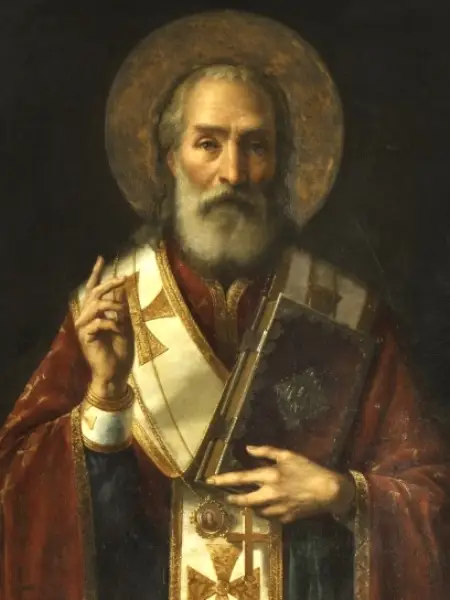
Overview
Nicholas of Myra, traditionally born on 15 March 270 and died on 6 December 343, was a Greek-descended bishop of the early Church, born in the port town of Patara in Anatolia, in what is now the Antalya Province of Turkey. Renowned for the miracles attributed to his intercession, he is honored as Nicholas the Wonderworker, and his reputed habit of secret generosity, above all the rescue of three destitute sisters with gifts of gold tossed through their window by night, made him the pattern of the secret gift-giver and ultimately the ancestor of the folklore of Santa Claus. Tradition makes him a wealthy orphan who gave away his inheritance, a pilgrim to Egypt and the Holy Land, and the providentially chosen bishop of Myra, where he was imprisoned during the persecution of Diocletian and freed under Constantine. An early list names him among the fathers of the First Council of Nicaea in 325. His relics, honored in Myra for centuries and famous for the sweet manna that flowed from them, were carried off by sailors from Bari in 1087 and enshrined in the Basilica di San Nicola, from which his devotion spread across the Western world. He is patron of sailors, children, merchants, and countless cities, and his memory is kept by nearly every Christian tradition on earth.
The Complete Life
A Son of Patara
Tradition places the birth of Nicholas in the Mediterranean port city of Patara in Lycia, on the southwestern coast of Asia Minor, around the year 270, within a wealthy family of Greek Christians. The names of his parents are given differently by different accounts, some recording Epiphanius and Johanna, others Theophanes and Nonna, and it is said that an uncle of his served as bishop of nearby Myra. Recognizing his nephew's calling, that uncle ordained him to the priesthood, binding the boy early to the church of the city he would one day govern. The shaping catastrophe of his youth came when an epidemic carried off his parents, leaving the young man rich in goods but alone in the world. Rather than cling to his inheritance, he resolved to distribute it to the poor, a decision that set the pattern of his whole life. From this resolve sprang the deed that would define him forever: hearing of a devout man reduced to poverty by misfortune, unable to provide dowries for three daughters who faced being sold into prostitution, Nicholas went by night and cast a purse of gold through the window of the house, and twice more repeated the gift until all three girls were honorably married. The father, lying in wait at last, caught him in the act and fell at his knees in thanksgiving, but the saint commanded silence about what he had done.
§ Family and background
Pilgrim and Shepherd of Myra
As a young man, Nicholas is said to have journeyed on pilgrimage to Egypt and to Syria Palaestina, travels that carried him across the eastern Mediterranean and fixed his memory forever among those who travel by sea. On the voyage the ship was nearly destroyed by a violent storm, which the young priest is said to have rebuked; from this episode came his enduring patronage of sailors and of all who go down to the sea. While in Palestine he lived in a crypt near Bethlehem, close to the place where the Nativity of Jesus is believed to have occurred, and a church in the town of Beit Jala, of which Nicholas is patron, stands above the crypt where he is believed to have dwelt. Shortly after his return to Lycia the church of Myra was thrown into crisis: the see stood vacant: the bishop who had followed Nicholas's uncle in office had lately died, and the clergy determined that whoever of their number first came to the church the following morning should be elevated to it. Nicholas went to the church simply to pray, and so by what his votaries saw as the direct guidance of God he found himself proclaimed the new Bishop of Myra. In that office he spent most of his life, shepherding a harbor city whose mixture of merchants, sailors, and traders made it a crossroads of the Roman East.
§ Bishop of Myra
Bishop in Times of Peril
The episcopate of Nicholas unfolded in an age when the church of the Roman Empire passed from persecution to triumph. When Diocletian's great persecution swept the empire, Nicholas is said to have suffered imprisonment and torture for his confession, winning release only when Constantine the Great came to power; the story is plausible but unattested in the earliest sources, and historians doubt its detail. Among the oldest and most firmly attested stories of his life is his rescue of three innocent men sentenced to die at the hands of governor Eustathius. When the executioner lifted his sword, Nicholas appeared, forced the blade to the ground, struck off the prisoners' chains, and turned upon the juror who had taken a bribe. A related account tells of the consul Ablabius, who accepted money to condemn three famous generals though they were guiltless; Nicholas appeared in dreams to both Ablabius and the Emperor Constantine himself, disclosing the truth and frightening the consul into releasing the men for fear of hell. A fuller medieval version weaves the episodes together, with the generals Ursos, Nepotianos, and Herpylion first rebuked by the bishop for their soldiers' looting in Myra, then aided by him in halting an unjust execution, and finally freed from prison through his nightly appearances. In a different register, the famine of 311–312 gave him the chance to feed his whole people, persuading a shipload of sailors to part with wheat intended for Constantinople after he pledged that their cargo would suffer no loss; when they reached the capital the scales showed that nothing was missing, though the wheat taken at Myra sufficed for two full years.
§ Bishop of Myra
Confessor of Nicaea
The spiritual portrait of Nicholas is that of a bishop whose charity was inseparable from doctrinal firmness. An early list records his name on the tenth line of the attendees at the First Council of Nicaea in 325, where he appears as an unbending adversary of Arianism and a warm champion of the Trinity, and as one of the bishops who subscribed the Nicene Creed. His presence at the council, however, is a matter of scholarly debate: Athanasius of Alexandria, who knew every notable bishop of the period, never mentions him, nor does the historian Eusebius, and his name appears only on the longer of the varying attendance lists. Some scholars judge it likeliest that a devotee added his name to a list from which it was inexplicably absent; others suspect that it was removed. A later legend, first recorded a thousand years after his death, holds that at the council Nicholas lost his temper and slapped the heretic Arius, for which Constantine stripped him of his miter and pallium until Christ and the Mother of God appeared to him in prison, restored his vestments, and freed him. Whatever the truth of the episode, the Eastern Church has never ceased to paint it: the aged bishop with Christ at his left shoulder offering him the Gospel and the Theotokos at his right presenting the omophorion. Beneath the legend lies the consistent memory of a man who combined boldness in confession with secrecy in generosity, the very temperament that made three gold coins the emblem of his charity.
§ Council of Nicaea
Death and the Manna of Myra
Nicholas died traditionally on the sixth of December in the year 343, at about seventy-three years of age, in the city of Myra where he had ruled as bishop for most of his life. The date has been so long and so universally established that it anchors every calendar that honors him, even though the exact year of his death is disputed among scholars. He was buried in his own city, though recent archaeological evidence raises the possibility that he was first entombed in a rock-cut church at the summit of the small island of Gemile, some twenty miles from Patara, an island known in antiquity as Saint Nicholas Island and painted with his name. If so, his remains were moved to Myra by the middle of the seventh century, when Arab fleets made the coast unsafe. At Myra his tomb became one of the celebrated shrines of the East, for the relics were believed each year to exude a clear, sweet-smelling watery liquid called manna or myrrh, credited by the faithful with miraculous powers. So well known was it that all his relics lay in the sealed sarcophagus at Myra that relic forgers of the age rarely dared to claim possessions of his body. When anatomists finally examined the Bari bones in the twentieth century, they found the remains of a man over seventy, of moderate height and slender build, who had suffered chronic arthritis of spine and pelvis and a broken nose that had healed before death, an injury that conforms strikingly to the old reports that he had been beaten in the Diocletianic persecution.
§ Relics
Raised Up by the Whole Church
Nicholas belongs to the company of saints canonized not by decree but by the instinct of the whole Christian people, his cult arising so early that no formal act of elevation was ever required. Already by the 500s his devotees were numerous and his honor secure: the Emperor Theodosius II ordered the church of Saint Nicholas built at Myra over the site of his episcopal church, the historian Procopius records Justinian renovating churches dedicated to him in Constantinople, and the list of Theodore Lector, compiled between 510 and 515, inscribes his name among the fathers of Nicaea. His earliest biography, by Michael the Archimandrite in the early ninth century, drew on older written sources and oral traditions, and the theologian Eustratius of Constantinople, writing around 583, already cited his miracle of the three generals as proof that souls can act apart from the body. The Orthodox Church keeps his memory on almost every Thursday of the year, singing the hymns of the Octoechos in his honor, and chants akathists and canons composed for his intercession; his icon stands in countless churches not named for him. The Coptic Church observes his departure on 10 Kiahk, the Lutherans, the Church of England, and the Episcopal Church all keep his feast on 6 December, and in Serbia his day is the most common family slava of all. In Lycia itself, in Greece, Russia, and the Balkans, he remains the most readily recognizable of all the saints.
§ Biographical sources
From Bari to Santa Claus
The translation of the relics carried Nicholas's fame to the ends of the Latin West. In the spring of 1087, after the Seljuk conquest had severed Myra from Byzantine protection, sailors from Bari seized the principal bones from his burial church, over the protests of the Greek monks, and brought them home, arriving on the ninth of May; Pope Urban II himself placed them in the crypt of the new Basilica di San Nicola two years later. Eastern Christians and Turks have long called the act a theft, while Bari has always called it a rescue. Whatever its morality, the translation made the saint materially accessible to the West: crusaders mustering at Bari in 1096 carried his cult across Europe, fragments of his bones reached Normandy, Flanders, and the Low Countries, and Venice later claimed the remaining fragments of his skeleton. His association with sailors and travelers, his secret gifts to the poor, and his rescue of children built up a devotion that shaped the customs of half a continent: the boy bishops of medieval England, the anonymous alms of Belgian and French nuns, the Nicholas fairs of the Low Countries where parents bought the first small presents of the winter. From the Dutch Sinterklaas, transported to New Amsterdam, descended Santa Claus himself, and streets, parks, cathedrals, and even a cantata by Benjamin Britten keep his name alive in every quarter of the world.
§ Veneration and celebrations
Timeline
- 15 Mar 270
Traditionally born at Patara in Lycia to a wealthy Greek Christian family.
§ Family and background
- 311
During the great famine of Myra in 311–312, he persuaded sailors to unload wheat from a ship bound for the emperor, enough to feed the city for two years.
§ Other reputed miracles
- 325
Named on early lists as an attendee of the First Council of Nicaea, though never mentioned by writers present at the council.
§ Council of Nicaea
- 6 Dec 343
Died traditionally on 6 December at Myra, aged seventy-three; the Orthodox calendar commemorates his death on this date.
§ Veneration and celebrations
- 1044
Venice consecrated the monastery basilica of San Nicolò al Lido in his honor at the northern tip of the Lido.
§ Venice
- 9 May 1087
Sailors from Bari carried off the principal bones of the saint from his Myra burial church despite the monks' protests; the relics reached Bari on 9 May.
§ Bari
- 1089
Pope Urban II inaugurated the Basilica di San Nicola in Bari and personally placed the relics in the tomb beneath its altar.
§ Bari
- Jun 1092
A tooth and two fragments of the sarcophagus, given to the Norman knight William Pantulf, were placed in the Church of St. Peter at Noron in Normandy.
§ Other locations
- 1096
The duke of Apulia gave several of the saint's bones to the count of Flanders, who enshrined them in the Abbey of Watten.
§ Other locations
- 1100
A Venetian fleet under Bishop Enrico Contarini turned back to Myra during the First Crusade and carried the remaining bone fragments to Venice.
§ Venice
- 1101
A French clerk, directed by a vision of the saint, carried a finger bone from Bari to his hometown of Port near Nancy, later Saint-Nicolas-de-Port.
§ Other locations
- 1204
After the Sack of Constantinople in the Fourth Crusade, relic fragments of Nicholas kept in that city were scattered across western Europe.
§ Other locations
- 1966
A crypt vault below the Basilica di San Nicola was set apart as an Orthodox chapel, commemorating the lifting of the mutual anathemas of 1054.
§ Bari
- Jul 1992
The bone fragments claimed by Venice were examined for the last time in July.
§ Venice
- 2000
The Russian government donated a bronze statue of the saint by Gregory Pototsky, placed in the square before the medieval Church of St Nicholas in Demre.
§ Myra
- 2004
Researchers at the University of Manchester reconstructed the saint's face from the anatomical data gathered at Bari.
§ Scientific analysis
- 28 Dec 2009
The Turkish government formally requested the return of the skeletal remains from Italy.
§ Turkish repatriation request
- 2014
The Face Lab at Liverpool John Moores University produced an updated reconstruction of the saint's face.
§ Scientific analysis
- May 2017
A portion of the relics was loaned to Moscow, where more than a million people queued to venerate a rib of the saint.
§ Bari
- 2017
Oxford researchers radiocarbon dated a pelvis fragment claimed as the saint's and found it to be genuinely of the fourth century.
§ Scientific analysis
- 2017
Surveyors working at the Demre church of St. Nicholas reportedly found a temple hidden below it, and digging was undertaken to seek the saint's remains.
§ Turkish repatriation request
- 2024
A sarcophagus possibly containing the saint's remains was discovered during the excavations at Demre.
§ Turkish repatriation request
In Their Own Words
This bone fragment, in contrast, suggests that we could possibly be looking at remains from St Nicholas himself.
The Record
- Major works
- Defense of Trinitarian faith at the First Council of Nicaea, attested on early lists of attendees·Episcopal care of the church of Myra over most of his life
- Patron of
- Children·Sailors, fishermen, and travelers·Merchants and toymakers·Coopers and brewers·Pharmacists and archers·Pawnbrokers·Broadcasters·The falsely accused, prisoners, and repentant thieves·Unmarried people·Greece, Russia, and Albania·Bari, Amsterdam, Moscow, Galway, Liverpool, and Aberdeen·The Hellenic Navy and the Russian Navy
- Symbols
- Vested as a bishop with omophorion and Gospel Book in Eastern iconography·Three purses, three coins, or three balls of gold·Three children rising from a wooden barrel·Ships or drowning sailors he rescues
- Canonization
- Pre-congregation; venerated as a saint by all Christian denominations that venerate saints
Prayer
Bibliography
Show 7 sources
- Seal, Jeremy (2005), Nicholas: The Epic Journey from Saint to Santa Claus, New York City, New York and London, England: Bloomsbury, ISBN 978-1-58234-419-5.
- Jones, Charles W. (1978), Saint Nikolaos of Myra, Bari, and Manhattan: Biography of a Legend, Chicago, Illinois: University of Chicago Press, ISBN 978-0-226-40700-5.
- English, Adam C. (2012). The Saint Who Would Be Santa Claus: The True Life and Trials of Nicholas of Myra. Waco, TX: Baylor University Press. ISBN 978-1-60258-636-9.
- Wheeler, Joe L. (2010), Saint Nicholas, Nashville, Tennessee: Thomas Nelson, ISBN 978-1-59555-115-3.
- Ferguson, George (1976) [1954], "St. Nicholas of Myra or Bari", Signs and Symbols in Christian Art, Oxford, England: Oxford University Press, pp. 135–136.
- Lendering, Jona (2006), "Nicholas of Myra", Livius.org.
- Ott, Michael (1907). "Nicholas of Myra". The Catholic Encyclopedia. Vol. 11. New York: Robert Appleton Company.
Profile text adapted from the Wikipedia article, licensed CC BY-SA 4.0.
Pray with this saint every day
Save St. Nicholas of Myra to your favorites, read the full profile, and get feast-day reminders in the Saints app.
Get the Saints AppFree on the App Store for iPhone and iPad