
c. 1245 – 1305·Feast September 10
St. Nicholas of Tolentino
Patron of the Holy Souls in Purgatory
Overview
Nicholas of Tolentino, an Augustinian friar of the thirteenth and early fourteenth centuries, became the first member of his order to be raised to the altars and remains one of the most beloved intercessors in Catholic devotion. Born at Sant'Angelo in Pontano in 1245 to parents who had begged the favor of a child at the shrine of Nicholas of Myra, he entered the Order of Hermits of Saint Augustine as a youth, was ordained a priest in 1270, and settled in 1274 at Tolentino, the Marchigian town where he would spend the rest of his life. There he served as pastor, preacher, and confessor in a community torn by the civil war of Guelphs and Ghibellines, feeding the poor at the monastery gate, visiting prisoners, and laboring as a peacemaker. His fame as a wonderworker grew from a simple instrument: bread blessed and dipped in water, given to the sick at Mary's instruction in a vision, from which came the Augustinian custom of Saint Nicholas Bread. His visions of Purgatory shaped his distinctive spirituality of intercession for the suffering dead, and in 1884 Leo XIII proclaimed him their patron. He died at Tolentino on September 10, 1305, after a long illness, and Eugene IV canonized him in 1446 upon evidence of three hundred miracles.
The Complete Life
A Child Given Through Prayer
Nicholas was born in 1245 at Sant'Angelo in Pontano, a small town in the Marche of central Italy, into a family that had known the pain of waiting. His parents, childless for years, had made pilgrimage to the shrine of Saint Nicholas of Myra to beg God for a son, and when the boy came they gave him the saint's own name in gratitude. The story of his conception through intercession marked him from the beginning; centuries later, settlers in the Andes would entrust their children to him for the same reason his parents had sought his patron's help. He grew into a studious, kind, and gentle youth, drawn early to the religious life. At sixteen he sought admission among the Augustinians and received the habit as a novice, studying under the Blessed Angelus de Scarpetti. His formation carried him through a series of houses of the Order of Hermits of Saint Augustine: he lived as a friar at the Priory of Saint Augustine in Recanati, at the priory of Macerata, and in other communities, growing in learning and in the quiet charity that would define his priesthood.
§ Life
An Augustinian Priest
Nicholas took his place among the friars before he was fully grown, and his gifts showed themselves quickly. At eighteen he was a friar of the Order of Hermits of Saint Augustine, and after seven more years of preparation he was raised to the priesthood in 1270, in his twenty-fifth year. His preaching and teaching soon drew notice, for he spoke of the things of God with a directness that reached ordinary people, and he became known throughout the region as a confessor whose gentleness opened even hard hearts. Yet his vocation was not to move from dignity to dignity. He remained a simple friar, and when visions came to him of angels repeating a single word, Tolentino, he took the heavenly message literally: around 1274 he asked to be sent to that town in the Marche, not far from his birthplace. He would never leave it. The choice bound him to a community at war with itself, for Tolentino suffered bitterly from the struggle between Guelphs and Ghibellines that convulsed the cities of Italy, and it was precisely there that this priest of peace was to spend his fifty remaining years.
§ Life
Pastor in a Divided City
In Tolentino Nicholas exercised the ministry that made him a saint: the patient care of a flock in a city at war with itself. While factions of Guelphs and Ghibellines fought across Italy for dominance, one party upholding the Pope and the other the Holy Roman Emperor, Nicholas refused every banner but the Gospel. He worked as a peacemaker among citizens trained to hatred, ministered to his flock through decades of civil strife, served the poor with conspicuous generosity, and went to visit the prisoners whom the factional wars filled in the town's cells. His superiors, knowing his kind and gentle manner, appointed him to hand out bread each day to the needy at the friary door; his almsgiving ran so far ahead of the house's stores that the brother in charge of provisions appealed to the prior to curb him. From his charity flowed the wonderworking for which all Italy knew him. After one fast had left him faint, he beheld Christ, his Mother, and the founder of his order in a vision, directing him to take a morsel scratched with a cross, soak it in water, and eat it; vigor flooded back into him at once, and he began giving such rolls to the ailing with prayer to Mary, frequently curing them. After every cure he begged those he helped to say nothing of it, calling himself only God's instrument.
§ Life
Intercessor of the Holy Souls
The distinguishing grace of Nicholas's interior life was his devotion to the souls in Purgatory. He was a man of visions throughout his days, among them images of the suffering dead, which his friends ascribed to his lengthy fasts and bodily austerities. What he saw there fixed the direction of his prayer: prayer for the souls in Purgatory became the outstanding characteristic of his spirituality, the labor he kept with greatest fervor through the weeks of Lent and the whole of November. He understood that the dead could not help themselves, and he offered his masses, penances, and alms on their behalf as a daily oblation. This charity did not remain private. The bread he blessed became a token of it, and the Augustinian order made the practice its own: houses of the Augustinian family, the Discalced branch included, keep a weekly hour of intercession in his name for the suffering dead to this day, and November 2, All Souls' Day, holds special significance for his devotees. In recognition of a spirituality he had lived six centuries before, Pope Leo XIII proclaimed him in 1884 the patron of the souls in Purgatory, the title by which the faithful most commonly invoke him.
§ Life
The Long Illness
The last years of Nicholas's life were marked by suffering accepted in the same spirit that had marked his health. He fell ill and endured great pain, yet the austerities that had always shaped his observance were not set aside, and he pressed on with them as far as his body permitted. The friar who had spent decades feeding others at the monastery gate now lived on the charity of his brethren, and the wonderworker who had cured so many found no cure for himself, receiving his long illness as a final penance offered for souls. He died at Tolentino on September 10, 1305, in his sixty-first year, having given the town nearly thirty years of ministry. The people who had known him did not wait for ecclesiastical process: petitions for his canonization began immediately upon his death, and devotion to him spread through the Augustinian houses of Italy and far beyond. His body was preserved at Tolentino, and when it was examined in 1926 it was found complete but for the severed arms, relics that had been taken and venerated separately, a silent testimony to the eagerness of the faithful to possess something of the friend of the holy souls.
§ Life
First Canonized Augustinian
The cause that began at Nicholas's tomb reached its fulfillment a century and a half after his death. On June 5, 1446, Pope Eugene IV, himself a son of the Augustinian order, canonized Nicholas at the Vatican, making him the first Augustinian friar to receive that honor. The record laid before the pope was immense: the proceedings accepted three hundred wonders as proved, three of them raisings of the dead. The legends collected around his name give some sense of what the faithful believed him able to do. He was said to have revived more than a hundred dead children, including several drowned together; to have quelled a storm that was sinking a ship, appearing in the sky in the black Augustinian habit, radiating golden light, a lily in his left hand; to have rescued the Doge's blazing residence at Venice by hurling a morsel of blessed bread into the fire; and, in a tale told of his vegetarian gentleness, to have made the sign of the cross over a roasted fowl served to him and watched it fly from the window. His remains are venerated at the Shrine of Saint Nicholas in the Basilica of Saint Nicholas of Tolentino in Tolentino, in the province of Macerata.
§ Veneration
Bread Across the World
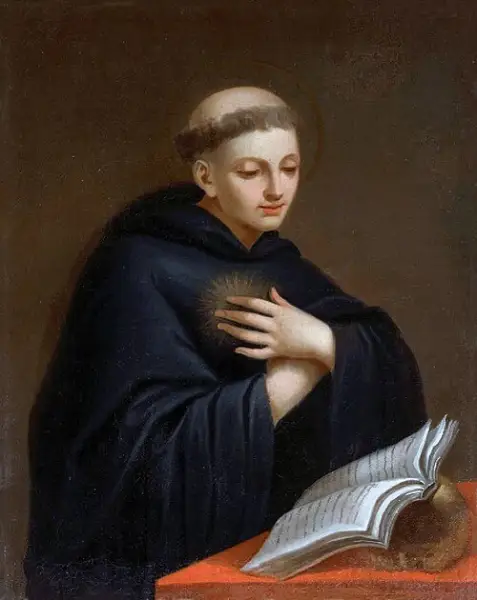
The cult of Nicholas of Tolentino traveled wherever the Augustinians went, and it took root with particular strength in the Spanish and Portuguese worlds. In Ireland, Augustinian churches and friaries historically kept his feast with a ceremony distributing bread, at times stamped with his likeness, a custom strongest in County Waterford. The Philippines received his patronage on a remarkable scale: the church built for him at Banton in the sixteenth century gave rise to the annual Biniray festival, a four-hundred-year-old Augustinian church stands in his honor at Macabebe in Pampanga, where a second-class relic is venerated each Tuesday and a cookie called Pan de San Nicolas has been baked in his honor since the 1600s, and his name guards cathedral and parish churches from Cabanatuan to Cebu City, Sinait, Ajuy, Cabatuan, Guimbal, Lambunao, and Mariveles. In South America, the Peruvian chronicler Antonio de la Calancha credited him with making possible the Spanish settlement of Potosí, after a father dedicated his unborn child to the saint and the infant who arrived that Christmas night of 1598 grew to sturdy manhood. In art he wears the black habit of the Hermits of Saint Augustine, a star above or on his breast, bearing a lily, a crucifix garlanded with lilies, or a basket of bread.
§ Veneration
Timeline
- 1245
Born at Sant'Angelo in Pontano; named for Nicholas of Myra, at whose shrine his parents had prayed for a child.
§ Life
- 1270
Ordained a priest at the age of 25, after formation in the priories of Recanati and Macerata.
§ Life
- 1274
Read the angels' repeated cry of Tolentino as a heavenly summons and transferred to that town, never to depart from it again.
§ Life
- 10 Sep 1305
Died at Tolentino after a long illness, borne with continued mortifications; petitions for his canonization began at once.
§ Life
- 5 Jun 1446
Canonized by Pope Eugene IV, credited at canonization with three hundred miracles, including three resurrections.
§ Veneration
- 1884
Proclaimed by Pope Leo XIII as patron of the souls in Purgatory.
§ Life
- 1926
His body, with its severed arms, was discovered at Tolentino.
§ Life
In Their Own Words
Say nothing of this
The Record
- Patron of
- souls in purgatory·the dying·babies·sailors, mariners, boatmen and watermen·animals and sick animals·bakers·La Aldea de San Nicolás, Spain·Barranquilla, Colombia·many dioceses and towns of the Philippines
- Symbols
- black Augustinian habit·star above him or on his breast·lily or crucifix garlanded with lilies·basket of bread·bird on a plate·crucifix·vial filled with money or bread
- Canonization
- Canonized on June 5, 1446, by Pope Eugene IV at the Vatican; first Augustinian friar to be canonized
Prayer
Bibliography
Show 8 sources
- Stracke, Richard (2015-10-20). "Nicholas of Tolentino". Christian Iconography.
- "Devotion to St. Nicholas of Tolentine". St. Augustine's Church, Cork, Ireland.
- Bittle, Berchman, O.F.M.Cap. A Saint A Day. The Bruce Publishing Company, 1958.
- "Saint Nicholas of Tolentine". Augustinians of the Midwest.
- Garesché, Edward. "St. Nicholas of Tolentino". The Catholic Encyclopedia. Vol. 11. New York: Robert Appleton Company, 1911.
- Calancha, Antonio de la. Crónica moralizada del Orden de San Agustín en el Perú. Barcelona: P. Lacavalleria, 1639, p. 750.
- Vauchez, André; Dobson, Richard Barrie; Lapidge, Michael. Encyclopedia of the Middle Ages, Volume 2. Chicago: Fitzroy Dearborn, 2000.
- Hennig, John (1943). "St. Nicholas' Bread". Béaloideas. 13 (1/2): 264-269.
Profile text adapted from the Wikipedia article, licensed CC BY-SA 4.0.
Pray with this saint every day
Save St. Nicholas of Tolentino to your favorites, read the full profile, and get feast-day reminders in the Saints app.
Get the Saints AppFree on the App Store for iPhone and iPad