
c. 1562-1606·Feast March 22 (also May 4 with the Forty Martyrs of England and Wales)
St. Nicholas Owen
Jesuit Lay Brother and Martyr
Overview
Nicholas Owen was born in Oxford at around 1562, the son of a Catholic carpenter, Walter Owen, and was apprenticed as a joiner in 1577 — a trade that would carry the English mission through its darkest years. Two of his brothers became priests; Nicholas found his own vocation with tools. After serving Edmund Campion and being arrested once for defending him, he joined the household of the Jesuit Henry Garnet around 1588 and spent eighteen years building priest holes in the homes of recusant families. Small of stature, herniated and with a leg ruined by a horse, he worked under the names Little John, Little Michael, Andrewes and Draper, taking only necessities as pay, sometimes building a decoy hide to shield a deeper one. Arrested in 1594 and tortured, he revealed nothing. He helped John Gerard escape the Tower in 1597. Caught for the last time at Hindlip Hall in early 1606 — starved out of one of his own hides — he was racked in the Tower until the iron plate strapped over his hernia killed him on the night of 1-2 March. He had given his inquisitors nothing.
The Complete Life
Early Life
Nicholas Owen was born in Oxford around 1562, into a devoutly Catholic family that grew up under the Penal Laws. Walter Owen, his father, worked as a carpenter, and Nicholas was bound apprentice as a joiner in February 1577, and so acquired the craft that would make his name. Two of his older brothers became priests — the Owen household was thus, from the outset, exactly the kind of family the Elizabethan state had been built to watch, and the two brothers in orders were its principal targets. Nicholas himself never took orders: he would in time join the Jesuits as a lay brother — one of the few non-priests the English province took on, and it is in that capacity, as a workman, that he became indispensable to the mission. Physically he was unfitted for the work that made him famous: he was of very short stature, suffered from a hernia, and had a crippled leg from an early accident in which a horse fell on him — a man, in other words, who could not have carried a priest to safety but could build the wall behind which one hid.
§ Life
Conversion and Vocation
Owen was in the service of Edmund Campion, and when Campion was taken by the priest hunters in 1581 Nicholas was himself arrested for protesting his master's innocence. Released, he entered the service of the Jesuit Henry Garnet around 1588, and from then until his final arrest in 1606 he built hiding places for priests in the homes of Catholic families across England. He worked under the name 'Little John', with the aliases 'Little Michael', 'Andrewes', and 'Draper', and took only his keep as payment before setting out for the next job. By day he worked openly as a traveling carpenter to deflect suspicion; the hides themselves were built, so far as possible, when no one else was in the house, and their locations were known to himself and the owner alone. The scale of this labor is the measure of its danger: every house he worked in was, in law, a felony scene, and every family that employed him risked the ruin that followed a discovered hide. His entry into the Society as a coadjutor brother formalized what he was already doing.
§ Life
Mission and Ministry
The priest hole was the Catholic mission's infrastructure. A searched house meant a captured priest, and the searches were professional: floorboards measured, walls sounded, wainscoting taken up, chimneys and cellars combed, and the searchers prepared to stay for days. Against this Owen designed and built concealments of genuine ingenuity — cavities behind chimney breasts, recesses under staircases, rooms within garrets — and one of his characteristic tricks was to build a more easily discovered outer hiding place that concealed an inner one, so that a search which found something would stop. At Baddesley Clinton, in 1591, seven priests survived a search of several days inside one of his hides. One example of his work is certainly identified, at Broad Oaks Manor, and probable ones at Sawston and elsewhere; in all he is credited with the great majority of the hides that protected the English mission through its worst decades.
§ Life
Trial and Final Years
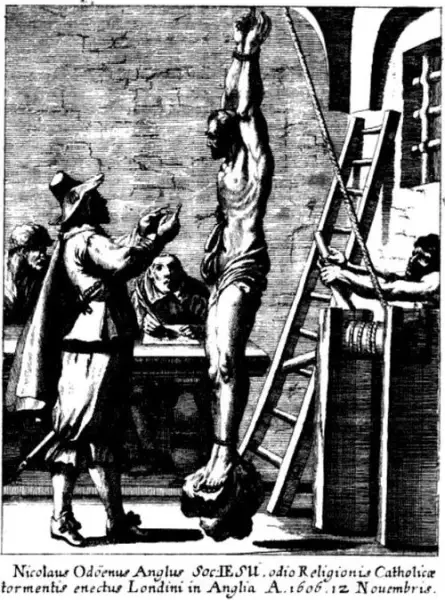
Owen was taken at last in January 1606, in the aftermath of the Gunpowder Plot, at Hindlip House with Garnet. The authorities understood within days that they had caught 'Little John', the builder himself — the man whose knowledge of the hiding places, and of the houses and families that contained them, was worth more than any single priest's. He was tortured on the rack in the Tower of London by Richard Topcliffe's successors, with the Privy Council's authorization, over several days. His crippled leg — the legacy of an old accident in which a horse had fallen on him — was, by every account, broken afresh on the rack. He gave them nothing. He died in the Tower on the night of 1 or 2 March 1606, and the official account of his death, a convenient suicide, was not believed at the time or since. The Council's own papers, which survive, show the questions put to him — the locations of hides, the names of houses and priests — and show his refusals. It was the third time he had been arrested in his life, and the first time the authorities had known whom they had.
§ Life
Canonization
Owen was among the Forty Martyrs of England and Wales whom Paul VI canonized on 25 October 1970, having been beatified in 1929 with the earlier groups of Elizabethan and Stuart martyrs. He is one of the very few canonized martyrs who was not killed for practicing the faith himself but for enabling others to practice it — the charge against him was complicity in the Plot, but the reason he was racked was his trade. His individual feast is 22 March in some lists and 1 March, his dies natalis, in others; the group's is 25 October. The path from his death to his canonization ran through the long process of the English martyrs, whose causes were assembled from the prison and assize records of the period; in Owen's case those records are unusually grim reading, since the rack was illegal and his use of it was known.
§ Introduction
Legacy
Owen's working legacy is physical: his hides survive at Baddesley Clinton, Broad Oaks, Harvington Hall, and other English houses, and they are now studied as documents of Elizabethan building craft and of the mission alike — Harvington in particular preserves a set attributed to him, and the trust that runs it keeps his memory deliberately. He is invoked as the patron of escapologists, on the obvious ground, and more seriously as a patron of builders and of those who shelter the persecuted. For the historiography of the English mission he is the proof that the recusant network was not merely gentry piety but a material enterprise, dependent on craftsmen who could keep a secret through a week of torture. He has also become a minor figure in the literature of the English house: the hides are measured and photographed, their carpentry dated, and the point usually made is that they were built to a professional standard by a man who had served a full apprenticeship.
§ Life
Timeline
- 1562
Born in Oxford to Walter Owen, a Catholic carpenter
§ Introduction
- 1577
Apprenticed as a joiner, learning the craft of his life's work
- 1581
Serves Edmund Campion and is arrested for protesting his innocence
§ Life
- 1588
Enters the service of the Jesuit Henry Garnet and begins building priest holes
§ Life
- 1591
Seven priests survive a search hidden in one of his hides, probably at Baddesley Clinton
§ Life
- 1594
Arrested and tortured at the Poultry Compter; reveals nothing
§ Life
- 1597
Helps John Gerard escape from the Tower of London
§ Life
- 1606
Starved out of his hide at Hindlip Hall; tortured to death in the Tower between 1 and 2 March
§ Life
- 1970
Canonized among the Forty Martyrs of England and Wales
§ Introduction
The Record
- Patron of
- Illusionists and escapologists (honoured by Catholic stage magicians for Gospel Magic)
- Symbols
- Carpenter's and joiner's tools·The priest hole
- Canonization
- Canonized by Pope Paul VI on 25 October 1970 as one of the Forty Martyrs of England and Wales
Prayer
Bibliography
Show 10 sources
- 1 2 Herbermann, Charles, ed. (1913). "Nicholas Owen" . Catholic Encyclopedia . New York: Robert Appleton Company.
- ↑ Reynolds, Tony. "St Nicholas Owen: Priest-Hole Maker" Gracewing 2014
- ↑ Hodgetts, Michael (October 1999). "The Owens of Oxford". Recusant History . 24 (4): 415– 430. doi : 10.1017/S0034193200002612 .
- ↑ "The Jesuit Curia in Rome" . www.sjweb.info . Archived from the original on 24 August 2018 . Retrieved 24 August 2018 .
- 1 2 Gerard, John (1871). A Narrative of the Gunpowder Plot . Longmans. ISBN 9781729755396 . {{ cite book }} : ISBN / Date incompatibility ( help )
- 1 2 3 4 5 Hodgetts, Michael (2024). Secret Hiding Places (2nd, ed Paul Hodgetts ed.). Dudley: Pear Branch. ISBN 9781738427000 .
- ↑ Hodgetts, Michael (2024). "Nicholas Owen: Jesuit Lay Brother?". Midlands Catholic History . 31 .
- ↑ Gerard, John (2006). The Autobiography of an Elizabethan . Family Publications. ISBN 1871217636 .
- 1 2 Narrative of the Gunpowder Plot , Fr. John Gerard, S.J.
- ↑ "},"publisher":{"wt":"St. Nicholas Owen church, Little Thornton"},"access-date":{"wt":"29 July 2014"},"archive-url":{"wt":"https://web.archive.org/web/20140531010405/http://stnicholasowen.co.uk/LifeofNichOwen.htm"},"archive-date":{"wt":"3
Profile text adapted from the Wikipedia article, licensed CC BY-SA 4.0.
Pray with this saint every day
Save St. Nicholas Owen to your favorites, read the full profile, and get feast-day reminders in the Saints app.
Get the Saints AppFree on the App Store for iPhone and iPad