
1534 – 1572·Feast July 9
St. Nicholas Pieck
Franciscan guardian and first of the Gorkum martyrs
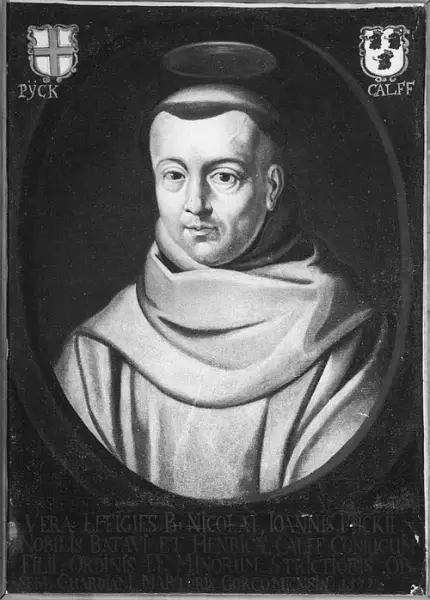
Overview
Nicholas Pieck, called Nicolaas or Claes in his own land, was a Dutch Friar Minor who gave his life in the persecution that followed the Calvinist capture of Gorkum in 1572. Born at Gorkum on 29 August 1534 to devout Catholic parents, Jan Pieck and Henriea Clavia, he studied at 's-Hertogenbosch and received the Franciscan habit in the friary of that town as soon as his classical studies were done. Ordained a priest in 1558, he threw himself into preaching, defending the dogma of the Real Presence against the Calvinist preachers of the region, and in time was appointed Guardian of the friary in his native town. When the Watergeuzen seized the citadel of Gorkum in June 1572 they imprisoned the clergy of the city, tortured Nicholas by hanging him from a beam with his own cord until it snapped, and refused his two brothers' plea to free him alone. Transported half-naked to Brielle, the nineteen captives declined every offer of freedom purchased by apostasy and were hanged on 9 July 1572 at the deserted Ruggen Monastery. Clement X beatified them in 1675; Pius IX canonized them among the Martyrs of Gorkum in 1867.
The Complete Life
A Son of Gorkum
Nicholas Pieck was born on 29 August 1534 in the town of Gorkum, now Gorinchem, in the County of Holland of the Holy Roman Empire. His father, Jan Pieck, and his mother, Henriea Clavia, were devout Catholics, and the faith they planted in their son proved deep enough to cost him his life. He was sent away for his schooling, studying at the college of 's-Hertogenbosch, the chief town of the region, and no sooner were his classical studies finished than he asked to enter the Order of Friars Minor, receiving the habit at the friary in that same town. The friary of 's-Hertogenbosch formed many of the Franciscans who served the towns of Holland, and within its walls the young religious from Gorkum grew into the preacher his region would remember. The sequence of his formation, from a pious household to a humanist college and then straight into a Franciscan friary, marked him as a religious vocation of unusual singleness of purpose. He was raised to the priesthood in 1558 and gave himself wholly to the apostolic ministry, and in due course his brethren appointed him Guardian of the friary at Gorkum, placing the young priest in charge of the religious house of his own native town.
§ Life
Preacher of the Real Presence
As a Friar Minor Nicholas preached against the spread of Calvinism in the Dutch towns, and his preaching had a particular center of gravity: the dogma of the Real Presence of Christ in the Eucharist. In a region where the confession of the sacrament had become the dividing line between the old and new religions, the Franciscan guardian staked his ministry on that article of faith, and in the end he was asked to surrender precisely that point. In June 1572 the citadel of Gorkum fell to the Watergeuzen, the Sea Beggars of the revolt against Spain, who although they had promised the inhabitants free departure without molestation, kept nineteen of the clergy in custody, friars and priests and religious of other houses alike. To exact reprisals for the town's determined defense, they herded the members of the clergy of Gorkum into a single prison and vented on the priests and religious their grievances against the Spanish crown. Among the captives were Nicholas and eight other Franciscan friars, confined together in a dark and foul dungeon while the town they had served decided nothing on their behalf.
§ Life
The Dungeon and the Barn
The captors tormented their prisoners, and Nicholas received the cruelest treatment. Taking the cord he wore around his waist in the Franciscan fashion, they put it about his neck, hanged him from a beam, and let him fall heavily to the floor, repeating the torture until the cord broke and the father dropped to the ground unconscious. His two brothers tried to purchase his release, but the guardian refused to leave his companions, and so he shared their fate. On 6 July the nineteen prisoners were loaded, barely clothed, into the hold of a vessel bound for Brielle; along the way, at Dordrecht, their captors charged spectators money to gape at them. Once in Brielle the Watergeuzen commander, William II de la Marck, dangled freedom before them under a single condition: denial of the pope's authority and of the Real Presence. To a man they refused. Although Prince William the Silent had instructed that they be spared, and although the magistrates of Gorkum protested, the nineteen went to the gallows on 9 July 1572, strung up in a barn of the abandoned Ruggen Monastery beyond the town. The execution was clumsily done, and some of the victims took two hours to strangle.
§ Life
Honor Delayed and Granted
The Church moved deliberately but surely to honor the nineteen who died at Brielle. Nicholas and his companions were beatified by Pope Clement X on 24 November 1675, a century after their death, and the cause advanced further in the age of restored Catholic life in the Netherlands: Pope Pius IX canonized them on 29 June 1867, enrolling the Martyrs of Gorkum among the saints of the universal Church. Year after year, pilgrims and processions make their way to the spot at Brielle where the nineteen died, and their major shrine stands in that town of South Holland where the barn once belonged to an abandoned monastery. Among the nineteen, Nicholas Pieck holds a special place as the guardian who would not desert his flock, and the Friars Minor keep the memory of their slain brethren with particular devotion, setting their guardian at the head of the list. Franciscans especially venerate him as one who proved in torments the truth of the Eucharistic doctrine he had spent his priesthood preaching. His feast is kept on 9 July, the day of his death, and his image appears in the stained glass of Dutch churches beside his fellow sufferers of that July night.
§ Veneration
Memory of the Nineteen
The Martyrs of Gorkum became, in the centuries after their death, the clearest memorial of the Catholic endurance of the Dutch Church through the upheavals of the Reformation and the revolt against Spain. Their story has been told and retold in the hagiography of the Franciscan order and of the Low Countries, from the pages of the Catholic Encyclopedia to modern collections of the saints, and the account of their captivity, their ship journey, and their refusal of the bargain offered at Brielle has passed into the common memory of Catholics in the Netherlands. Pilgrims continue to walk to the martyrdom site in Brielle, where processions have honored the nineteen year after year. For the Friars Minor the example of their guardian has a particular charge: Nicholas Pieck is remembered as a superior who shared every hardship of his brethren, refused a private rescue, and, when the choice was set between apostasy and the gallows, kept the faith of the Church without hesitation. His witness stands as a lasting answer to the question his captors put to him, and his feast on 9 July gathers the Dutch Church each year around the memory of its bravest sons.
§ Veneration
Timeline
- 29 Aug 1534
Born at Gorkum in the County of Holland, son of Jan Pieck and Henriea Clavia.
§ Life
- 1558
Ordained a priest after studies at 's-Hertogenbosch and profession among the Friars Minor.
§ Life
- Jun 1572
Imprisoned with the other clergy of Gorkum after the Watergeuzen seized the citadel of the town.
§ Life
- 6 Jul 1572
Shipped off toward Brielle, stripped nearly bare and stowed in the vessel's hold beside the rest.
§ Life
- 9 Jul 1572
Put to death by hanging with his Gorkum brethren in a barn of the abandoned Ruggen Monastery outside Brielle.
§ Life
- 24 Nov 1675
Beatified at Rome by Pope Clement X together with his companion martyrs.
§ Veneration
- 29 Jun 1867
Canonized at Rome by Pope Pius IX among the Martyrs of Gorkum.
§ Veneration
The Record
- Symbols
- Franciscan habit
- Canonization
- Beatified 24 November 1675 by Pope Clement X; canonized 29 June 1867 by Pope Pius IX
Prayer
Bibliography
Show 5 sources
- Heckmann, Ferdinand. "St. Nicholas Pieck." The Catholic Encyclopedia. Vol. 11. New York: Robert Appleton Company, 1911.
- Habig O.F.M., Marion. The Franciscan Book of Saints, Franciscan Herald Press, 1959.
- Schaeffer, Fred. Holiness in Holland, 2001.
- Foley O.F.M., Leonard. Saint of the Day: Lives, Lessons, and Feast, (revised by Pat McCloskey O.F.M.), Franciscan Media. ISBN 978-0-86716-887-7.
- Albers, Petrus Henricus. "The Martyrs of Gorkum." The Catholic Encyclopedia. Vol. 6. New York: Robert Appleton Company, 1909.
Profile text adapted from the Wikipedia article, licensed CC BY-SA 4.0.
Pray with this saint every day
Save St. Nicholas Pieck to your favorites, read the full profile, and get feast-day reminders in the Saints app.
Get the Saints AppFree on the App Store for iPhone and iPad