
c. 1340-1391·Feast November 14
St. Nicholas Tavelic
Franciscan Friar, Priest and Martyr
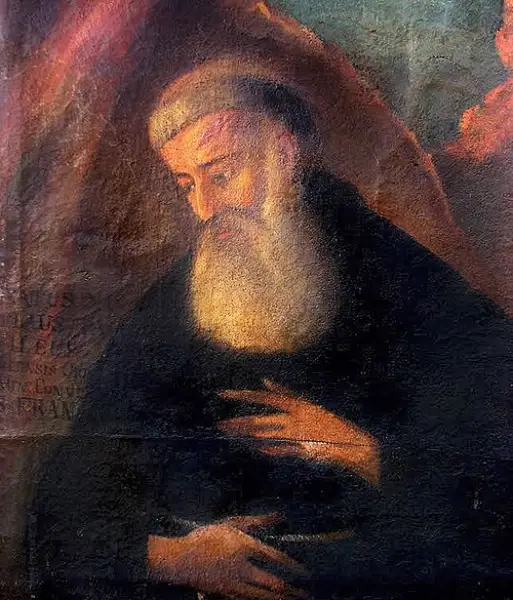
Overview
Nikola Tavelić was born around 1340, most probably at Šibenik on the Dalmatian coast, perhaps of noble stock, though one tradition favours Velim near Stankovci. In 1365 he received the habit of the Friars Minor at Bribir, then a seat of the powerful Šubić family. Answering a missionary appeal grounded in Nicholas IV's bull Prae cunctis, he laboured for roughly twelve years in Bosnia, working among the adherents of the Bosnian Church at a time when Rome judged them heretical; the Franciscan guardian's later report to the pope credited such missions with the reconciliation of tens of thousands. About 1383 he passed to the Custody of the Holy Land, dwelling at the friary on Mount Zion with Deodatus Aribert of Rodez, Peter of Narbonne, and Stephen of Cuneo, learning Arabic and serving at the holy places that drew pilgrims from across Europe. When years of quiet ministry brought no conversions from the city's Muslim rulers, the four friars took up the way Francis's Rule allows before unbelievers: they preached Christ openly at the Qadi's tribunal, were jailed, refused the offer of Islam, and were executed near the Jaffa Gate on 14 November 1391, their remains burned. Paul VI canonized them together in 1970.
The Complete Life
Early Life
Nikola Tavelić was born around 1340, most probably at Šibenik on the Dalmatian coast of Croatia, though one tradition favors Velim near Stankovci; he is generally held to have come from a noble family. In 1365 he received the habit of the Friars Minor at Bribir, then a seat of the powerful Šubić family. He was one of some sixty friars from various Franciscan provinces who answered the Bosnian guardian's appeal for missionaries — an appeal grounded in the 1291 bull Prae cunctis of Pope Nicholas IV — himself a Friars Minor, for work among the adherents of the Bosnian Church, which Rome judged heretical.
§ Life
Mission and Ministry
Tavelić spent roughly twelve years spreading Catholicism around Bosnia, laboring among the members of the Bosnian Church at a period when the frontier between Latin Christianity and that community was also the frontier between Hungary and the Bosnian state. The measure of such missions was kept by the Franciscans themselves: in his later report to the pope, the Bosnian guardian reckoned that the missionaries had converted some fifty thousand members of that Church. Around 1383 Tavelić transferred to the Custody of the Holy Land, where he joined Deodatus Aribert of Rodez, Peter of Narbonne, and Stephen of Cuneo. The four lived at the friary on Mount Zion — the ancient house the Friars Minor kept in Jerusalem — spending several years upon Arabic and upon ministry at the holy places of Jesus' life, which the order tended and which still drew pilgrims from all Christian Europe.
§ Life
Trial and Final Years
Years of quiet service at the holy places, however, won from the city's Muslim inhabitants few if any converts, and the four friars chose the other road their founder's Rule opened before unbelievers: plain public proclamation. At the Qadi's ordinary sitting in Jerusalem they stood forth and preached Christ. For this they were seized; the offer of Islam they declined; in prison, days later, the offer was renewed and again declined, and sentence of death followed for all four. Near the Jaffa Gate, on 14 November 1391, they were put to death and their bodies burned outright. Gerard Chalvet, guardian of the Jerusalem friary, saw the executions with his own eyes, and with Friar Martin of Šibenik dispatched the full account to Europe — to the pope, to Leipzig, to Šibenik and other places — and the friars of Europe, Šibenik above all, hailed them at once as martyrs.
§ Life
Canonization
Formal recognition took five centuries. In 1880 the bishop of Šibenik, Antun Josip Fosco, began the procedure before the Holy See, and by special decree Pope Leo XIII recognized Tavelić's ancient cultus for Šibenik in 1889, then for the entire order in 1898, and shortly afterwards for the Holy Land. The cultus of the other three friars was recognized in 1966 under Paul VI, keeping a separate feast on 17 November, and on 21 June 1970 Paul VI canonized all four together before some twenty thousand Croats, with a joint feast on 14 November.
§ Veneration
Legacy
Tavelić's distinction is first: he is the first canonized Croatian saint. The national shrine in his honor stands at the Franciscan monastery and church of St Francis in Šibenik, and his feast is known in Croatian simply as Tavelićevo. The first Croatian parish consecrated to him was founded in Zagreb's Kustošija in 1939, its church consecrated by Archbishop Alojzije Stepinac in 1943; churches under his name now stand across Croatia and, among the emigration, in Argentina, Canada, Australia, and Bosnia-Herzegovina.
§ Churches
Timeline
- 1340
Born around this time, probably at Šibenik, into a noble family
§ Life
- 1365
Became a Franciscan friar at Bribir, seat of the Šubić noble family
§ Life
- 1383
Entered the Franciscan custody of the Holy Places, residing at the Mount Zion friary in Jerusalem
§ Life
- 14 Nov 1391
Executed near the Jaffa Gate with three companions after refusing to convert to Islam; remains burned
§ Life
- 1880
Bishop Antun Josip Fosco of Šibenik opened the formal beatification procedure with the Holy See
§ Veneration
- 1889
Pope Leo XIII recognized his ancient cultus for the Diocese of Šibenik by special decree
§ Veneration
- 1898
Same recognition of his cultus extended to the entire Franciscan Order
§ Veneration
- 1966
Pope Paul VI recognized the cultus of his three companion martyrs, with a separate feast on 17 November
§ Veneration
- 21 Jun 1970
Canonized with his three companions by Pope Paul VI before 20,000 Croats at St. Peter's
§ Veneration
The Record
- Symbols
- Franciscan habit·Palm of martyrdom
- Canonization
- Ancient cult confirmed by Pope Leo XIII in 1889 for the Diocese of Šibenik and in 1898 for the Franciscan Order; canonized with his three companions by Pope Paul VI on 21 June 1970 — the first canonized Croatian saint
Bibliography
Show 11 sources
- 1 2 "Hrvatsko nacionalno svetište sv. Nikole Tavelića" [ Croatian National Shrine of St. Nicholas Tavelic ] . svetiste-sibenik.hr (in Croatian). Šibenik: Croatian National Shrine of St. Nicholas Tavelic . Retrieved 14 November 2023 .
- 1 2 "NAJAVA: Blagdan sv. Nikole Tavelića" [ ANNOUNCEMENT: Feast of St. Nikola Tavelić ] . svetiste-sibenik.hr (in Croatian). Šibenik: Croatian National Shrine of St. Nicholas Tavelic. 8 November 2023 . Retrieved 14 November 2023 .
- ↑ "Tavelić, Nikola, sv." . Croatian Encyclopedia (in Croatian). Zagreb: LZMK. 2021 . Retrieved 14 November 2023 .
- 1 2 3 4 "Tavelić, Nikola, sv." . Proleksis Encyclopedia (in Croatian). Zagreb: LZMK. 30 December 2014 . Retrieved 14 November 2023 .
- ↑ Laszlo Klemar, Kosjenka (2016). "Srednjovjekovni franjevački samostan i crkva sv. Marije u Bribiru" [ The Medieval Fransican monastery and church of St. Mary in Bribir ] . Contributions to the History of Art in Dalmatia (in Croatian). 43
- 1 2 "Saints Nicholas Tavelic, Stephen of Cuneo, Deodato Aribert from Ruticinio and Peter of Narbonne, November 14" . The Black Cordelias . Retrieved 13 September 2015 .
- ↑ Cecelja, Vilim (1961). Osnutak prve župe bl. Nikole Tavelića u Kustošiji (in Croatian). Salzburg. {{ cite book }} : CS1 maint: location missing publisher ( link )
- ↑ Milas, Krunoslav. "Povijest župe" [ Parish history ] . nikolatavelic.com (in Croatian). St. Nikola Tavelić Parish Zagreb, Kustošija . Retrieved 14 November 2023 .
- ↑ "Crkva sv. Nikole Tavelića – Bezdanski put (Sombor)" [ St. Nikola Tavelić Church – Bezdanski put (Sombor) ] . zkvh.org.rs (in Croatian). Department for culture of Croats of Vojvodina. 23 November 2020 . Retrieved 14 November 2023 .
- ↑ "Odluka o dodjeli priznanja Povelja Republike Hrvatske za nesebičan i izniman doprinos u pružanju socijalne i duhovne skrbi te za dugogodišnju pastoralnu djelatnost mađu hrvatskim iseljenicima u Kanadi" . Narodne novine (in Croatian). 201
- ↑ "Croatian Catholic Centre, Clifton Hill" . Cronet . Archived from the original on 2001-04-26.
Profile text adapted from the Wikipedia article, licensed CC BY-SA 4.0.
Pray with this saint every day
Save St. Nicholas Tavelic to your favorites, read the full profile, and get feast-day reminders in the Saints app.
Get the Saints AppFree on the App Store for iPhone and iPad