
1075 – 1094·Feast June 2
St. Nicholas the Pilgrim
Fool for Christ and wanderer of Apulia
Overview
Nicholas the Pilgrim, called also Nicholas of Trani, was born at Steiri in Boeotia in 1075 and died at Trani in Apulia on 2 June 1094, a wanderer whose ceaseless cry of Kyrie Eleison made him one of the strangest and most beloved figures of his age. As a shepherd in his native Greek hills he fell into a life of contemplation marked by the unending repetition of that prayer, a habit that his neighbors could not understand and that brought him conflict and ill treatment wherever people gathered. His own mother, convinced that he was tormented by demons, placed him in the great monastery of Hosios Loukas, whose monks eventually expelled him for conduct they judged close to madness. Set loose upon the roads, he embraced the life of a pilgrim. At nineteen he resolved to make his way to Rome, sailed from Naupaktos to Otranto, and passed through the Greek-speaking districts of Apulia before reaching Trani, where his pilgrim life ended and his veneration began. Both the Catholic and Eastern Orthodox Churches number him among the saints; the Orthodox honor him as a Fool for Christ, and the city of Trani venerates him as its patron.
The Complete Life
The Shepherd of Steiri
Nicholas was born in 1075 at Steiri in Boeotia, a Greek country town beneath the slopes where the great monastery of Hosios Loukas stood. His boyhood was spent in solitude as a shepherd, and the lonely vigil with the flocks became for him a school of contemplation. Out of those quiet hours there grew a devotion that would shape the whole of his life: the constant repetition of the words Kyrie Eleison, Lord, have mercy. What began as prayer became an unbroken refrain, sounding from his lips at all times and in all places. To a mind formed in the Eastern tradition of unceasing prayer, the habit was a treasure; to the villages of Boeotia it looked like affliction. Wherever he came among people, the relentless cry drew conflict and aggression, and Nicholas suffered much oppression at the hands of those he had come to pray among. Even in his own family the strange vocation was mistaken for disease: his mother, persuaded that her son was possessed by demons, resolved to place him where the Church might deal with what she could not fathom.
§ Biography
Turned Out of the Monastery
The remedy his mother chose was the monastery of Hosios Loukas, one of the great religious houses of medieval Greece, standing within sight of Nicholas's own birthplace. There the young shepherd was left in the care of the monks, who were to discern whether a demon or a calling possessed him. They decided against the calling. Nicholas's behavior unsettled the community, above all his continual exclamation of the Kyrie Eleison, which the brethren read as conduct bordering on the insane. Unable to bear the disturbance, they expelled him from the cloister. Thus the only monastery he ever approached cast out the very man whom both East and West would one day enroll among the saints. Stripped of flock, family, and cloister, Nicholas was left with nothing but the prayer that had caused all the trouble, and he made of that nothing a vocation: he would be a pilgrim, homeless for the sake of the Name he never ceased to invoke. At the age of nineteen he determined to walk as a pilgrim to Rome, the shrine of the apostles.
§ Biography
The Road to Trani
The pilgrimage of the nineteen-year-old pilgrim carried him out of Greece and across the Adriatic. From Naupaktos on the Gulf of Corinth he took ship to Otranto, the port on the heel of Italy that faced his homeland, and landed in Apulia. There he lingered among the Greek-populated regions of the province, where the language and liturgy of his native Boeotia still lived in the colonies of Byzantine south Italy, before pressing on to Trani, a prosperous harbor city on the Adriatic coast. In Trani his journey ended. He died there on 2 June 1094, having reached the city whose name would be joined forever to his own as Nicholas of Trani. He was still in his nineteenth year. His life would have vanished with him had it not been written down at once: of the three accounts that preserve his story, the earliest was set down only three years after his death, drawing its facts from Bartholomew, the companion who had traveled with him. Through that faithful witness the pilgrim's few crowded years passed into the memory of the Church.
§ Biography
The Archbishop and the Pope
Veneration for the young stranger rose in Trani almost as soon as he was dead. Three years after his passing, Archbishop Bisantius of Trani set in motion the work that made the city a place of pilgrimage: he commissioned the building of a new cathedral to be dedicated to Nicholas himself. To give the veneration legal form, the archbishop approached Pope Urban II while the pontiff presided at the Lateran council of 1098 and 1099, asking his permission for the sanctification of the pilgrim. Urban granted it, and Nicholas stands among the saints canonized by that pope. It was a remarkable elevation for a shepherd boy whom monks had expelled as a madman only a few years before. The Orthodox churches of the East received the same memory with equal honor, ranking him among the Fools for Christ, those holy ones who embrace apparent madness to shame the wisdom of the world. His feast is kept on 2 June, the day of his death, in both the Catholic and Eastern Orthodox calendars.
§ Veneration
Patron of Trani
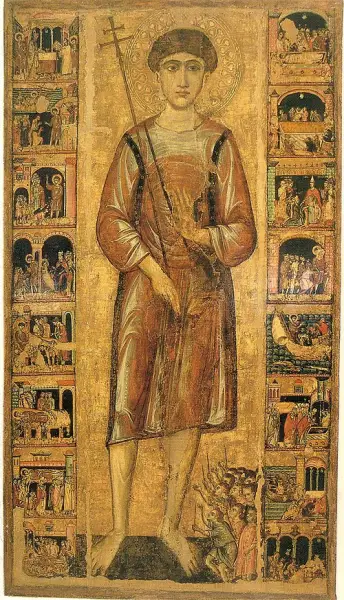
The cathedral that Archbishop Bisantius raised in Nicholas's honor became the great church of Trani, and to this day it bears the pilgrim's dedication, while the city itself acknowledges him as its patron saint. Each year, in the last week of July, the annual procession winds through the streets of Trani carrying the figure of the saint in his honor, a festival that keeps alive the memory of the young Greek who died there in 1094. In the art that grew from his cult he is shown as tradition describes him: a beardless youth, eternally young, clothed in a brown robe, a cross in his hand and always bare of foot, the barefootedness of the pilgrim who possessed nothing. He is invoked especially for the young, as one who sanctified a short life barely out of boyhood. His story rests on three early sources, the oldest drawn from the lips of his travel companion, and modern scholarship continues to study him as a rare documented witness to the Byzantine tradition of holy folly passing into the Latin West.
§ Veneration
Timeline
- 1075
Born at Steiri in Boeotia, where he later worked as a solitary shepherd.
§ Biography
- 2 Jun 1094
Died at Trani in Apulia, after passing through the Greek-populated regions of the province.
§ Biography
- 1098
Canonized by Pope Urban II at the request of Archbishop Bisantius of Trani.
§ Veneration
The Record
- Patron of
- Youth·Trani
- Symbols
- beardless man in a brown robe holding a cross·bare feet
- Canonization
- Canonized in 1098 by Pope Urban II
Prayer
Bibliography
Show 4 sources
- Bunson, Matthew; Bunson, Margaret. Our Sunday Visitor's Encyclopedia of Saints. Second Edition. Our Sunday Visitor, 2014, p. 616. ISBN 978-1612787169.
- "June 2". Orthodox England: Latin Saints of the Orthodox Patriarchate of Rome (St John's Orthodox Church, Colchester). Retrieved 10 July 2017.
- The Roman Martyrology. Transl. by the Archbishop of Baltimore. Baltimore: John Murphy Company, 1916, p. 292.
- Slootjes, Daniëlle; Verhoeven, Mariette (eds.). Byzantium in Dialogue with the Mediterranean: History and Heritage. Brill, 2019, pp. 124-127. ISBN 9789004393585.
Profile text adapted from the Wikipedia article, licensed CC BY-SA 4.0.
Pray with this saint every day
Save St. Nicholas the Pilgrim to your favorites, read the full profile, and get feast-day reminders in the Saints app.
Get the Saints AppFree on the App Store for iPhone and iPad