
1st century·Feast August 31
St. Nicodemus
Pharisee who came to Jesus by night
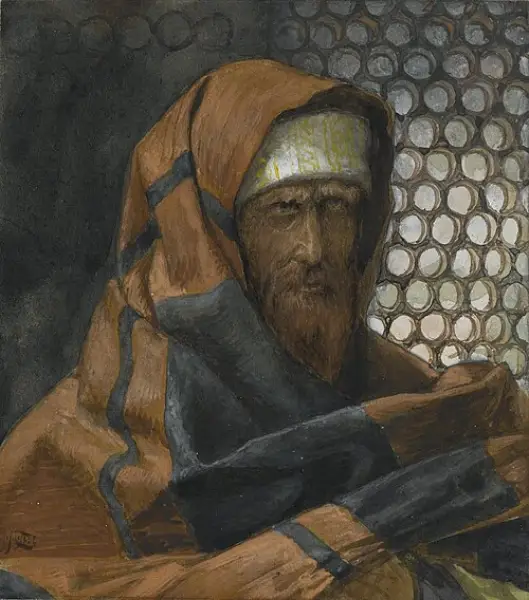
Overview
Nicodemus stands among the most quietly compelling figures of the New Testament: a Pharisee seated on the Sanhedrin, a rabbi of Israel, who found his way to Jesus one night and never wholly went back. The Gospel of John alone tells of him, in three appearances that trace a hidden journey of faith. He comes first by night, acknowledging that no one could work the signs Jesus worked unless God were with him, and receives the teaching about being born again that has shaped Christian language ever since. He appears next in the Sanhedrin itself, reminding his colleagues that the law requires a man to be heard before he is judged, a word of protest that won him the title of defender of Jesus. Last of all, after the crucifixion, he steps out of the shadows entirely, bringing a royal quantity of myrrh and aloes, about a hundred Roman pounds, to anoint the dead body of the Master and helping Joseph of Arimathea lay it in the tomb. Both the Catholic and Orthodox traditions revere him as a secret disciple made bold at last; ancient tradition says his remains came to light beside those of Saint Stephen, and he is invoked as patron of the curious and of those who bury the dead.
The Complete Life
A Teacher of Israel Comes by Night
Nicodemus first steps into the Gospel at night. He is introduced as a Pharisee and a ruler, a man of standing among the teachers of Israel, and after Jesus has cleansed the temple courts at Passover and the crowds have begun to believe in his signs, Nicodemus comes to question him under cover of darkness. Why he came then, John never says. Some readers have heard in the hour only the memory of an old conversation; others, the habit of rabbis who debated late into the night; others again, a disciple's caution, the wish of a man of rank not to be seen. In John's Gospel, night is never merely an hour: it is the darkness of the world that does not know the light. Whatever drew him, what Nicodemus said on arriving has echoed through every generation of Christians: he acknowledged that Jesus was a teacher come from God, for no one could do such signs unless God were with him. The reply he heard — that no one may behold the kingdom of God without being born anew — bewildered him at first, but the conversation that followed made him the first hearer of the words the whole world now knows as John 3:16.
§ Gospel narrative
Defender and Burier of the Lord
Nicodemus appears twice more in the Gospel of John, and each time he comes a little further into the light. In the seventh chapter, when the chief priests and Pharisees sent officers to arrest Jesus and were debating what to do with him, Nicodemus rose in the council to remind his colleagues of their own law: that a man must be heard before he is judged. The rebuke was received with scorn, the council answering that no prophet arises from Galilee, but the word had been spoken, and on it rest his title as the defender of Jesus before the Sanhedrin. The third appearance is the most costly. After the crucifixion, when the disciples had scattered, Nicodemus came openly to the place of execution with a mixture of myrrh and aloes weighing about a hundred Roman pounds, some thirty-three kilograms, and joined Joseph of Arimathea in taking the body down, binding it in linen sheets with the fragrant ointments as Jewish custom required at death. Pope Benedict XVI observed that so extraordinary a quantity of balm exceeds all normal proportion and amounts to a royal burial. The man who had once come by night anointed the King of the dead in broad daylight.
§ Gospel narrative
Saint and Holy Myrrhbearer
The church remembered the man who buried its Lord. The Orthodox East, the Oriental churches, Rome, Anglicanism and Lutheranism all number Nicodemus among the saints, ranked among those the East calls the Holy Myrrhbearers. The Byzantine churches commemorate him on the Sunday of the Holy Myrrhbearers, the third Sunday of Pascha, when the Gospel reads of the women who came with spices to the tomb as he had come before them. Pious tradition holds that his relics were discovered on 2 August, together with those of Saint Stephen the Protomartyr, Gamaliel, and Gamaliel's son Abibon, an event the Eastern churches keep on that date, while the Roman calendar keeps on 3 August the removal of his body to a place of honor, which by that same account had been uncovered a day earlier. The Roman Martyrology assigns him 31 August, celebrated jointly with Saint Joseph of Arimathea, his companion in the burial. Local observance varies: at the Franciscan church of Saints Nicodemus and Joseph in Ramla, founded in the nineteenth century, the Latin Patriarch of Jerusalem gave leave for the two saints to be commemorated on a Saturday of the Easter season, binding their work at the tomb to the weeks of resurrection in the land where they lived.
§ Veneration
The Night That Shaped the Centuries
Few New Testament figures have left so long a shadow in Christian imagination. Medieval artists placed Nicodemus at the foot of the cross in the great depictions of the Descent from the Cross, showing him and Joseph of Arimathea lowering the body of Christ, ladder in hand, and pious legend made him the carver of the Holy Face of Lucca and the Batlló Crucifix, works of a thousand years after his death that tradition credited to his hand with angelic aid. An apocryphal Gospel bearing his name, produced in the mid-fourth century and largely a reworking of the Acts of Pilate, put his name upon the account of the Harrowing of Hell. The sixteenth century coined the word Nicodemite, at first a term of disparagement for those who hid their true creed, a use John Calvin made famous and later regretted, since, as he argued, the once-timid Nicodemus became an honorable and courageous Christian. Henry Vaughan built his poem The Night upon the visit in darkness; Bach set the meeting for Trinity Sunday in his cantata BWV 165; and from the night conversation came the phrase born again and the verse John 3:16, while Martin Luther King Jr. called America to the same rebirth in 1967.
§ Legacy
Timeline
- 1544
John Calvin's Excuse à messieurs les Nicodemites attacked religious dissemblers under a name drawn from Nicodemus's night visit.
§ Social influence
- 1715
Johann Sebastian Bach composed the cantata O heilges Geist- und Wasserbad, BWV 165, for the Trinity Sunday gospel of Jesus and Nicodemus.
§ Music
- 1864
Henry Clay Work published the abolitionist song Wake Nicodemus!, linking the biblical figure to the hope of emancipation.
§ Music
- 16 Aug 1967
Martin Luther King Jr. invoked Nicodemus and the call to be born again in his speech Where Do We Go From Here? at the SCLC convention in Atlanta.
§ Social influence
In Their Own Words
Rabbi, we know that you are a teacher who has come from God. For no one could perform the signs you are doing if God were not with him.
The Record
- Patron of
- curiosity·undertakers and pallbearers
- Symbols
- Pharisee
- Canonization
- Pre-Congregation; venerated from the earliest centuries across Catholic, Orthodox, Anglican and Lutheran traditions
Prayer
Bibliography
Show 7 sources
- Driscoll, James F. (1911). "Nicodemus". In Herbermann, Charles (ed.). Catholic Encyclopedia. Vol. 11. New York: Robert Appleton Company.
- Carson, D. A. (1991). The Gospel According to John. Pillar New Testament Commentary. Apollos. ISBN 978-0-85111-749-2.
- Keener, Craig S. (2012) [2003]. The Gospel of John: A Commentary. Vol. 1. Baker Academic. ISBN 978-1-4412-3705-7.
- Bailey, Kenneth E. (2008). Jesus Through Middle Eastern Eyes: Cultural Studies in the Gospels. IVP Academic. ISBN 978-0-8308-2568-4.
- Ochser, Schulim; Kohler, Kaufmann (1905). "Nicodemus". In Singer, Isidore (ed.). The Jewish Encyclopedia. Vol. 9. New York: Funk & Wagnalls. pp. 299-300.
- Burke, Daniel (17 March 2013). "Nicodemus, The Mystery Man of Holy Week". The Washington Post.
- Bauckham, Richard (1996). "Nicodemus and the Gurion Family". The Journal of Theological Studies. 47 (1): 1-37.
Profile text adapted from the Wikipedia article, licensed CC BY-SA 4.0.
Pray with this saint every day
Save St. Nicodemus to your favorites, read the full profile, and get feast-day reminders in the Saints app.
Get the Saints AppFree on the App Store for iPhone and iPad