
died 1083
St. Nicodemus of Palermo
Orthodox bishop of Palermo under Muslim rule
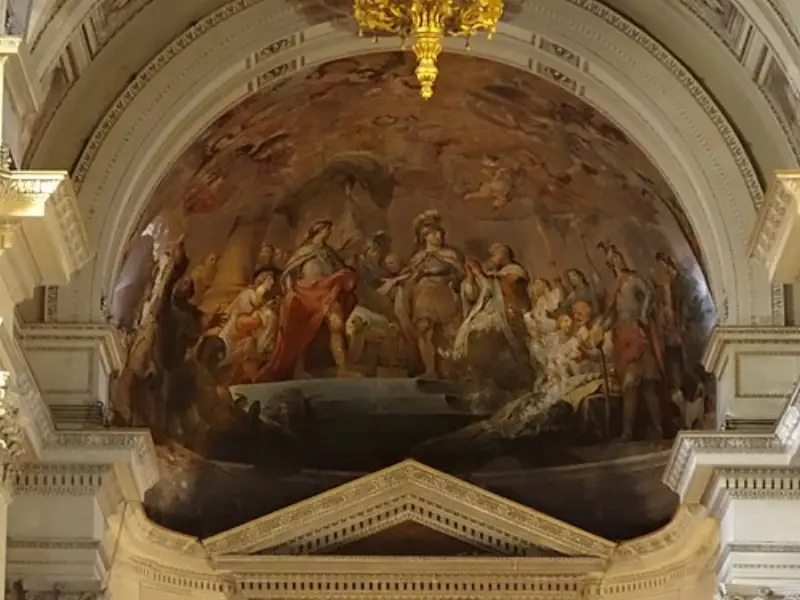
Overview
Nicodemus served as bishop of Palermo in the eleventh century, when Sicily lay under Muslim dominion and its Christian population lived as a subject people. The island's church was Byzantine in rite and obedience, belonging to the Patriarchate of Constantinople, and in Palermo alone some twenty Orthodox churches still served a community that, though heavily taxed and subordinate, was generally permitted to keep its faith and its professions. Nicodemus was raised to the episcopate in 1065, with his seat at the Byzantine church of Santa Domenica Kuriacia in Monreale. His episcopate witnessed the collapse of Muslim power in the island's capital: in 1072 he welcomed the Norman count Roger I into Palermo, was confirmed in his office by Pope Alexander II, and saw the ancient church of Saint Mary, which had served as a mosque for some two hundred and forty years, restored to Christian worship with a solemn Divine Liturgy at his hands. The new Latin masters of the city, however, preferred a bishop of their own rite, and Nicodemus was moved to dwell outside the walls in the district now called Mezzomonreale. He died in 1083, and his remains were laid to rest in a stone coffin within the undercroft of Palermo's Norman cathedral.
The Complete Life
A Bishop for a Church in Bondage
When Nicodemus took up the government of the see of Palermo, the Christians of Sicily had lived for more than two centuries under Muslim rule, which had begun on the island around 827. As Jews and Christians within an Islamic state, they bore the burden of subjugation and heavy taxation, yet in most cases they were suffered to practice their religion and follow their professions. The church they kept alive was Byzantine in rite, tied to the Patriarchate of Constantinople rather than to Rome, and it flourished within limits: Palermo alone could count twenty Orthodox churches serving its faithful. Into this world Nicodemus was ordained bishop in 1065. His seat was the Byzantine church of Santa Domenica Kuriacia at Monreale, near the capital, and from there he led a community that worshipped in Greek, kept the traditions of the East, and endured its minority position with quiet perseverance. His appointment fell in the last generation of Muslim dominance, and he would prove to be the bishop who received the island's Christian life back into the daylight.
§ History
Liberation and Reconsecration
In 1072 the fortune of Palermo turned. The Norman count Roger I of Sicily entered the city, ending Muslim rule over the Sicilian capital, and it fell to Bishop Nicodemus to mark the moment in Christian terms. He celebrated the conqueror's entry with solemn thanksgiving, and his authority over the see was confirmed by Pope Alexander II, a recognition that linked the old Byzantine church of the island to the papacy at the very hour of the Norman conquest. The climax of the year was the recovery of the city's most ancient shrine. The old church of Saint Mary, which the faithful had lost and which had served the other religion for roughly two hundred and forty years, was returned to divine service and consecrated anew. Within its walls Nicodemus himself offered the Divine Liturgy, restoring to the heart of Palermo the sacrifice that had been silenced for the span of living memory. For a pastor who had spent his episcopate under the dominion of another faith, the sight of the ancient altar burning again must have been the crowning work of his ministry.
§ History
Displacement and Death
The triumph of 1072 did not secure Nicodemus's position. Once the new rulers had established their hold on Palermo, their preference became plain: they wanted a bishop of the Latin rite, not a prelate of the Greek church that had served the island under the old order. Out of fidelity to the Eastern Orthodox communion in which he had been raised and consecrated, Nicodemus would not conform, and for that fidelity he was sent away from his own city. He went to live beyond the walls, in the district southwest of Palermo that is now called Mezzomonreale, a bishop displaced from his cathedral in the land he had served. He died in 1083, a dozen years after the liberation he had celebrated. He was entombed in a carved stone coffin in the undercroft of the great Norman church of Palermo, and there he lies still. The church that pushed him aside thus became his lasting resting place, and the Greek bishop who would not change his rite sleeps beneath the pavement of the city that preferred another.
§ History
A Forgotten Saint Remembered
For centuries Nicodemus remained one of Sicily's neglected figures, a saint remembered in the Orthodox tradition he refused to abandon rather than in the Latin island where he labored. His memory found fresh honor in modern times. On 5 May 2002 his successor in the see, Archbishop Lorenzo, Metropolitan of the Ukrainian Autocephalous Orthodox Church Abroad and Archbishop of Palermo and All Italy, instituted the Cross of Merit of Saint Nicodemus, Orthodox Bishop of Palermo. The decoration honors those who serve the church in Palermo or come to its aid as benefactors, and it is bestowed as a cross of merit through the Knights of the Most Holy Trinity, a confraternity whose Grand Master is Archbishop Lorenzo himself. Through this award the name of the displaced Greek bishop has been joined again to the life of the city that once set him outside its walls, and his example of fidelity to rite and conscience, kept even at the cost of his see, has become a standard for those who serve the church of Palermo today.
§ History
Timeline
- 1065
Appointed bishop of Palermo, seated at the Byzantine church of Santa Domenica Kuriacia in Monreale.
§ History
- 1072
Welcomed Roger I's entry into Palermo, was confirmed by Pope Alexander II, and reconsecrated the church of Saint Mary.
§ History
- 1083
Died after being sent to live outside the city at Mezzomonreale; buried in Palermo Cathedral.
§ History
- 5 May 2002
The Cross of Merit of Saint Nicodemus was instituted in his honor by Archbishop Lorenzo of Palermo.
§ History
The Record
- Canonization
- Pre-congregation; venerated by the Eastern Orthodox Church
Prayer
Bibliography
Show 3 sources
- Salerno, Vincenzo. "Nicodemus, Sicily's Forgotten Saint". Best of Sicily Magazine, 2002.
- "Cross of Merit of Saint Nicodemus Bishop of Palermo". Ukrainian Orthodox Church, Archdiocese of Palermo and All Italy.
- Birk, Joshua C. Norman Kings of Sicily and the Rise of the Anti-Islamic Critique. Springer, 2017, p. 240. ISBN 9783319470429.
Profile text adapted from the Wikipedia article, licensed CC BY-SA 4.0.
Pray with this saint every day
Save St. Nicodemus of Palermo to your favorites, read the full profile, and get feast-day reminders in the Saints app.
Get the Saints AppFree on the App Store for iPhone and iPad