
1749 – 1809·Feast July 14
St. Nicodemus the Hagiorite
Athonite ascetic and compiler of the Philokalia
Overview
Nicodemus the Hagiorite, born Nicholas on Naxos in 1749, was an ascetic monk, mystic, and theologian of the Greek East, honored among the saints of the Orthodox Church. Turkish persecution interrupted his schooling and brought him back to Naxos in 1770, and a few years later his meeting with Macarius of Corinth set him on the path to monastic life. In 1775, at twenty-six, he arrived on Mount Athos, where he was tonsured and given the name Nicodemus. He aligned himself with the Kollyvades, the monks laboring to restore Orthodox tradition and the literature of the fathers, and devoted the rest of his life to translating, compiling, and publishing that inheritance while writing original works of his own. He is best known for compiling the Philokalia with Macarius of Corinth, the canonical collection the Pedalion with Agapios Monachos, and the Evergetinos with Macarius, alongside the influential Handbook of Spiritual Counsel. His ascetic prayer literature helped restore hesychasm, the Byzantine way of contemplative prayer, to the heart of Orthodox life. Raised to the Great Schema, he died on the Holy Mountain on July 14, 1809, and was canonized in 1955.
The Complete Life
A Naxian Childhood Under Ottoman Rule
The saint first bore the name Nicholas, given to him at his birth on the island of Naxos in 1749. The Cycladic island of his childhood belonged to the Greek lands then ruled by the Ottoman Turks, and the insecurity of that era shaped the opening of his life. His family sent him away for schooling, and for a time he pursued his studies with promise. That education was cut short when persecution from the Turks fell upon the Greek world, and in 1770, still a young man, he made his way back to Naxos. The interruption might have ended his formation altogether, yet the years on his native island proved decisive in another sense. Living again among his own people, he encountered the monastic ideal that would govern everything that followed, and the learning he had already gathered was not lost but slowly redirected toward sacred ends. The boy who had left the island to study returned to it prepared, though he could not yet have known it, for a life of translation, compilation, and authorship that would mark Orthodox spirituality for generations to come.
§ Early life and education
From Naxos to the Holy Mountain
A few years after his return home, Nicholas met Macarius of Corinth, and the acquaintance ripened into a lifelong friendship that would bear extraordinary literary fruit. Around the same time he came to know three monks from Mount Athos, Gregory, Niphon, and Arsenios, and their example moved him to embrace the monastic state. The Holy Mountain had already served as a great center of monasticism for more than seven hundred years, and the three visitors persuaded the young islander to follow them there. He arrived at Athos in 1775, twenty-six years old. When he received the tonsure, his baptismal name was changed, as custom required of those who had abandoned the world, and he became Nicodemus. His elders initiated him into hesychia, the discipline of prayer built upon inner stillness, controlled breathing, and ceaseless repetition of the Jesus Prayer. He attached himself to the Kollyvades, the monks laboring to renew Orthodox tradition and the patristic inheritance, and he gave the remainder of his days to translating and publishing those works while composing many original books. In time he attained the megaloskhemos, the Great Schema, the highest degree attainable by an Orthodox monk.
§ Monastic life
Compiler of the Church's Inheritance
The achievement for which Nicodemus is most remembered came through collaboration. With Macarius of Corinth he compiled the Philokalia, the anthology of monastic spiritual writings that reawakened the Christian East to its own contemplative tradition. With the same Macarius he was responsible for the compilation and publication of the Evergetinos, a vast companion collection drawing on the wisdom of the ascetic masters. A third monument was the Pedalion, known in English as The Rudder, a compilation of canon law he co-wrote with the hieromonk Agapios Monachos. Beyond these works he moved through the libraries of Mount Athos, collecting, assembling, and editing manuscripts that had lain scattered among its monasteries. Among his own compositions the most celebrated is the Enchiridion of Counsels, a handbook of spiritual counsel composed at the urging of his cousin Hierotheos, newly raised to the see of Euripos. Addressed to clergy and laity alike, it has been praised as a work of theological ethics uniting psychological penetration with a rigorous, scientific habit of mind, and it keeps its hold on Greek spirituality to this day. He also knew the Western spiritual writers, publishing reworked versions of Ignatius of Loyola's Spiritual Exercises and Lorenzo Scupoli's Spiritual Combat.
§ Major works
The Rediscovery of Hesychasm
At the heart of Nicodemus's spiritual vision stood hesychasm, the method of contemplative prayer handed down from the Byzantine period, which his writing and editing did so much to restore. The discipline he practiced and commended involved inner stillness, the measured control of breathing, and the unbroken repetition of the Jesus Prayer, that shortest and most searching of pleas for mercy. Through this simple, demanding practice the monk turned inward, gathering the mind into the heart and standing before God in attention and contrition. Nicodemus did not treat such prayer as the possession of specialists alone; the books he compiled and translated were meant to carry the ascetic tradition into the hands of any serious Christian. His ascetic prayer literature circulated the inheritance of the desert and the great Byzantine masters to a Greek world that had largely lost contact with it, and his alignment with the Kollyvades placed him squarely within the movement for liturgical and patristic renewal. The elevation to the Great Schema confirmed a life wholly given to this work of inner transformation, pursued quietly on the Holy Mountain until his death in 1809.
§ Monastic life
Enrollment Among the Saints
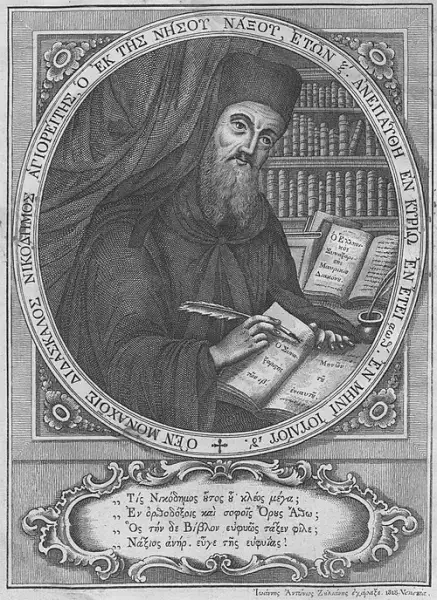
The Church confirmed what the monasteries had long believed when the Ecumenical Patriarchate of Constantinople canonized Nicodemus on May 31, 1955, more than a century and a quarter after his death. His principal shrine is Mount Athos itself, the Holy Mountain where he labored, and the Church of the Naxian Saints on his native Naxos honors him alongside the other saints of that island. His feast falls on July 14, the anniversary of his repose in 1809, and the faithful of Paros and Naxos keep his memory in common on the first Sunday of September. The standard iconography derives from the image printed in the Great Synaxarion published in Venice in 1819, little more than a decade after his death: an elder with a long white beard, clothed in the monastic garb of the Holy Mountain, shown writing on a scroll or bent over a book. It is a fitting portrait, for Nicodemus presented himself to the Church chiefly as a writer, one whose pen gathered the wisdom of the fathers and placed it, carefully ordered, into the hands of ordinary believers.
§ Monastic life
A Revival That Never Ended
Nicodemus described his life's work as the restoration of Christian practice and of the literature of the fathers, and time has vindicated the claim. The Philokalia he compiled with Macarius of Corinth became the single most influential collection of Eastern Christian ascetic writing, guiding generations of monks and laypeople into the practice of watchful, interior prayer and shaping the modern rediscovery of hesychasm. The Pedalion gave the Orthodox world a working synthesis of its canonical tradition, while the Evergetinos preserved the moral teaching of the desert in an accessible compilation. His Handbook of Spiritual Counsel, composed for clergy and laity together, remains a living text of Greek spirituality, prized as a work of theological ethics that unites psychological penetration with disciplined clarity of thought. Even his reworkings of Western classics by Ignatius of Loyola and Lorenzo Scupoli testify to a mind confident enough to borrow freely across confessional lines for the good of souls. His canonization in 1955 set the Church's seal upon this achievement, and the ongoing circulation of his books in Greek and in translation has carried the Athonite revival he served far beyond the peninsula where it began.
§ Major works
Timeline
- 1749
Born on the island of Naxos and given the name Nicholas.
§ Early life and education
- 1770
Turkish persecution cut his schooling short, and he returned home to Naxos.
§ Early life and education
- 1775
Arrived on Mount Athos at age twenty-six to embrace the monastic life.
§ Monastic life
- 14 Jul 1809
Died on Mount Athos at the age of sixty.
§ Monastic life
- 31 May 1955
Canonized by the Patriarchate of Constantinople.
§ Monastic life
The Record
- Major works
- The Philokalia, compiled with Macarius of Corinth·The Pedalion (The Rudder), compiled with Agapios Monachos·The Evergetinos, compiled and published with Macarius of Corinth·Enchiridion of Counsels (Handbook of Spiritual Counsel)·Reworked version of the Spiritual Exercises of Ignatius of Loyola·Reworked version of The Spiritual Combat of Lorenzo Scupoli
- Symbols
- long white beard·monastic garb·writing on a scroll or in a book
- Canonization
- Canonized May 31, 1955 by the Patriarchate of Constantinople
Prayer
Bibliography
Show 5 sources
- Gerasimos Micragiannanitis, 'The Life of Saint Nikodemos', in Constantine Cavarnos, St. Nicodemos the Hagiorite (Belmont, Massachusetts: The Institute for Byzantine and Modern Greek Studies, 1974), 66-70
- George S. Bebis, in Nicodemos of the Holy Mountain Handbook of Spiritual Counsel, trans. Peter A Chamberas, New York: Paulist Press, 1989
- Gregory Palamas, The Triads, trans. Nicholas Gendle (New York: The Paulist Press, 1983), 41-55
- Donald Attwater, review of Unseen Warfare, being the Spiritual Combat and Path to Paradise of Lorenzo Scupoli by Nicodemus of the Holy Mountain, Theophan the Recluse, E. Kadloubovsky, G. E. H. Palmer, H. A. Hodges, Life of the Spirit (1946-1964), vol. 7, no. 73, 1952, pp. 32-34. JSTOR, accessed 29 December 2023
- Meyendorff, St Gregory Palamas and Orthodox Spirituality, 138
Profile text adapted from the Wikipedia article, licensed CC BY-SA 4.0.
Pray with this saint every day
Save St. Nicodemus the Hagiorite to your favorites, read the full profile, and get feast-day reminders in the Saints app.
Get the Saints AppFree on the App Store for iPhone and iPad