
1650 – 1709·Feast February 2
St. Nicola Saggio
Humble Minim oblate of Longobardi and Rome
Overview
Nicola Saggio was an Italian Roman Catholic professed oblate of the Order of Minims, born at Longobardi on the sixth of January 1650, in a small town on the Calabrian shore of the Tyrrhenian Sea. Baptized Giovanni Battista Clemente, he was the first of five children of Fulvio Saggio, a farmer, and his wife Aurelia. Too poor to fund his studies, his parents set him to work in the fields, but a visit to the convent of the Minims awakened in him the desire for religious life. Against their opposition he joined the Franciscan Minims at the monastery of Paola, taking the name Nicolas. He held posts at San Marco Argentano, at Montalto, and at Cosenza before Paola summoned him back to serve the provincial as secretary; in 1681 his superiors dispatched him to the Roman house of San Francesco di Paola ai Monti, there to aid the parish priest and keep the door. A pilgrimage made on foot to Loreto in 1683, praying that Vienna be delivered from the Turkish army, marked a further deepening of his spirit. He returned to Longobardi in 1694 and died of pleurisy in Rome on February 3, 1709, aged fifty-nine. Canonized in 2014, he is the patron of Longobardi.
The Complete Life
A Farmer's Firstborn on the Calabrian Coast
The future religious was born on January 6, 1650, in Longobardi, a small town set on the Tyrrhenian coast of Calabria in southern Italy. His parents, Fulvio Saggio, a farmer, and Aurelia Saggio, born Pizzini, had him baptized just four days later, on January 10, bestowing the name Giovanni Battista Clemente. He was the first of five children in a household without means, and his parents, unable to pay for formal studies, raised him instead with high moral and spiritual values and set him to labor in the fields. The education poverty denied him was supplied, in its own fashion, by the rhythms of rural work and by the faith his mother and father practiced and passed on. As a boy he learned the discipline of early rising, physical toil, and simple obedience that would later serve a life of religious humility. A single experience, however, redirected everything: his visit to the convent of the Minims, the austere order founded by Francis of Paola, planted in the young field worker the conviction that the religious life was to be his path, whatever obstacles stood in the way.
§ Life
Against His Parents' Wishes, to Paola
The desire born at the convent of the Minims met immediate resistance at home. Fulvio and Aurelia opposed their son's plan, as many farming parents would, for the family needed its eldest son's labor and had counted on him for the future. Giovanni Battista held firm, and in time his resolve prevailed: he left Longobardi and joined the Franciscan Minims at the monastery of Paola, the cradle of the order, where he took the name Nicolas. The novice who had worked the fields of Calabria now embraced the Minims' strict way of penance and humility. His superiors soon found uses for his steadiness. He was sent to serve at San Marco Argentano, at Montalto, and at Cosenza, moving among the houses of the order across the region before being recalled to Paola to act as secretary to the provincial, an office of trust and administration for a brother of such modest formation. The years of obedience in these varied posts formed the pattern of his religious life: readiness to go where he was sent, competence without self-assertion, and a quiet fidelity that commended him to superiors and brothers alike.
§ Life
Porter of a Roman House and Pilgrim to Loreto
In 1681 obedience carried Nicolas far north, to Rome, where he was assigned to San Francesco di Paola ai Monti to assist the parish priest and to serve as doorkeeper of the house. The porter's post, seemingly small, placed him at the meeting point of the convent and the city: at that door passed the poor who sought help, the sick who sought comfort, and the curious who sought the saintly brother they had begun to hear about. He kept the office with patient charity for years. A further change in his spiritual life came in 1683, when he undertook a pilgrimage on foot to Loreto, the Marian shrine in the Marche, to entreat the Mother of God, through her intercession, on behalf of a Vienna hard-pressed by the Ottoman invaders. The city on the Danube stood at that moment under Turkish siege, and Christians across Italy prayed and marched in solidarity with its defense. For the humble Calabrian the journey became an act of intercessory faith, joining his own steps to the fate of Christendom. In 1694 he returned to Longobardi, the hometown he had left decades before as a disputed novice.
§ Life
Last Days in Rome
The final chapter of Nicolas's life unfolded in Rome, in the house of San Francesco di Paola ai Monti where he had spent so many of his active years. Age and labor had worn the former field worker and long-serving porter, and in the winter of his fifty-ninth year pleurisy took hold of him, the inflammation of the lungs bringing a painful close to a life of unbroken service. He died in the city on February 3, 1709, having spent the better part of three decades in the Minims' Roman house. His body found its rest in the same church that had framed his Roman life: his relics remain in the Church of San Francesco di Paola ai Monti to this day, where the community he served in life continues to venerate him in death. For the town of Longobardi, the death of their native son in the Eternal City did not end his story but began its second phase, as devotion to the holy Minim spread from the door of a Roman convent back to the fields and families of the Calabrian coast that had given him to the Church.
§ Life
From Venerable to the Altars of the Universal Church
The cause of the humble porter advanced by measured steps across more than two centuries. On March 17, 1771, Pope Clement XIV declared him Venerable, confirming a life of heroic virtue. After the approval of two miracles attributed to his intercession, Pope Pius VI personally presided over his beatification on September 17, 1786, in Saint Peter's Basilica, and the newly blessed was thereafter honored as patron of his native Longobardi. The miracle that would carry him to sainthood occurred far later, in 1938, when a mason of Longobardi fell from a scaffold without sustaining any injury. The diocesan investigation ran from May 24, 2008, to June 15, 2009; the Congregation for the Causes of Saints validated the process on March 11, 2011, and its consulting medical board approved the healing on December 13, 2012. Theologians gave their assent on November 28, 2013, and the Congregation followed on March 4, 2014. Pope Francis approved the miracle on April 3, 2014, and on November 23, 2014, canonized Nicola Saggio in Saint Peter's Square, with the Rev. Ottavio Laino serving as postulator of the cause.
§ Sainthood
Patron of Longobardi
Nearly a hundred years separate the death of Nicola Saggio in 1709 from his beatification in 1786, and more than two hundred from his canonization in 2014, yet the memory of the holy porter held firm at both ends of that span. In Rome, his relics enshrined in the Church of San Francesco di Paola ai Monti anchor a devotion tied to the house where he kept the door and assisted the parish priest. In Longobardi, his baptismal font survives as a tangible link to the January morning in 1650 when the farmer's firstborn was christened Giovanni Battista Clemente, and the town that opposed his leaving came to claim him proudly as its patron after the beatification. His feast is kept on February 2. The 1938 preservation of the local mason who fell from a scaffold gave the town a modern token of the intercession of its native son, and the long canonical process that ended in Saint Peter's Square in 2014 confirmed for the universal Church what Calabria had long held: that sanctity hides as readily in a porter's lodge as in a bishop's palace.
§ Sainthood
Timeline
- 6 Jan 1650
Born in Longobardi, a small town on the Tyrrhenian coast of Calabria.
§ Life
- 10 Jan 1650
Baptized with the name Giovanni Battista Clemente.
§ Life
- 1681
Sent to the Roman convent of San Francesco di Paola ai Monti to help the parish priest and keep the door.
§ Life
- 1683
Walked in pilgrimage to Loreto, imploring Vienna's deliverance from the Ottoman siege.
§ Life
- 1694
Returned to his hometown of Longobardi.
§ Life
- 3 Feb 1709
Died of pleurisy in Rome at the age of fifty-nine.
§ Life
- 17 Mar 1771
Declared Venerable when Pope Clement XIV confirmed his heroic virtue.
§ Sainthood
- 17 Sep 1786
Beatified by Pope Pius VI in Saint Peter's Basilica after the approval of two miracles.
§ Sainthood
- 1938
The third miracle for his canonization occurred, when a mason of Longobardi fell from a scaffold without injury.
§ Sainthood
- 24 May 2008
Diocesan investigation into the canonization miracle opened.
§ Sainthood
- 23 Nov 2014
Canonized by Pope Francis in Saint Peter's Square.
§ Sainthood
The Record
- Major works
- Service as secretary to the provincial at the monastery of Paola·Doorkeeper and assistant to the parish priest at San Francesco di Paola ai Monti, Rome
- Patron of
- patron of Longobardi
- Symbols
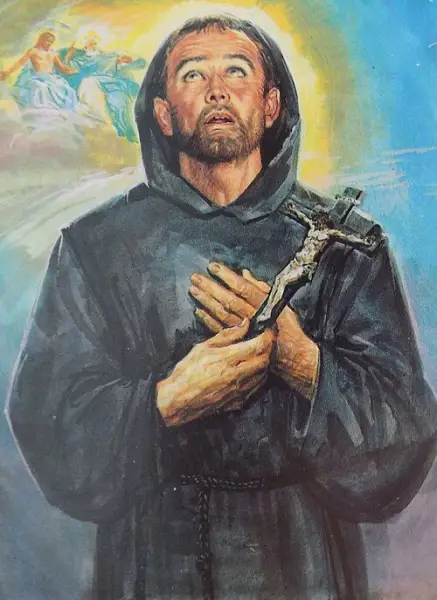
- crucifix·Minim habit
- Canonization
- Beatified September 17, 1786 by Pope Pius VI; canonized November 23, 2014 by Pope Francis in Saint Peter's Square
Prayer
Bibliography
Show 6 sources
- Announcement during the consistory of 12 June 2014
- Santi e Beati
- 'Saint Nicola Saggio de Longobardi', Nominis
- 'San Nicola Saggio da Longobardi', Calabria Portal
- P.A. Bellantonio, Nicola Saggio. Più in alto delle aquile, ed. Postulazione generale dei Minimi, 1986
- 'San Nicola Saggio', Longobardinfoto
Profile text adapted from the Wikipedia article, licensed CC BY-SA 4.0.
Pray with this saint every day
Save St. Nicola Saggio to your favorites, read the full profile, and get feast-day reminders in the Saints app.
Get the Saints AppFree on the App Store for iPhone and iPad