
6th century – c. 610·Feast September 30 (Wales), November 3 (Scotland)
St. Nidan
Welsh confessor of Penmon and founder of Llanidan
Overview
Nidan, sometimes called Midan or Idan, was a Welsh priest of the sixth and seventh centuries, remembered in some sources as a bishop. His birthplace and birth year are unknown, but manuscript tradition names Gwrfyw ab Pasgen ab Urien Rheged as his father, of the line of the celebrated northern warrior Urien Rheged. He served as confessor to the monastery headed by St Seiriol at Penmon, on the eastern tip of the island of Anglesey, and founded a church near the Menai Straits at what is now Llanidan, a foundation tradition dates to 616. He lived at Cadair Idan near the church, where a nearby well is honored as his holy well. Scottish tradition adds that he joined the company of 665 monks said to have traveled with St Kentigern from Llanelwy to Scotland, and that with the companion Finan he helped establish Christianity at Midmar in Aberdeenshire, where a church was dedicated to him. Some sources give his death as about 610, a date difficult to reconcile with the Llanidan foundation of 616. His feast is kept on September 30 in Wales and November 3 in Scotland.
The Complete Life
A Son of the Line of Urien
Little is known in detail about the beginnings of Nidan, and both the year and the place of his birth have been lost. He is sometimes referred to as Midan and sometimes as Idan, the variations typical of early Welsh saintly tradition. The manuscripts, however, preserve a claim to distinguished lineage. Peniarth MS 45, a fourteenth-century codex now in the National Library of Wales, names Gwrfyw ab Pasgen ab Urien Rheged as his father, and so traces his descent from Urien Rheged, the celebrated warrior of the late fifth century whose deeds the poet Taliesin commemorated. That northern royal line produced other holy figures as well: Saint Grwst of Llanrwst, whose town lies on the Welsh mainland to the south, in the present county borough of Conwy, shared that same descent. To be born a kinsman of warriors was, in the Welsh understanding, no barrier to the cloister; the same aristocratic kindred that furnished chieftains furnished also the confessors and founders who evangelized the island. Whatever the precise truth of the genealogy, the tradition marks Nidan as a man of the old British nobility who turned the inheritance of his house toward the service of the Church.
§ Life
Confessor of Penmon and Founder by the Straits
Nidan's recorded life belongs to Anglesey, the great monastic island of north Wales. He was associated with the monastery of St Seiriol at Penmon, on its eastern tip, where he served as the community's confessor, the spiritual father to whom the monks unburdened their consciences and sought direction; one source goes further and styles him a bishop. From Penmon he moved to found a church of his own at what is now Llanidan, close to the Menai Straits that separate Anglesey from the mainland. Tradition fixes the establishment of this church in 616. Near the foundation he lived at the place still called Cadair Idan, the chair of Nidan, and a spring some two hundred yards from the church has long been honored as his holy well. Such sites anchor a saint's memory in the landscape: the chair where he sat, the water he blessed, the church he raised. In the dense devotional geography of Anglesey, where nearly every parish preserves the name of one of the early saints, Nidan's corner of the island remains distinctly his, testimony to a ministry of spiritual direction and settlement in the seventh century.
§ Life
North with Kentigern to Midmar
The furthest reach of Nidan's story carries him out of Wales altogether. Tradition counts him among the band of 665 monks said to have journeyed with Kentigern, called Mungo as well and reckoned his kinsman, from Llanelwy in north Wales into Scotland. In that company, together with another companion of Kentigern named Finan or Ffinan, he is credited with helping to establish Christianity at Midmar, in what is now Aberdeenshire, during the seventh century. The mission left a permanent mark: a church at Midmar was dedicated to Nidan, and the Scottish calendar of saints keeps his memory there to this day. The tradition has not gone unchallenged. One author dismissed it flatly, judging that the whole idea of any connection between Nidan, Finan, and Kentigern lacks real foundation, and critics have noted that the supposed death date of about 610 cannot be reconciled with the reported foundation of Llanidan in 616. Even so, the persistence of the story in both Welsh and Scottish sources testifies to an early conviction that the faith of north Wales and that of northeast Scotland were bound together by missionaries such as this confessor of Penmon.
§ Life
Relics, Churches, and Two Feasts
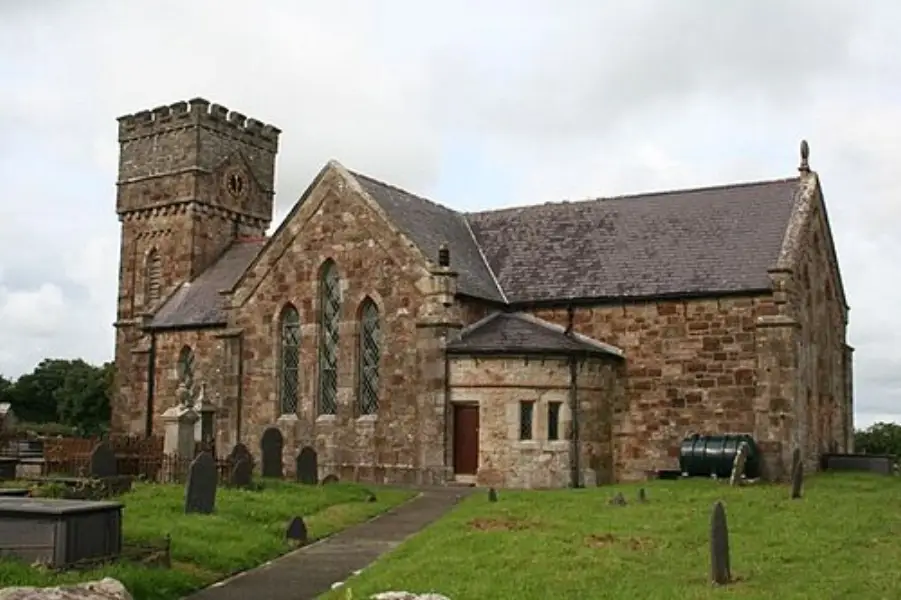
Nidan's memory endures most concretely in the churches and relics of two nations. On Anglesey, the Old Church of St Nidan at Llanidan served the faithful until the middle of the nineteenth century, when a new St Nidan's Church was built nearer the growing village of Brynsiencyn, partly because the old building needed repair and partly because the population needed a church; the medieval structure was then partially demolished. The new church preserves its most precious inheritance: a sandstone reliquary about twenty-six inches long, said to contain the saint's relics, its date uncertain between the fourteenth and sixteenth centuries. It had lain hidden, perhaps in some time of danger, until its discovery in 1700 beneath the altar of the older building. Midmar Old Kirk in Aberdeenshire keeps his dedication in Scotland, where he is also honored on November 3, while the Welsh calendar keeps September 30. As the historian Jane Cartwright observes, holiness in Wales was bestowed locally, and the medieval Welsh saints passed through no papal process of canonization; Nidan belongs wholly to that older, local world of veneration, honored where he preached and buried rather than by decree.
§ Commemoration
Timeline
- 610
According to some sources, died in about this year, though the date sits uneasily with the later Llanidan foundation.
§ Life
- 616
By tradition, established the church at Llanidan on Anglesey, near the Menai Straits.
§ Life
- 1700
The sandstone reliquary said to hold his relics was found buried beneath the altar of the old church at Llanidan.
§ Commemoration
The Record
- Major works
- Foundation of the church at Llanidan on Anglesey·Establishment of Christianity at Midmar in Aberdeenshire, alongside Finan
- Patron of
- St Nidan's Church and the Old Church of St Nidan at Llanidan in Anglesey·Midmar Old Kirk in Aberdeenshire
- Canonization
- Pre-congregation; venerated locally in Wales and Scotland, never formally canonized by a pope
Prayer
Bibliography
Show 6 sources
- St. Augustine's Abbey (Ramsgate, England) (1994). The book of saints (6th ed.). Cassell. p. 401. Midan (Nidan) (St) Sept 30 d. c.610
- Baring-Gould, Sabine; Fisher, John (1907). The lives of the British saints; the saints of Wales and Cornwall and such Irish saints as have dedications in Britain. Vol. 4. Honourable Society of Cymmrodorion. pp. 14-16
- Owen, Morfydd E. 'Welsh Triads: An Overview'. Celtica. 25. Dublin Institute for Advanced Studies: 225
- Barrett, Michael (1919). A calendar of Scottish saints. Fort Augustus: Abbey Press. p. 158
- Haslam, Richard; Orbach, Julian; Voelcker, Adam (2009). 'Anglesey'. The Buildings of Wales: Gwynedd. Yale University Press. p. 190. ISBN 978-0-300-14169-6
- Cartwright, Jane (Spring 2002). 'Dead virgins: feminine sanctity in medieval Wales'. Medium Aevum. 71 (1). The Society for the Study of Medieval Languages and Literature
Profile text adapted from the Wikipedia article, licensed CC BY-SA 4.0.
Pray with this saint every day
Save St. Nidan to your favorites, read the full profile, and get feast-day reminders in the Saints app.
Get the Saints AppFree on the App Store for iPhone and iPad