
before 1157 – 1180·Feast Unknown
St. Niels of Aarhus
Danish prince and ascetic builder of churches
Overview
Niels of Aarhus, called Niels the Holy in Danish, was a prince of the royal line who turned from the privileges of birth to a life of ascetic labor around the eastern Jutland town of Aarhus. Born Niels Knudsen before 1157, he was an illegitimate son of King Canute V and brother of Bishop Valdemar of Schleswig, and was probably named for his great-grandfather King Niels of Denmark. Tiring of court life while still young, he retired to Skibby, a village near Aarhus, and raised a church there by the labor of his own hands. His days were given to holiness and to aiding the folk of the countryside around the town. While felling trees with townspeople for another church at Viby by the sea, he answered a workman's thirst with prayer, and a spring appeared that has run ever since; Hellig Niels' Kilde, St. Niels's Spring, became a place of pilgrimage and reported healings for hundreds of years. Dying in 1180, he begged for a grave in the little seaside church of St. Clements, and there in its churchyard his body was laid. Aarhus Cathedral later rose nearby and became the center of his veneration.
The Complete Life
An Illegitimate Prince of the Danish Crown
The man whom Aarhus would come to call its holy one entered the world inside the highest circle of Danish society yet apart from its clearest privileges. Born Niels Knudsen before 1157, he was an illegitimate son of King Canute V, the monarch whose contested reign divided the kingdom in the mid-twelfth century. Through his father he was nephew to a royal house in turmoil and brother to Bishop Valdemar of Schleswig, a figure who would pursue a very different, and far more turbulent, ecclesiastical career. His name probably honored his great-grandfather, King Niels of Denmark, an earlier ruler of the line. What childhood at or near the court of Canute V was like the record does not say; what it does record is the effect. The prince grew up with rank, connections, and expectation surrounding him, and with the sharpest kind of security hanging over such positions in a century of Danish succession wars. That he would later abandon court life altogether cannot be separated from this background: the boy who knew exactly what the crown could give was also positioned to know exactly how little it could finally promise.
§ Biography
From the Court to Skibby
Still young, Niels tired of the court and its life and abandoned it, a renunciation that set the course of the rest of his days. He settled at Skibby, a village near Aarhus set by the lake west of the town, and there began the work that fixed his memory in the landscape: a church raised by his own labor. For a prince of the blood to take up the craftsman's task personally, rather than commission it, marked the withdrawal as something more than aristocratic retirement; it was an embrace of labor and humility. At Skibby he lived what the tradition calls a saintly life, helping the people of the district around Aarhus with the quiet availability that later centuries would remember more clearly than any documented deed. The pattern is a familiar one in northern hagiography, the nobleman who trades the court for a modest settlement and makes himself neighbor and servant to a rural community. In Niels's case the choice proved permanent: he never returned to royal life, and the churches he raised around Aarhus became the setting of everything the region would later tell about him.
§ Biography
The Spring at Viby
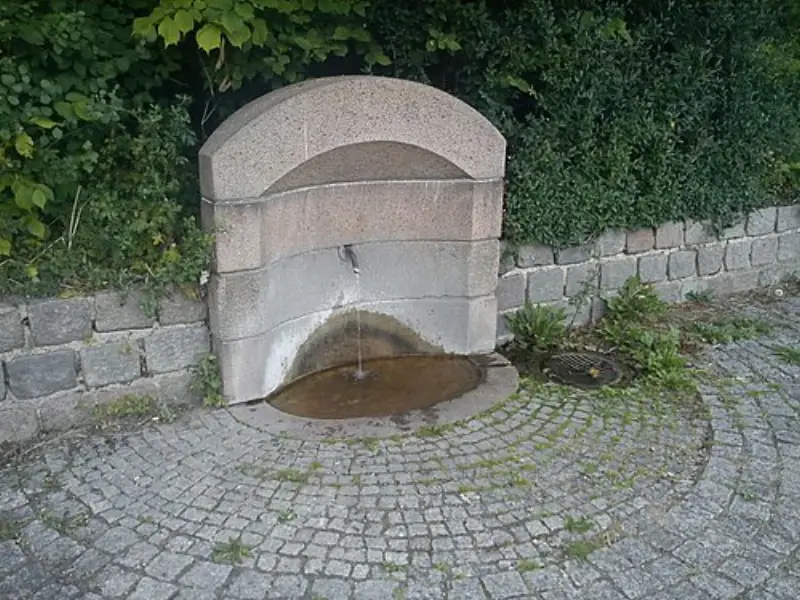
The story that Aarhus treasured above all others concerns a day's work and a drink of water. Niels had gone with several men of the town to fell trees for the building of another church, this one at Viby near the sea. Amid the labor one of the workers complained of thirst, and the prince answered the complaint not with provisions but with prayer. He prayed for water, and a spring burst forth to answer the man's thirst; it has flowed without pause ever since. The site became known as Hellig Niels' Kilde, St. Niels's Spring, and for hundreds of years it drew pilgrims to its banks, especially on St. John's Day, when crowds came in hope of the miraculous healings said to have taken place there. Whether the account is read as history or as the flowering of local devotion, it captured what the people of Aarhus believed their holy neighbor to be: a man through whom God answered ordinary need. The spring bound his name to the land itself, and it remains the single best-known element of his cult, a gift of water at the center of a building project for the Church.
§ Biography
Burial by the Sea and a Cathedral Rising
Niels died in 1180, not long after the years of his building work, and the manner of his burial was chosen by his own dying request. On his deathbed he begged to rest in the small church standing by the sea, St. Clements, and the churchyard received his body. The spot proved providential for the town. Aarhus Cathedral was later erected near that site, and the great church grew into the focal point of the townspeople's reverence for the princely saint, whom they also called St. Nickolas. The movement from a village churchyard grave to a cathedral shrine traces the growth of a cult in real time: the people who had known the builder at Skibby and the spring at Viby kept his memory alive, their devotion gathered momentum, and the Church's principal building in Aarhus rose beside the grave of the man they reckoned a saint. No formal canonization ever followed, yet the reverence proved durable, lasting in Aarhus until the eighteenth century, five hundred years after the prince had asked, with his final breath, for a grave by the sea.
§ Biography
The Record
- Major works
- Church built with his own hands at Skibby near Aarhus·Church begun at Viby near the sea
- Canonization
- Pre-congregation; never canonized, revered as a saint in Aarhus until the 18th century
Prayer
Bibliography
Show 3 sources
- 'Den hellige Niels av Århus (~1150-1180)'. Den katolske kirke. Retrieved January 1, 2019
- 'Skt. Nicolaus' kilde - Hellig Niels' kilde ved Strandvejen'. Aarhuswiki. Retrieved January 1, 2019
- Carl Frederik Bricka (1887-1905): Niels (Hellig Niels) Dansk Biografisk Leksikon (p. 202), Vol. XII
Profile text adapted from the Wikipedia article, licensed CC BY-SA 4.0.
Pray with this saint every day
Save St. Niels of Aarhus to your favorites, read the full profile, and get feast-day reminders in the Saints app.
Get the Saints AppFree on the App Store for iPhone and iPad