
c. 758 – 828·Feast March 13 and June 2
St. Nikephoros I of Constantinople
Patriarch, iconodule confessor, and historian
Overview
Nikephoros I, born in Constantinople around 758, was a Byzantine writer and Ecumenical Patriarch of Constantinople from April 12, 806 to March 13, 815. Son of the imperial secretary Theodore and his wife Eudokia, he inherited the iconodule convictions of a family that had suffered under the first wave of Iconoclasm, his father having been scourged and banished to Nicaea for supporting the venerators of images. Brought to court while young, he became an imperial secretary and served as commissioner at the Second Council of Nicaea in 787 before withdrawing to a cloister he had founded on the Thracian Bosporus to pursue asceticism and study. Around 802 he returned to public life as director of Constantinople's largest hospital for the destitute, and in 806, though still a layman, he was chosen patriarch at the emperor's wish, an uncanonical election that provoked the opposition of the Stoudites. Deposed by Leo V the Armenian after refusing the iconoclast turn of 815, he spent his final years in the monasteries he had founded, writing in defense of the holy images. He died on April 5, 828, revered as a confessor, and his remains were returned in triumph to Constantinople in 847.
The Complete Life
Born Into the Iconoclast Storm
Nikephoros was born in Constantinople around 758, the son of Theodore and Eudokia, into a household marked by loyalty to the holy images at a time when such loyalty carried a price. His father served as one of the secretaries of Emperor Constantine V, the fierce iconoclast ruler, yet Theodore's zealous support of the Iconodules brought him scourging and banishment to Nicaea. The son inherited his father's religious convictions along with his administrative gifts. Still a boy, Nikephoros was presented at court; he took up a post as imperial secretary and gave his early years to the Empire's service, treading the same bureaucratic paths his father had trodden beneath the persecutor's patronage. The irony was not lost on the age: the sons of the persecuted often rose within the very apparatus that had broken their parents. For Nikephoros the court became a school of governance and discipline that would later serve the Church. In 787, under Empress Irene of Athens, he took part in the synod of Nicaea, the council that restored the veneration of icons, acting as imperial commissioner. The young official thus stood personally at the restoration of orthodoxy his family had suffered for, before his greatest trials were yet to come.
§ Life
From Court Service to Cloister and Hospital
After the council of 787 Nikephoros turned from imperial administration to the service of God, withdrawing to a cloister of his own founding on the Thracian Bosporus. His days there belonged to ascetic discipline and to study, as he mastered the secular learning of the age in grammar, mathematics, and philosophy alongside the Scriptures. The combination would define him: a patriarch who wrote history and theology with the discipline of a trained civil servant. The retreat ended around 802 with a recall to the capital and an appointment to run the greatest of its hospitals for the destitute, an office that set the empire's most needy sick and poor under his daily care. The choice of such a man for such a post suggests both competence and compassion in equal measure. Then came the summons that transformed his life. When Patriarch Tarasios died, the clergy and court officials divided bitterly over a successor, and the emperor's wish fell on the capable layman who had governed the great hospital. At Easter, April 12, 806, Nikephoros was enthroned as Ecumenical Patriarch while still wearing no monastic habit, an uncanonical leap from the hospital to the patriarchate that the strictly clerical party of the Stoudites never forgave.
§ Life
A Patriarchate of Compromise and Collision
The patriarchate of Nikephoros opened under a shadow. The irregular manner of his election antagonized the Stoudites, and the dispute hardened into open breach when he, unbending in morals on every other score, bent to the emperor's wish by restoring to communion the priest Joseph, whom censure had shut out. Yet the crisis that would define his life came from another quarter. After vain theological disputes, December 814 brought personal insults, as the iconoclast party around Leo V the Armenian gathered strength. Nikephoros at first answered his impending removal by excommunicating its architects, but under Leo's pressure he was obliged to yield to force. Stripped of his office on March 13, 815, he was taken first to Tou Agathou, one of the cloisters he himself had founded, and later to that called Tou Hagiou Theodorou. From monastic confinement the deposed patriarch waged a written campaign on behalf of the iconodules against the iconoclast council of 815, supplying the theological resistance that the persecuted Church needed. On the change of emperors in 820 his name was put forward again for the patriarchate, and he obtained at least a promise of toleration, though not restoration.
§ Life
Confessor in Exile
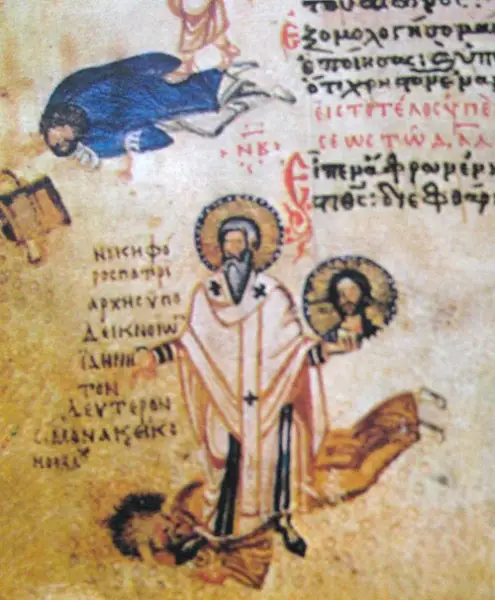
The last years of Nikephoros belonged to the monasteries rather than the palace. He died at the monastery of Saint Theodore on April 5, 828, revered as a confessor, the title the Church gives to those who suffer for the faith without shedding their blood. He had held the highest office in Eastern Christendom and lost it for refusing to surrender the images of Christ and his saints, and he ended his days as a monk in houses his own foundations had built. Death in such circumstances was itself a testimony. Within a generation the iconoclast controversy was settled definitively in favor of the venerators, and the confessor-patriarch received posthumous honors. His relics returned in solemn procession to the capital under Patriarch Methodios I on March 13, 847, and were laid in the Church of the Holy Apostles, the resting place of emperors, where the court paid them yearly homage. Greeks and Romans alike keep his feast on that day of that translation, March 13, while the Greeks also observe June 2 as the anniversary of his death. The miniature in the Chludov Psalter, showing him trampling the iconoclast John VII, preserves the polemical energy of his memory in art.
§ Life
Feasts of a Confessor-Patriarch
The veneration of Nikephoros took shape around the two dates the Church fixed in his memory: the return of his relics to Constantinople on March 13, 847, and his death on June 2, 828. Both Eastern and Western traditions honor him, a rare double recognition for a Byzantine patriarch of the iconoclast age. The Orthodox Church counts him among the saintly hierarchs of Constantinople, and the Catholic Church likewise keeps his feast, fruits of his standing as a defender of the faith under persecution rather than of any formal canonical process in the modern sense. In the Byzantine imagination he stands with Tarasios, his predecessor, and Methodios, who translated his bones home, as the patriarchal line that carried the Church through the second iconoclasm. His cult has always been attached to particular places and objects of devotion: the Church of the Holy Apostles where the emperors honored him yearly, the monasteries of the Bosporus that sheltered his exile, and the Psalter illustrations in which artists pictured the orthodox prelate triumphing over his iconoclast rival. As a confessor who died in peace, he models a sanctity of endurance, the fidelity of a bishop who outlasted the emperors who deposed him.
§ Life
Historian and Theologian of the Images
Nikephoros left a double legacy, as historian and as theologian of the icon. His Historia syntomos, a brief history treating the years from 602 to 769, earned praise for its non-partisan treatment, drawing on the chronicle of Trajan the Patrician without naming it, so as to connect himself with the tradition of Theophylact Simocatta; its theme is the tension between the offices of emperor and patriarch, and in it he defended the patriarchate by criticizing iconoclast prelates for submitting to the emperor rather than for their doctrine of images. His tables of universal history, the Chronography, running from Adam and Eve to his own day, enjoyed wide favor among the Byzantines and circulated abroad in the Latin version of Anastasius Bibliothecarius and in Slavonic translation; to it he appended a canon catalog and the Stichometry of Nicephorus, counting the lines of each scriptural book, a tool still useful for judging apocrypha preserved only in fragments. His three great iconophile works, the Apologeticus minor, the Apologeticus major with its three Antirrhetici, and the refutation of the synod of 815, form a complete dogmatics of the veneration of images. Following John of Damascus, his merit lies in thoroughness and in the serviceable knowledge of his opponents' texts.
§ Works
Timeline
- 758
Born in Constantinople to Theodore and Eudokia, into a family that suffered under the earlier Iconoclasm.
§ Life
- 787
Served as imperial commissioner at the synod of Nicaea under Empress Irene of Athens.
§ Life
- 802
Called back from monastic retirement to head the greatest of Constantinople's hospitals for the destitute.
§ Life
- 12 Apr 806
Chosen Ecumenical Patriarch of Constantinople at Easter, though still a layman.
§ Life
- 13 Mar 815
Removed from the patriarchal office under Emperor Leo V the Armenian and confined to monasteries he had founded.
§ Life
- 815
Carried on a literary polemic for the iconodules against the iconoclast synod of that year.
§ Life
- 820
Nominated once more for the patriarchal throne as emperors changed, winning at least a pledge of toleration.
§ Life
- 5 Apr 828
Died at the monastery of Saint Theodore, revered as a confessor.
§ Life
- 13 Mar 847
Bones escorted in honor back to the capital under Methodios I and laid to rest in the Church of the Holy Apostles.
§ Life
The Record
- Major works
- Historia syntomos (Short History, or Breviarium)·Chronography (Chronographikon Syntomon), with the Stichometry of Nicephorus·Apologeticus minor·Apologeticus major with the three Antirrhetici against Constantine Kopronymos·Refutation of the iconoclast synod of 815
- Canonization
- Pre-congregation; revered as a confessor, venerated in the Eastern Orthodox and Catholic churches
Prayer
Bibliography
Show 6 sources
- Paul J. Alexander, The Patriarch Nicephorus of Constantinople, Oxford University Press, 1958
- Johann Peter Kirsch, 'St. Nicephorus', Catholic Encyclopedia, Vol. 11, New York, Robert Appleton Company, 1911
- Chisholm, Hugh, ed. (1911). 'Nicephorus Patriarcha'. Encyclopædia Britannica. Vol. 19 (11th ed.). Cambridge University Press. p. 648
- 'Martyrs and Confessors', Orthodox Church in America
- Treadgold, Warren (2011). 'Trajan the Patrician, Nicephorus, and Theophanes'. In Bibel, Byzanz, und christlicher Orient - Festschrift für Stephen Gerö zum 65. Geburtstag. Louven: Peeters Publishers. pp. 589-621
- Marjanović, Dragoljub (2018). Creating Memories in Late 8th-century Byzantium - The Short History of Nikephoros of Constantinople. Amsterdam: Amsterdam University Press. pp. 65-70
Profile text adapted from the Wikipedia article, licensed CC BY-SA 4.0.
Pray with this saint every day
Save St. Nikephoros I of Constantinople to your favorites, read the full profile, and get feast-day reminders in the Saints app.
Get the Saints AppFree on the App Store for iPhone and iPad