
c. 1750 – 1821·Feast May 1
St. Nikephoros of Chios
Chiote hieromonk and hymnographer of the saints
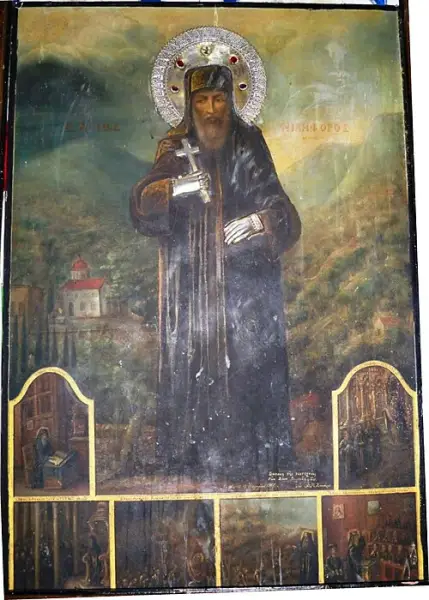
Overview
Nikephoros of Chios was a hieromonk of the Aegean island of Chios, born about 1750 at Kardamyla, a town on the island's northeastern side. As a child he fell gravely ill with a contagious disease, and his parents promised their son to the monastery of Nea Moni as a monk should he live. He recovered, received the tonsure, and studied at the famous Chiote school, where his mentors included Father Neophytos Kafsokalyvitis, Father Athanasius of Paros, and St Macarius of Corinth, the spiritual father who shaped him most deeply. Ordained and chosen to head Nea Moni, he stepped down short of two years in office, ill at ease with the estate's accounts amid the brotherhood's resistance. He left the monastery for the hermitage of Resta, where he lived while teaching and writing on Chios, an island dear to him both as native ground and as a home of devotion and learning. He compiled liturgical services and lives of the martyrs, and at Macarius's deathbed in 1805 undertook to complete and publish The New Leimonarion. He died in 1821, probably in summer, in the lodging by Saint Paraskeve's church; twelve months later Turkish violence laid waste to Chios. His relics rest in the Church of Saint George at Resta.
The Complete Life
A Vow Made Over a Sickbed
Nikephoros entered the world around 1750 in Kardamyla, a town in the northeastern part of Chios, the great Aegean island close to the Asia Minor coast. His path to the monastic life was marked out, according to the family tradition, by illness and a promise. In childhood a contagious sickness brought him near death, and his parents made a vow over his bed: should the boy live, he would belong to Nea Moni, the celebrated imperial foundation in the island's interior. The child recovered, and in due course the promise was honored: he became a monk. His gifts soon showed themselves, and he was sent to study at the famous Chiote school, an institution that made the island a center of Greek learning under Ottoman rule. There he came under the guidance of remarkable teachers, among them Father Neophytos Kafsokalyvitis, himself a convert Jew who became an Athonite monk and director of the Chiote school, and Father Athanasius of Paros. The boy from Kardamyla thus received both the ascetic formation his parents had vowed and the education that would later make him a writer of services and lives of saints.
§ Life
Abbot Who Stepped Aside
Nikephoros's monastic career advanced to its visible summit and then turned aside from it. He was ordained to the priesthood and elected abbot of Nea Moni, the monastery to which his very existence had been vowed as a child. Yet he did not complete his term: he resigned with less than two years served, ill at ease in managing the monastery's property and its spiritual affairs, where his decisions met the brotherhood's resistance. The resignation reads at first like failure, but the tradition records it without censure, as the act of a man who knew the shape of his own gifts. Administration was not his calling; teaching and writing were. Leaving the monastery, he settled at Resta, a hermitage where he lived for the rest of his life, though he would pass nights in a lodging by Saint Paraskeve's church when the road back proved too much. From that hermitage he taught and wrote on Chios, leading a life of spiritual endeavor while remaining within the island's confines throughout his days. Chios was dear to him as native ground and as an island where devotion and learning thrived alike, and no occasion ever arose to draw him from it.
§ Life
Teacher and Hymnographer of the Martyrs
The work that filled Nikephoros's mature years was the celebration of the saints, and especially of the modern martyrs of the Ottoman age, in liturgical poetry and narrative. He composed church services and hymns for Saints Niketas, John, and Joseph, whose feast falls on May 20, for Saint Matrona of Chios, remembered on October 20, and for the new martyr Nicholas the New, whose service, published in Venice in 1791, carried the witness of the Chiote martyrs into print. In the tradition of his Kollyvades-connected mentors, he understood that the memory of the martyrs feeds the courage of the faithful, and he gave that memory the form the Church prays: services, hymns, and lives. This labor reached its fulfillment through the trust of his teacher. Macarius of Corinth, who had the greatest influence on his life, summoned him in 1805 to his deathbed and asked him to finish The New Leimonarion and see that it was published. The volume gathers lives and liturgical services for martyrs, ascetics, and saints of every rank, and it had three collaborating authors: Macarius, Nikephoros, and Saint Athanasius Parios. The dying master's charge made the hermit of Resta the executor of one of the great hagiographic collections of modern Orthodoxy.
§ Bibliography
Death, Devastation, and the Uncovering of Relics
Nikephoros died, probably in the summer of 1821, in a home near the church of Saint Paraskeve in Chios town, where he sometimes stayed when unable to return to Resta. His body was carried to the hermitage and laid in a grave that already held sacred memories, for Saint Athanasius Parius and the monk Nilus had been buried there before him. The timing of his death spared him a sorrow his island could not escape: one year later the Turks devastated Chios, inflicting on the island the massacre and destruction that shattered its famed prosperity. The saint's memory survived the catastrophe. The grave was opened in 1845, and the relics were carried in honor to the metropolitan church of Chios, where the faithful could venerate them freely. Years later the tanners' guild petitioned for them, and they were enthroned in the Church of Saint George at Resta, the hermitage that had sheltered him, where they remain. In 1907, devotion took formal liturgical shape: a painted image of the saint appeared, and a liturgical service was written for his feast, completing the arc from a Kardamyla sickbed to the official song of the Church. His feast is kept on May 1.
§ Life
A Saint Recognized in His Own Lifetime
Unusually among the modern saints of the Greek Church, the holiness of his life and conduct was acknowledged while he still lived, and the circle of ascetics and scholars around him counted him a saint long before his death. No formal decree was needed; the recognition of the Church followed the recognition of those who knew him, and after his death his grave at Resta became the focus of veneration. The dates of his cult map its growth: the uncovering of his relics in 1845, a quarter century after his death, their enthronement in the metropolitan church and later at the Church of Saint George in Resta, and the composition of an icon and liturgical service in his honor in 1907, nearly ninety years after his repose. His feast on May 1 was fixed not by the date of his death, which fell in the summer, but by the Church's judgment, weaving him into the calendar beside the saints of the spring. He stands in the company of the renewed Athonite and Chiote spirituality of the late eighteenth century, alongside Macarius of Corinth and Athanasius Parios, the generation whose labors recovered the Philokalia, the Evergetinos, and the memory of the new martyrs for the Orthodox world.
§ Life
The Island That Kept His Memory
Nikephoros's legacy lives wherever the services he composed are sung and wherever the story of the Chiote church is told. He belonged to a remarkable generation: a disciple of Macarius of Corinth, whom he met before he met Saint Athanasius and saw frequently during Macarius's stays on Chios in 1780 and from 1790, and a collaborator of Athanasius Parios, director of the city school. From these men he absorbed the revival of patristic and liturgical learning that marked late Ottoman Orthodoxy, and he gave it a Chiote voice. The New Leimonarion, finished and published at Macarius's dying request, preserved the lives and services of martyrs, ascetics, and saints for the use of the faithful. His individual services kept the memory of Matrona of Chios, of Niketas, John, and Joseph, and of the new martyr Nicholas the New in print from 1791 onward. The island he refused to leave repaid him with devotion: his relics at the Church of Saint George in Resta, his icon and service from 1907, and his feast on May 1. When the Turks devastated Chios a year after his death, they could destroy its wealth but not the memory of its holy monk, which endures in the Church's song.
§ Relationships
Timeline
- 1750
Born at Kardamyla, a town on the northeastern side of the island of Chios.
§ Life
- 1780
St Macarius of Corinth, his chief spiritual influence, arrived at Chios.
§ Relationships
- 1790
Macarius of Corinth returned to Chios, renewing the saint's access to his teacher.
§ Relationships
- 1791
His church service and hymns to the new martyr Nicholas the New were published in Venice.
§ Bibliography
- 1805
The dying Macarius asked him to finish The New Leimonarion and see it published.
§ The New Leimonarion
- 1821
Died in the summer at a home near the church of Saint Paraskeve; his body was brought to the hermitage of Resta.
§ Life
- 1822
Chios was laid waste by Turkish violence a year after his repose.
§ Life
- 1845
Relics uncovered and translated with honor to the metropolitan church of Chios.
§ Life
- 1907
An icon of the saint was painted and a church service composed in his honor.
§ Life
The Record
- Major works
- Church service and hymns to Saints Niketas, John, and Joseph (May 20)·Church service and hymns to Saint Matrona of Chios (October 20)·Church service and hymns to the new martyr Saint Nicholas the New (October 31), published in Venice in 1791·The New Leimonarion, completed and published at the dying request of Macarius of Corinth
- Canonization
- Pre-congregation; regarded as a saint already during his lifetime, venerated in the Eastern Orthodox Church
Prayer
Bibliography
Show 2 sources
- Cavarnos, Constantine (1976), St. Nikephoros of Chios: Outstanding Writer of Liturgical Poetry and Lives of Saints, Educator, Spiritual Striver, and Trainer of Martyrs. Belmont, Massachusetts: Institute for Byzantine and Modern Greek Studies. (Modern Orthodox Saints, 4). ISBN 0-914744-33-X (2nd, augmented ed., 1986)
- 'Venerable Nikephoros of Chios', Orthodox Church in America (OCA)
Profile text adapted from the Wikipedia article, licensed CC BY-SA 4.0.
Pray with this saint every day
Save St. Nikephoros of Chios to your favorites, read the full profile, and get feast-day reminders in the Saints app.
Get the Saints AppFree on the App Store for iPhone and iPad