
1881 – 1956·Feast May 3
St. Nikolaj Velimirović
Bishop of Ohrid and Žiča, the new Chrysostom
Overview
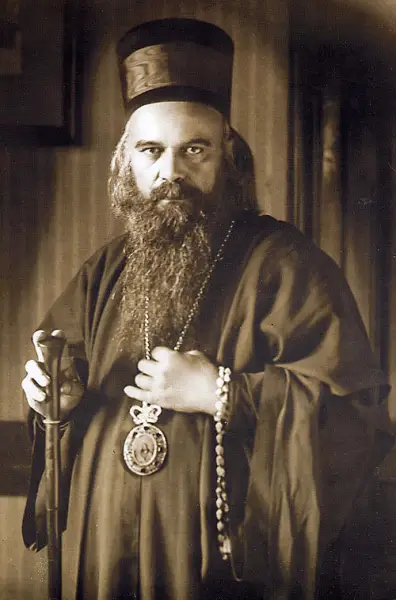
Nikolaj Velimirović was a Serbian Orthodox bishop, theologian, and celebrated preacher who led the dioceses of Žiča and Ohrid across the first half of the twentieth century. Born to farming parents in the village of Lelić, he trained at the Seminary of Saint Sava in Belgrade and earned doctorates in Switzerland before receiving monastic tonsure in 1909. Renowned as an orator — contemporaries called him the new John Chrysostom — he toured the United States and Britain during the First World War on Serbia's behalf and became one of the most influential bishops of his church. As Bishop of Ohrid he founded monasteries, composed devotional works such as The Prologue from Ohrid, and articulated a vision of national life rooted in the gospel of Saint Sava. The German occupation of Yugoslavia brought arrest in 1941 and, in 1944, imprisonment in the Dachau concentration camp. Released that winter, he never returned to communist Yugoslavia, spending his final decade teaching in American Orthodox seminaries until his death in 1956. The Serbian Orthodox Church glorified him as a saint in 2003. His writings and political associations remain debated, yet his homiletic and devotional corpus holds a central place in modern Serbian Orthodoxy.
The Complete Life
A Farmer's Son from Lelić
Nikola Velimirović was born on 4 January 1881 in the village of Lelić near Valjevo, in the Principality of Serbia, on the feast of Saint Naum of Ohrid — the saint whose monastery would one day serve as his episcopal see. He was the eldest of the nine children of Dragomir and Katarina Velimirović, devout farmers of the Valjevo region. Frail from birth, he was baptised without delay at the nearby monastery of Ćelije and received the name Nikola, after Saint Nicholas, the family's patron. His mother gave him his earliest instruction in God, in Christ, in the lives of the saints and in the feasts of the Church year, and she regularly brought him to Ćelije for prayer and Holy Communion. His schooling likewise began at the monastery and continued in Valjevo. Rejected by the Military Academy after failing a physical examination, he entered the Seminary of Saint Sava in Belgrade, where alongside the prescribed curriculum he read widely among Eastern and Western writers, from Shakespeare, Voltaire and Nietzsche to Marx, Pushkin, Tolstoy and Dostoevsky. He graduated in 1905, and such was the quality of his work that he was marked out for advanced study in Western Europe, where his gift for languages — he soon possessed a good command of Russian, French and German — served him well.
§ Childhood
The Monk Nikolaj
In the autumn of 1909, home again in Serbia, Nikolaj fell gravely ill with dysentery. Confronting the likelihood of death, he made a vow: should he recover, he would renounce the world and devote his life to God as a monk. His health returned, and at the close of 1909 he received monastic tonsure with the name Nikolaj. Ordination followed swiftly: he was made a hieromonk and soon afterwards elevated to the rank of archimandrite. Not long after his ordination he left Serbia once more, this time for the Theological Academy in Saint Petersburg. He travelled across Russia, visiting monasteries and other holy places and acquainting himself with Russian culture and religious life. Among the Russian writers he came to know, Fyodor Dostoyevsky made the deepest impression, and the philosophical strain of that author's meditations on faith, freedom and suffering helped shape the young monk's own theological outlook. These years of study and pilgrimage gave Nikolaj both a scholarly equipment and a lived acquaintance with Orthodox monasticism, and they prepared him for the public work of preaching and teaching that would soon make him a leading spokesman of his church. When the First World War engulfed Serbia, the archimandrite stood ready to be sent wherever his church and government required him.
§ Monastic life
Shepherd of Žiča and Ohrid
Consecrated Bishop of Žiča in 1919, Nikolaj soon moved to southern Yugoslavia, shepherding the Eparchy of Ohrid from 1920 to 1931 and then the united see of Ohrid and Bitola until 1936, when he resumed his original diocese of Žiča. In 1920 he crossed the Atlantic with the task of organising the Serbian Orthodox Diocese of North America, and he visited the United States again in 1927. Writing in The Times, he set before the British public the sufferings of the Serbian clergy under wartime occupation, recounting the massacre of priests in eastern Serbia, the deportation of younger clerics to forced road labour in Bulgaria, and the internment of several hundred priests by the Austrian authorities, many of whom succumbed to cold, hunger or the illnesses they carried home. He argued that scarcely any part of the Christian Church had given more of its lives and goods than the Church of Serbia, whose clergy had embodied the ideal of national liberation. In 1935 the German chancellor Adolf Hitler conferred a civil medal on him for his part in renovating the German military cemetery at Bitola. During the Concordate Crisis he stood among the chief opponents of the accord with Rome, helping organise the protest liturgy of 1937 and warning parliamentarians that the agreement would hand sweeping privileges to a foreign church power to the detriment of the national church of Saint Sava.
§ Bishop
The Nationalism of Saint Sava
One modern scholar has discerned three phases in Nikolaj's thought: a pre-Ohrid period to 1919, an Ohrid period from 1920 to 1936, and a post-Ohrid period lasting until his death. In a celebrated address of 1935 he set out what he called the nationalism of Saint Sava, a vision of Serbian Orthodox national life grounded not in blood or secular ideology but in the gospel. In his account it embraced the national church, dynasty, state, education, culture and defence, yet he insisted that it stood against racism and hatred, pointing to the welcome and equal treatment that Serbian people had extended to colonial African and Asian soldiers during the Great War. He named God, King and Home as the supreme triad of values for the Serbian people, and described this evangelical nationalism as a barrier to chauvinism and exclusivity, teaching that every nation on earth, whatever its blood, tongue or creed, belongs to God's own people and stands as brother to the rest. In the same years he criticised internationalism and fascism alike, the dominant political movements of Europe, the one as a negation of the nation, the other as the idolatry of one's own nation. Amfilohije Radović attributed part of his success to his high education, his command of European culture and his ability to write well; the critic Milan Bogdanović, by contrast, judged his post-Ohrid writing a restatement of Orthodox canon and dogma.
§ Nationalism of Saint Sava
Prisoner of Dachau, Exile in America
Arrested by the German occupation authorities in 1941 on suspicion of contributing to the resistance, Bishop Nikolaj was confined first at the monastery of Ljubostinja and then at Vojlovica near Pančevo, where he was held alongside Patriarch Gavrilo V. On 15 September 1944 both prelates were sent to Dachau, at that time the principal camp for clergy arrested by the Nazis, where they were kept as honoured prisoners apart from the work camp. Released in December 1944 under a German settlement and moved to Slovenia, and later to Austria, they were freed by the American 36th Infantry Division in Tyrol in 1945. Nikolaj never returned to Yugoslavia. After a season in Europe he emigrated to the United States in 1946 and, in spite of failing health, carried on his missionary labours, teaching at Saint Sava's Seminary in Libertyville, Illinois, at Saint Tikhon's Seminary in South Canaan, Pennsylvania, and at Saint Vladimir's Seminary. The Yugoslav communist government banned his books in 1947. He died on 18 March 1956 at Saint Tikhon's, overtaken by death in prayer at his bedside just before the Liturgy, and was laid to rest at the Monastery of Saint Sava in Libertyville, near the tomb of the poet Jovan Dučić. Fr. Alexander Schmemann honoured him as an apostle and missionary of the new continent.
§ Immigration and Last Years
Glory in Lelić and Belgrade
Veneration of Bishop Nikolaj gathered strength after the fall of communism. On 12 May 1991 his remains were translated from Libertyville to his native Lelić and laid to rest beside his parents and his nephew, Bishop Jovan Velimirović. On 24 May 2003 the Serbian Orthodox Church glorified him as a saint, enrolling him in the calendar as Saint Nikolaj of Ohrid and Žiča, with days appointed on 5 and 18 March by the old reckoning and 3 May by the new. His principal shrine is the monastery of Lelić in his birthplace village, a foundation of his own. Devotion to him crosses the ocean as well: he is depicted among the All American Saints, and a Serbian Orthodox monastery in China Township, Michigan, bears his name. On Ascension Day 2023, Belgrade's patronal feast, his relics were carried at the head of a procession of more than one hundred thousand faithful — the largest procession in the history of the city — a public testament to his enduring place in Serbian memory and affection. In him the Church honours a pastor whose voice crossed two continents and whose trials became, for his own people, a seal of holiness.
§ Immigration and Last Years
An Uncontested and Contested Memory
Serbian Patriarch Porfirije has ranked Nikolaj among the three most internationally recognised Serb theologians, and his name appears in the volume The 100 Most Prominent Serbs. His homiletic and devotional writings, above all The Prologue from Ohrid, continue to circulate far beyond Serbia and have made him one of the most widely read Orthodox authors of the twentieth century. His memory, however, is not uncontested. Historians have identified antisemitic rhetoric in a number of his speeches and writings, reaching as far back as a 1927 sermon preached on American soil and attested most fully in the messages he wrote to his people from detention; critics likewise point to his early admiration for Hitler's handling of the German church question and to his association with the collaborationist leader Dimitrije Ljotić, whose political programme he nonetheless declined to support and whose emigration movement he publicly rebuked as a form of national godlessness. Against these judgments stands the record of his later words, in which he called the ideology of fascism a European evil and dismissed Hitler as a satanic menace, and the testimony of Ela Trifunović, who credited him with sheltering her for eighteen months at Ljubostinja and arranging her family's escape with false papers.
§ Legacy
Timeline
- 4 Jan 1881
Born in the village of Lelić near Valjevo, first of nine children of Dragomir and Katarina Velimirović.
§ Childhood
- 1905
Graduated from the Seminary of Saint Sava in Belgrade after wide reading in Eastern and Western literature.
§ Education
- 1908
Received his doctorate of divinity magna cum laude from the Old Catholic Theological Faculty at Berne.
§ Education
- 1909
Recovered from dysentery and was tonsured a monk, taking the name Nikolaj, in fulfilment of his vow.
§ Monastic life
- 1910
Awarded a second doctorate from the University in Bern for his treatise on the Franco-Slav battles in the Bay of Kotor.
§ Education
- Apr 1915
Sent by the Serbian government on a wartime lecture mission to the United States.
§ Missions during World War I
- 1916
Reached Britain and was granted an honorary doctorate of divinity by the University of Cambridge.
§ Missions during World War I
- 1919
Consecrated Bishop of Žiča while still an archimandrite.
§ Bishop
- 1920
Transferred to the Eparchy of Ohrid in southern Yugoslavia, which he shepherded until 1931.
§ Bishop
- 1920
Travelled to the United States to organise the Serbian Orthodox Diocese of North America.
§ Bishop
- 1927
Made a further journey to the United States in the course of his diocesan and missionary work.
§ Bishop
- 1935
Decorated by Chancellor Adolf Hitler for his contribution to renovating the German military cemetery at Bitola.
§ Bishop
- 1936
At last took up again the leadership of the diocese of Žiča, coming back to its monastery.
§ Bishop
- 26 Sep 1937
Preached against the Concordate during the crisis over Roman Catholic privileges in Yugoslavia.
§ Bishop
- 1941
Arrested by Nazi forces at the Monastery of Žiča on suspicion of aiding the resistance.
§ Detention and imprisonment in World War II
- 15 Sep 1944
Dispatched with Patriarch Gavrilo V to the Dachau concentration camp as a special prisoner.
§ Detention and imprisonment in World War II
- Dec 1944
Released from Dachau under a German settlement and transferred to Slovenia.
§ Detention and imprisonment in World War II
- 1945
Liberated by the United States 36th Infantry Division in Tyrol, Austria.
§ Detention and imprisonment in World War II
- 1946
Emigrated as a refugee to the United States, where he would spend the rest of his life.
§ Immigration and Last Years
- 1947
The communist authorities of Yugoslavia outlawed the printing of his books.
§ Immigration and Last Years
- 18 Mar 1956
Reposed while at prayer beside his bed at Saint Tikhon's Seminary in Pennsylvania.
§ Immigration and Last Years
- 12 May 1991
His remains were reburied in his home village of Lelić, beside his parents.
§ Immigration and Last Years
- 24 May 2003
Glorified as a saint by the Serbian Orthodox Church's Holy Synod.
§ Immigration and Last Years
In Their Own Words
I glorified St. Sava, not Hitler.
The Record
- Major works
- Faith in the Resurrection of Christ as the Foundation of the Dogmas of the Apostolic Church (1908)·Beyond Sin and Death (1914)·The New Ideal in Education (1916)·The Religious Spirit of the Slavs (1916)·The Spiritual Rebirth of Europe (1917)·Orations on the Universal Man (1920)·The Prologue from Ohrid (1926)·The Faith of Educated People (1928)·The War and the Bible (1931)·Emmanuel (1937)·Words to the Serbian People Through the Prison Window·The Faith of the Saints (1949)·The Life of Saint Sava (1951)·Cassiana - the Science on Love (1952)·Prayers by the Lake·Indijska pisma (Letters from India)
- Symbols
- Episcopal vestments
- Canonization
- Glorified 24 May 2003 by the Serbian Orthodox Church's Holy Synod, as Saint Nikolaj of Ohrid and Žiča
Prayer
Bibliography
Show 5 sources
- Byford, Jovan (2008). Denial and Repression of Antisemitism: Post-communist Remembrance of the Serbian Bishop Nikolaj Velimirović. Central European University Press. ISBN 978-963977615-9.
- Perica, Vjekoslav (2002). Balkan Idols: Religion and Nationalism in Yugoslav States. Oxford: Oxford University Press. ISBN 9780195174298.
- Markovich, Slobodan G. (2017). "Activities of Father Nikolai Velimirovich in Great Britain during the Great War". Balcanica (48): 143–190. doi:10.2298/BALC1748143M.
- Hoare, Marko Atilla (2024). Serbia: A Modern History. Oxford: Oxford University Press. ISBN 9780197790441.
- Vuković, Sava (1998). History of the Serbian Orthodox Church in America and Canada 1891–1941. Kragujevac: Kalenić.
Profile text adapted from the Wikipedia article, licensed CC BY-SA 4.0.
Pray with this saint every day
Save St. Nikolaj Velimirović to your favorites, read the full profile, and get feast-day reminders in the Saints app.
Get the Saints AppFree on the App Store for iPhone and iPad