
c. 930 – 998·Feast November 26
St. Nikon the Metanoeite
Itinerant preacher of repentance to Byzantine Greece
Overview
Nikon the Metanoeite — 'Nikon the Repent' — was a Byzantine monk and itinerant preacher whose evangelising journeys carried him from the Black Sea coast to the far south of Greece. Born around 930, of Greek origin, in Pontus or in Argos, he embraced the ascetic life as a young man at the monastery of Khrysopetro on the borders of Pontus and Paphlagonia, where his austerities were so severe that his brethren begged him to moderate them. Sent out by his abbot to preach, he spent three years calling Asia Minor to repentance, and after the Byzantine reconquest of Crete in 961 he laboured five years on that long-Islamicised island, urging those who had been forced into Islam to return to the Christian faith. It was there that he earned his name, from the cry of 'Repent!' with which he prefaced every sermon. He then preached through Epidauros, Athens, Euboea, Thebes and Corinth before settling in the Peloponnese, where thirty years of labour — three churches and a monastery at Sparta, the conversion of the Mani — made him, in the telling of his Life, the apostle of Laconia. He died on 26 November 998 in a monastery on the peninsula, and is honoured as patron of Sparta.
The Complete Life
From Pontus to the Golden Stone
Nikon was born around the year 930, a Greek either of Pontus on the Black Sea or, by another tradition, of Argos in the Peloponnese. As a young man he withdrew from the world to a monastery known as Khrysopetro — 'Golden Stone' — standing on the borders of Pontus and Paphlagonia. For twelve years he lived there a discipline of prayer and penance so severe that his own brethren begged him to temper his austerities. His abbot watched this discipline with admiration, but also with a practical concern: Nikon's father, newly returned, might succeed in drawing his son away from the ascetic life. The abbot's answer was to give the monk a harder and stranger vocation — he sent Nikon out into the world to preach. Thus the novice who had proven himself in the cell was judged ready for the road, and the man who would be called 'the Repent' began the missionary wanderings that fill his Life. The historian Andrew Louth has observed that Nikon comes most vividly before us as the Life's heroic protagonist, a portrait penned after his repose by one who succeeded him in the abbacy of his monastery.
§ Biography
Preacher of the Ascetic Cell
Nikon's vocation joined two callings that his age usually kept apart: the silence of the monastery and the noise of the public square. His biographer portrays him as a missionary monk whose abiding labour was proclamation rather than unbroken contemplation — a striking description in a literature that habitually praised contemplation above action. Sent from Khrysopetro to proselytise, he travelled first through Asia Minor, preaching repentance there for three years. His doctrine was simple and unsparing: the cry 'Metanoeite!' — 'Repent!' — opened every sermon he gave, so persistently that it became his surname. When the Byzantine armies expelled the Arabs from Crete in 961 after the siege of Chandax, Nikon crossed to the island, whose Christian life had decayed through more than a century and a half of Muslim rule. He regarded the islanders who had been forced into Islam not as apostates lost but as Christians corrupted merely by the passing of years and their long companionship with the Saracens, and he adapted his methods accordingly, using wit as well as exhortation to lead his hearers to penance where plain preaching would not serve.
§ Biography
Crete, the Mainland, and the Mani
Nikon's mission moved with the frontiers of the recovering empire. On Crete he confronted a population terrified even after the Arab expulsion: many Christians who had been forcibly converted to Islam dreaded the executioner's blade from fanatics or from Arab soldiers returned to the island — the penalty Islamic law appoints for those who abandon it, while those who had kept the faith had lost touch with the living tradition as their churches and monasteries fell into decay. After five years on the island — no earlier than 966 — he took the road again, visiting Epidauros, Athens and Euboea, then Thebes and Corinth, and at last making his way down into the Peloponnese. Popular memory credits him with delivering Laconia from a plague. In Sparta he saw three churches and a monastery rise under his direction, and his Life recounts miracles accompanying his work. He is remembered as the apostle of the Mani, the isolated southern peninsula that had resisted the gospel even while Christianity took firm hold of the mainland: the Maniots had begun to convert in the ninth century, but it was Nikon's preaching that was credited with making the Mani Christian at last.
§ Biography
Patron of Sparta
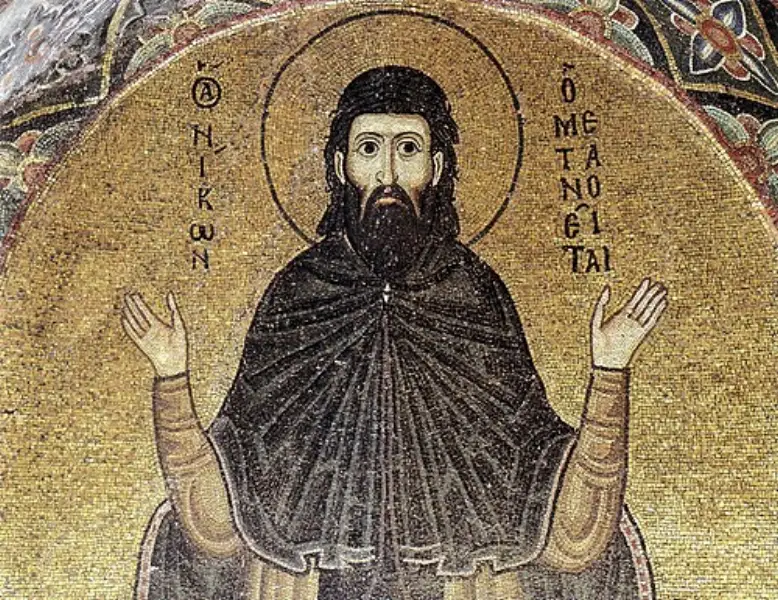
The Eastern Orthodox Church enrolled Nikon among its saints, and the city of Sparta chose him as its patron, the honour naturally following the labourer who had built and planted there. His feast is kept on 26 November, the day of his repose, celebrated especially in Laconia and the Mani, the lands where his thirty years of preaching bore their fruit. His biographer records that miracles continued after his death, and much of the Life is devoted to recounting them — wonders worked at his tomb and through his intercession that confirmed the people of southern Greece in their devotion. He is depicted in the mosaics of the monastery of Hosios Loukas in Boeotia, a foundation of the mid-tenth century, where his image stands among the company of the holy doctors and monks of Byzantium. For the communities of Laconia he remains the local apostle: the monk of Pontus or Argos who brought the gospel to their rugged peninsula and whose name, borne of a single repeated word, still summarises his whole message. In these honours the Church of Greece keeps alive the memory of her wandering preacher of repentance.
§ Legacy
The Apostle of Laconia Remembered
Nikon's posthumous influence rests chiefly on two foundations: the Christianisation of the Mani and the devotional landscape of Laconia. The isolated peninsula of the Maniots, the last stronghold of paganism in southern Greece, received the faith through his preaching after two centuries of gradual and incomplete conversion, and the churches he founded at Sparta and throughout Laconia anchored the ecclesiastical life of the region. His Life, written by a successor abbot of his monastery, became the vehicle of his memory, portraying the Peloponnese as a land full of demons which the saint was constantly struggling against, and multiplying accounts of the miracles he wrought in life and after death. Modern historians have read the work as both hagiography and evidence: Andrew Louth places Nikon among the preachers of the gospel within the Byzantine Empire, while scholars of missions have numbered him — as 'Greek monk, itinerant preacher, and saint' — in the company of the great missionary figures of the Christian centuries. His mosaic portrait at Hosios Loukas preserves his face for posterity, and his feast of 26 November keeps alive in Sparta and the Mani the memory of the preacher whom they still call, simply, the Repent.
§ Legacy
Timeline
- 930
Born around this year, of Greek origin, either at Pontus or at Argos in the Peloponnese.
§ Biography
- 961
Following the Byzantine reconquest of Crete, began his mission to call the island's forced converts back to Christianity.
§ Biography
- 966
After five years on Crete, departed to preach in Epidauros, Athens and Euboea.
§ Biography
- 26 Nov 998
Died in a monastery on the Peloponnese after thirty years of preaching there.
§ Biography
In Their Own Words
by time and long fellowship with the Saracens
The Record
- Major works
- Three churches and a monastery founded at Sparta·Foundation of a large number of churches across Laconia·Evangelisation of the Mani Peninsula
- Patron of
- Patron saint of Sparta and Laconia
- Canonization
- Canonized by the Eastern Orthodox Church; named patron saint of Sparta
Prayer
Bibliography
Show 6 sources
- Louth, Andrew (2007). Greek East and Latin West: The Church AD 681–1071. Crestwood, N.Y.: St Vladimir's Seminary Press. ISBN 9780881413205.
- Thurston, Herbert; Attwater, Donald (1956). Lives of the Saints, Volume 4. New York: P. J. Kenedy & Sons.
- Anderson, Gerald H. (1999). Biographical Dictionary of Christian Missions. Grand Rapids, Michigan: Wm. B. Eerdmans Publishing. ISBN 0-8028-4680-7.
- Neville, Leonora Alice (2004). Authority in Byzantine Provincial Society, 950-1100. Cambridge: Cambridge University Press. ISBN 0-521-83865-7.
- Runciman, Steven; Freely, John (2009). The Lost Capital of Byzantium: The History of Mistra and the Peloponnese. Cambridge, Massachusetts: Harvard University Press. ISBN 978-0-674-03405-1.
- Makrides, Vasilios (2009). Hellenic Temples and Christian Churches: A Concise History of the Religious Cultures of Greece from Antiquity to the Present. New York: New York University Press. ISBN 978-0-8147-9568-2.
Profile text adapted from the Wikipedia article, licensed CC BY-SA 4.0.
Pray with this saint every day
Save St. Nikon the Metanoeite to your favorites, read the full profile, and get feast-day reminders in the Saints app.
Get the Saints AppFree on the App Store for iPhone and iPad