
c. 365 – 430 (or 451)·Feast November 12
St. Nilus of Sinai
Ascetic writer and defender of John Chrysostom
Overview
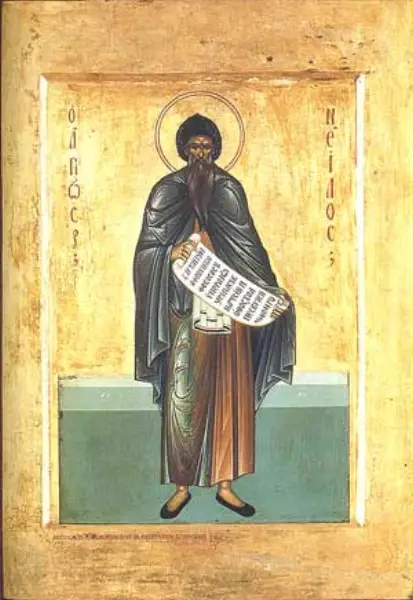
Nilus of Sinai — called also Neilos, Nilus of Ancyra, and Nil Postnik, 'the Faster' — was among the foremost ascetic writers of the fifth century and a stalwart disciple of John Chrysostom. Born around 365 in Galatia, he lived as a married layman with two children and served the imperial capital as its eparch before renouncing the world. Under the direction of Chrysostom he studied Scripture and the works of piety, and in the early years of the fifth century he and his wife separated by mutual resolve to become monastics: Nilus took his son Theodulos to Mount Sinai, while his wife and daughter entered a women's monastery in Egypt. At Sinai father and son endured the fury of Saracen raiders, who carried the boy into captivity and slavery. Nilus found him at last at Elusa in Palestine, where the local bishop ordained them both priests and sent them back to the holy mountain, where a cave housed them for forty years. His writings and correspondence — treatises on prayer and asceticism, hundreds of letters admonishing governors, abbots, bishops and emperors — made him a figure of consequence throughout the East. He died on 12 November 430, or by other accounts 451, and his relics were later translated to Constantinople.
The Complete Life
A Magistrate of the Imperial City
Nilus was born around the year 365, a native of Ancyra in Galatia according to his legend, though another tradition names Constantinople as his home. Whatever the city of his birth, his adult life was rooted in the imperial capital: he was there a layman, married, and the father of two children, and while still relatively young he was appointed eparch of the city, the civil officer who stood near the summit of its administration. He thus belonged by education, office and family to the highest ranks of Eastern Roman society, with every prospect of a distinguished worldly career. Yet the account of his life makes clear that rank never possessed him. Under the preaching and direction of John Chrysostom, the golden-mouthed patriarch of Constantinople, Nilus turned his formidable abilities toward the study of Scripture and the practice of piety, and the patriarch's influence extended to Nilus' wife as well as to himself. The household that the world regarded as established for honour was, unseen, being prepared for renunciation — a preparation that would send its members to the desert of Sinai and the monasteries of Egypt.
§ Life
One Household, Two Monasteries
Sometime between 390 and 404, husband and wife reached the same conclusion: that their common path lay in the monastic state. By mutual decision they separated, dividing the household not in discord but in a shared resolve for God. Nilus departed with his son Theodulos for Mount Sinai, the mountain of the Law, to take up the monk's habit; his wife and daughter went together to a women's monastery in Egypt. The father and the son embraced the austere life of the Sinai hermits, exposed alike to the rigor of the desert and the raids of its nomad neighbours. Nilus had been directed in his earlier spiritual formation by Chrysostom before the patriarch's first exile, and that schooling in Scripture bore fruit in the silence of the mountain. The sacrifice was tested to its limit around the year 410, when Saracen raiders fell upon the community and carried Theodulos captive; the boy was sold as a slave and came into the possession of the Bishop of Elusa in Palestine. What had been renounced freely — home, office, and the companionship of family — was now lost by violence, and Nilus set out from Sinai to search the world for his child.
§ Life
Sinai, Captivity, and Reunion at Elusa
The search for Theodulos became the strangest chapter of Nilus' life. Leaving the mountain, he made his way at last to Elusa, the Palestinian city where his son, sold from master to master, served as door-keeper of the church under the bishop who had received him among his clergy. There father and son were reunited, the captive restored and the pursuer rewarded in a single providence. The Bishop of Elusa ordained them both priests and permitted them to go back to Sinai, where for the next forty years they made their home in a cave, the younger Nilus living out his days beside the father who had crossed an empire to find him. Nilus' own account of these years was preserved in his treatise on the slaughter of the monks of Sinai, which tells of the Saracen invasion and his son's captivity. His reputation, meanwhile, extended far beyond the desert. Through his writings and correspondence he took a real part in the affairs of his time: he kept up a correspondence with Gainas, leader of the Goths, striving to convert him from Arianism, and he denounced the persecution of John Chrysostom to Emperor Arcadius and his courtiers without softening a word. People of every rank, from the emperor down, sought his counsel.
§ Life
Doctrine of the Desert
Nilus' spiritual teaching survives in a large and varied body of work. The Catholic Encyclopedia of the early twentieth century ranked him among the foremost ascetic authors of his century, and his Ascetic Discourse was judged worthy of a place in the first volume of the English Philokalia, the great anthology of Eastern Christian prayer. His treatise On Prayer counsels that the first thing to beg of God is the gift of prayer itself — the petition preceding all petitions. His writings fall into four kinds: discourses on the virtues and vices, among them his exposition on the word of the Gospel of Luke; works on the monastic life, including the seven-part narrative of the slaughter of the monks of Sinai, the life of the Nitrian monk Albianos held up as example, the Logos asketikos on the monastic ideal, his plea for voluntary poverty, and letters to individual monks such as Eulogios; the Admonitions or Chapters, some two hundred precepts in short maxims probably compiled by his disciples from his discourses; and finally his enormous correspondence, of which one editor published 355 letters and another 1,061 in four books, though several overlap or are spurious. Their temper is unfailingly bold: denunciation of heresy, paganism and abuses of discipline, addressed without fear even to emperors.
§ Works
Repose and Translation
The date of Nilus' death is given by his oldest authorities with a stubborn doublet: he died at Ancyra in Galatia on 12 November in the year 430, though some calendars defer his repose to 451. If he died in the later year he would have been a monk for well over half a century, and an old man of more than eighty; in either case he closed his life in the city of his birth, far from the mountain where his sanctity was forged. His body did not long remain there. In the reign of Justin the Younger, his remains were brought to Constantinople and deposited in the church of the Holy Apostles, the burial place of the emperors and the great ones of the capital — a last irony for the former eparch who had abandoned the city's honours for a cave, now returning to it only in his relics, and returning not to a palace but to the church of the apostles. There his memory was kept with the city's saints, while Sinai and the monasteries of the East preserved the words he had left them as the surer monument of his life.
§ Life
Feast Days of East and West
Nilus was never the object of a formal canonisation, for his sanctity was recognised from the generations immediately following his death, when the Church raised her great ascetics to the public honour of the altars by acclamation. He is venerated in the Eastern Orthodox Church, the Roman Catholic Church and the Armenian Apostolic Church alike. Both the Catholic and the Eastern Orthodox calendars keep his feast on 12 November, and the Roman Martyrology marks him on the same day as well. In Armenia the Church counts him — together with other fathers of Egypt — on the Thursday that follows the third Sunday of its Advent season, a place in the calendar that testifies to the esteem in which the monastic writers of the desert were held in Armenia. In the Coptic tradition he is likewise numbered among the monks and nuns of the Egyptian Church's golden age. Russian iconography portrayed him as 'Nil Postnik', Nil the Faster, and his image was carried onto the frescoes of the monasteries of Mount Athos, so that devotion to the ascetic of Sinai travelled with the art of the Orthodox world.
§ Life
The Ascetic Master and the False Prophecy
Nilus' lasting influence rests on his writings, which secured him a permanent place among the masters of Eastern Christian spirituality. His Ascetic Discourse, enshrined in the Philokalia, has guided Orthodox prayer for centuries, and his maxims and letters remain among the most quoted documents of early monasticism. History, however, attached to his name a burden he never bore. In 1912 there was published at Mount Athos a work titled 'The Posthumous Predictions of St. Nilus the Myrrh-streaming', an apocalyptic text attributed to a seventeenth-century Athonite monk who died in 1651 and is honoured as Nilus the Myrrh-streamer. With the spread of the Internet, these supposed prophecies took on the status of an urban legend, and they have been widely and wrongly imputed to Nilus of Sinai, confusing the fifth-century ascetic with his much later namesake. Scholars have laboured to keep the two apart, and the true Nilus needs no borrowed prophecies for his fame: his own pen — the seven-part chronicle of Sinai's martyrs, the treatise on prayer, the admonitions to the powerful — earned him the verdict of the encyclopedists as a theologian, a student of Scripture and a master of ascetical writing who shaped the monastic literature of Christendom.
§ Prophecy of St. Nilus
Timeline
- 365
Born around this year in Ancyra, Galatia, into a family of standing in the Roman East.
§ Life
- 390
Sometime between 390 and 404, he and his wife parted so that each might pursue the monastic life.
§ Life
- 410
Saracen raiders at Sinai captured his son Theodulos and sold him into slavery in Palestine.
§ Life
- 12 Nov 430
Died at Ancyra in Galatia; some authorities give the year of his death as 451.
§ Life
In Their Own Words
one of the leading ascetic writers of the 5th century
The Record
- Major works
- Ascetic Discourse (included in volume I of the English Philokalia)·On Prayer·Of the Vice Opposed to Virtues·On the Word of the Gospel of Luke·Concerning the Slaughter of the Monks on Mount Sinai, in seven parts·Concerning Albianos·Of Asceticism (Logos asketikos)·Of Voluntary Poverty (Peri aktemosynes)·Of the Superiority of Monks·To Eulogios the Monk·Admonitions (Gnomai) or Chapters (Kephalaia), about 200 maxims·Correspondence of 1,061 letters in four books, as published by Allatius
- Canonization
- Pre-congregation saint; venerated in the Eastern Orthodox, Roman Catholic and Armenian Apostolic Churches
Prayer
Bibliography
Show 5 sources
- Fortescue, Adrian. "St. Nilus." The Catholic Encyclopedia, Vol. 11. New York: Robert Appleton Company, 1911.
- Butler, Alban. "Saint Nilus, Anchoret, Father of the Church, Confessor". Lives of the Fathers, Martyrs, and Principal Saints, 1866. CatholicSaints.Info.
- Ware, Kallistos; Sherrard, Philip, eds. (1979). The Philokalia: the complete text. London: Faber. p. 10. ISBN 0-571-13013-5.
- "Saint Nilus of Ancyra | Greek Abbot & Miracle Worker". Encyclopaedia Britannica. Britannica.com.
- "Nilus the Ascetic of Sinai". Greek Orthodox Archdiocese of America. Goarch.org.
Profile text adapted from the Wikipedia article, licensed CC BY-SA 4.0.
Pray with this saint every day
Save St. Nilus of Sinai to your favorites, read the full profile, and get feast-day reminders in the Saints app.
Get the Saints AppFree on the App Store for iPhone and iPad