
c. 1433 – 1508·Feast May 7
St. Nilus of Sora
Father of Russian monastic non-possession
Overview
Nilus of Sora — Nil Sorsky, in secular life Nikolai Maikov — was a Russian Orthodox monk, spiritual writer and theologian, and the founder of the Sora Hermitage. Born in Moscow in 1433 to the Maikov nobility, he worked as a scribe and book copyist before embracing monastic life at the Kirillo-Belozersky Monastery, a community noted for its hostility to monastic landowning. Pilgrimage to Palestine, Constantinople and Mount Athos brought him into contact with the hesychast tradition of Gregory Sinai, and on his return to Russia between 1473 and 1489 he settled with his followers in a hermitage on the Sora River, becoming the leader of the Volga elders. He is remembered above all as founder of the tendency known as the non-possessors, which opposed ecclesiastical landownership and insisted on poverty, labour and inward prayer for monasteries. At the Synod of 1503 in Moscow he raised the question of monastic estates, which occupied about a third of the land of the Russian state. Tolerant towards the Novgorod heretics at a time of fiery repression, he taught instead the path of inward purification. He died on 7 May 1508, and the Russian Orthodox Church glorified him in 1903.
The Complete Life
A Scribe of Moscow
Nilus was born in 1433 in Moscow and descended from the Maikov nobility, a circumstance that might have destined him for service at court or in the Church's hierarchy. His first known work, however, was humbler: before monastic life he was employed as a scribe, engaged in the copying of books, an occupation that planted in him both a love of the sacred text and the patient habits of hand and mind that would later shape his written teaching. In his early years he journeyed to Palestine and Greece, and there he became acquainted with the hesychast movement, the tradition of inner prayer that the Athonite masters had cultivated for generations. The journey to the holy places left a permanent mark: as his early biographers recorded, it changed his whole individuality, and solitude, isolation and oblivion of the world became the chief features of his character. In a life divided between the capital of Muscovy and the deserts of the East, the young noble-copyist was being silently prepared to become the teacher of a new manner of Russian monasticism, one formed less by the wealth of great abbeys than by the poverty of the mountain saints.
§ Early life
Beloozero and the Way of the Desert
Nilus took monastic vows at the Kirillo-Belozersky Monastery in the northern forests, a house whose founder, Cyril of Beloozero, had been famous for refusing villages offered to him by devout nobles. The monastery's inherited hostility towards monastic landownership became the inheritance of its monks, who came to be known as the startsy of the Volga, with Nilus as their leader. Yet his formation was not complete within Russia. He set out again for the East, visiting Palestine, Constantinople and Mount Athos, acquainting himself at its sources with the mystical doctrine of hesychasm and reading deeply in the patristic literature of prayer. Coming back to Rus in the years between 1473 and 1489, he established a small cloister beside the Sora River, within reach of the Kirillo-Belozersky Monastery, and there took up his abode with the brethren who had gathered to him. The Sora Hermitage embodied his ideal: a small, secluded, modest community, living by the labour of its own hands, without estates or serfs, given to ceaseless inward prayer after the manner of Sinai and Athos. There the elder gathered around him the disciples who would carry his teaching into the great controversies of the next generation.
§ Early life
The Heresy Affair of Novgorod
Nilus was drawn into the Novgorod heresy affair, the controversy over the Judaizing heretics which stirred minds throughout Russia at the close of the fifteenth century. He and his closest associate, Paisius Yaroslavov, proved markedly more tolerant towards the accused than most of the Russian clergy, whose stern course was led by Archbishop Gennady of Novgorod and Joseph Volotsky. In 1489 Gennady, embarking on the path of combating the heretics, asked the Archbishop of Rostov to confer with the two elders dwelling in that diocese and request their help in the matter; no source records what became of these approaches, but from that day forward no cooperation is visible between Nilus and Paisius on the one side and Gennadius and Joseph on the other. The elders were nonetheless no indifferent spectators of heresy. Each of the two was on hand at the Synod of 1490, convened over the heresy, and each exerted his influence upon its final decision. Where the assembled clergy had at first unanimously supported burning all the heretics at the stake, the synod ended by condemning only a few priests, who were defrocked without being executed — a mitigation in which the temperate counsel of the two desert fathers plainly had its part, though later in the decade the fires returned to Novgorod and Moscow.
§ The Novgorod heresy affair
Inward Prayer Against Formality
Nilus opposed the formality that had crystallised in the religious life of his age, an orthodoxy of ritual in which the inward substance of the faith was too often lost. What he desired was to open up the inward meaning of Orthodoxy, giving primary attention to the life of the soul in God rather than to outward observance. Contemporaries judged him no mere bookworm but a speculator-philosopher, a theorist of the interior life; an unusually free spirit marked his whole personality. He taught that human existence, from beginning to end, is an unceasing climb of self-perfection and self-improvement resting upon the Holy Gospel, and he showed a penetrating psychological understanding of the spiritual struggle, outlining clear ways of what he called the graceful struggle. He held firmly that moral, inner, spiritual perfection is the ideal foundation of the active and productive life of the believer. In his teaching he developed the mystical and ascetical ideas of Gregory Sinai's hesychasm, calling believers to concentrate on the inner world and on the personal experience of faith as the means of union with God. To monks he demanded productive labour, and he urged reform of monastic life upon a basis of seclusion and modesty — poverty of means as the nurse of wealth of spirit.
§ Teaching and influence
The Synod of 1503
The final public act of Nilus' life was the struggle over monastic wealth. At the Synod of 1503 in Moscow he dedicated his efforts to fighting against monastic landownership rights, setting directly before the council the matter of the monastic domains — lands covering nearly a third of all Russia at that day, which in his estimation had been the ruin of the nation's monastic discipline. Behind him stood the elders of Kirillo-Belozersky and his pupil Vassian Patrikeyev, and he spoke in favour of Ivan III's policy of secularising the monastic lands — a remarkable alignment of desert asceticism with the crown's design upon church property, founded on the conviction that a monastery enriched is a monastery imperilled. The controversy was not resolved while he lived. Death overtook him before the conflict he had begun had run its course: he died on 7 May 1508, but his cause did not die with him: Patrikeyev and Artemius of the Trinity stood as his successors, carrying the non-possessor programme into the decades of fierce debate that followed the elder's repose. In that unfinished contest his teaching found its longest endurance.
§ Teaching and influence
The Hermitage on the Sora
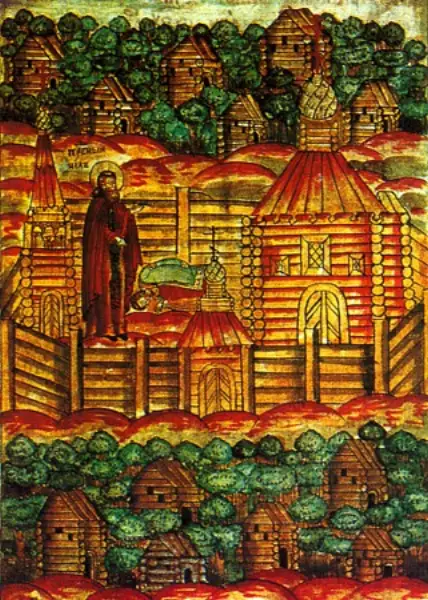
The little community Nilus planted beside the Sora, within reach of the Kirillo-Belozersky house, remained after his death the natural centre of his remembrance — the St. Nilus of Sora Hermitage, where pilgrims honoured the elder who had settled there with his followers and written in its quiet the rule of skete life for the Russian north. Formal recognition by the whole Church came slowly, in the manner of Russian sanctity: the Russian Orthodox Church canonized him in 1903, more than three centuries and a half after his repose, when the veneration that had never ceased among monks and scholars was raised to the rank of public, liturgical glorification. His feast is kept on 7 May, the anniversary of his death, and his life is commemorated in the synaxaria under the title of the Venerable Nilus, Abbot of Sora. In the Orthodox East he is honoured as a great ascetic of the Russian Church, and the Movement of the non-possessors that he founded is studied as one of the deep alternatives of Russian religious history — the vision of a Church whose monasteries possess nothing, and therefore lack nothing.
§ Early life
The Non-Possessors and Their Heirs
Nilus' influence outlasted every controversy of his lifetime. As founder of the nestyazhateli, the non-possessors, he gave Russian Christianity a permanent tradition of criticism directed against ecclesiastical wealth, and the movement he led stood for centuries as the conscience of Russian monasticism against the accumulation of estates, serfs and treasure. His direct disciples carried his programme forward: Vassian Patrikeyev became his successor in the struggle over property, and Artemius of the Trinity continued the non-possessor line after them. Beyond his own school, his reach extended to the greatest scholar of the age — Maximus the Greek, who came to Russia from Athos and who, like the elder Artemiy after him, shared Nilus' desire to reach the deep foundations of the faith and suffered for it in an age quick to cry heresy. His written works, above all The Rule and The Tradition, remain classics of Orthodox spiritual literature, handing on the hesychast method of prayer in a Russian idiom. Modern scholarship has returned to him anew, examining the sources of his life and the true character of his teaching, and finding in the elder of the Sora a figure of unusual inward freedom — a man who asked the Church of his time to be poor, so that it might be free.
§ Teaching and influence
Timeline
- 1433
Born in Moscow, descended from the Maikov nobility.
§ Early life
- 1473
Returned to Russia sometime between this year and 1489, founding a cloister on the Sora River near the Kirillo-Belozersky Monastery.
§ Early life
- 1489
Was asked, with Paisius Yaroslavov, to assist Archbishop Gennady in his campaign against the Novgorod heretics.
§ The Novgorod heresy affair
- 1490
Attended the Synod dealing with heresy and helped shape its lenient outcome, in which priests were defrocked but not executed.
§ The Novgorod heresy affair
- 1503
Raised the question of monastic estates at the Synod of Moscow, opposing monastic landownership.
§ Teaching and influence
- 7 May 1508
Died without seeing the end of the struggle over monastic property.
§ Teaching and influence
The Record
- Major works
- The Rule (Ustav)·The Tradition (Predanie)·Foundation of the Sora Hermitage on the Sora River
- Canonization
- Canonized in 1903 by the Russian Orthodox Church
Prayer
Bibliography
Show 6 sources
- Goldfrank, David M. "Recentering Nil Sorskii: The Evidence from Sources." Russian Review 66, No. 3 (2007): 359–376.
- Nil Sorsky: The Complete Writings. George Maloney, ed. and trans. Mahwah, NJ: Paulist Press, 2003.
- Moser, Charles (1992). The Cambridge History of Russian Literature. Cambridge University Press. p. 30. ISBN 978-0-521-42567-4.
- Terras, Victor (1985). Handbook of Russian Literature. Yale University Press. p. 306. ISBN 978-0-300-04868-1.
- Latourette, Kenneth Scott (1975). A History of Christianity: Beginnings to 1500. San Francisco: HarperOne. p. 617. ISBN 9780060649524.
- Prokurat, Michael. "Joseph of Volokolamsk, St." Encyclopedia of Monasticism (William M. Johnston, ed.). Routledge, 2013. ISBN 9781136787164.
Profile text adapted from the Wikipedia article, licensed CC BY-SA 4.0.
Pray with this saint every day
Save St. Nilus of Sora to your favorites, read the full profile, and get feast-day reminders in the Saints app.
Get the Saints AppFree on the App Store for iPhone and iPad