
910 – 1005·Feast September 26
St. Nilus the Younger
Calabrian abbot and founder of Italo-Byzantine monasticism
Overview
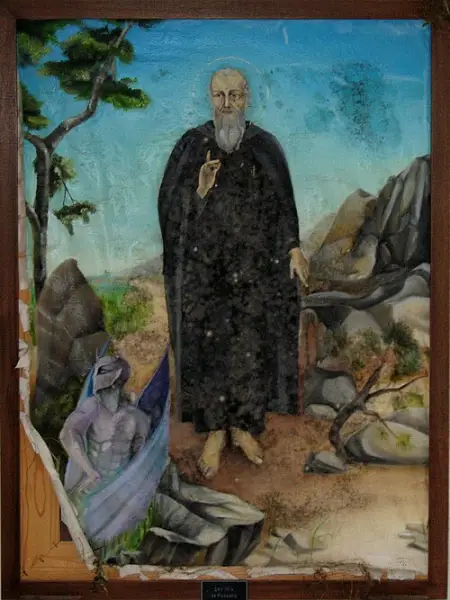
Nilus the Younger, also called Neilos of Rossano, was a Griko monk and abbot born in 910 at Rossano in the Byzantine theme of Calabria, in southern Italy. Raised in a Calabrian Greek family of Byzantine rite, he was for a time married and had a daughter before illness led him to embrace monastic life. He became a devoted propagator of the Rule of Saint Basil in Italy and is remembered as the founder of Italo-Byzantine monasticism in the peninsula. Renowned for ascetic discipline, virtue, and theological learning, he lived at first as a hermit, but his reputation drew disciples to Rossano. When he learned of plans to make him a bishop, he fled to Capua and remained there fifteen years. He later founded or restored several monasteries and, in 998, travelled to Rome to intercede for John Philogathos, whose cruel punishment he openly rebuked before Pope Gregory V and Emperor Otto III. His crowning work was the founding in 1004 of the Greek monastery of Grottaferrata near Frascati, of which he is counted the first abbot. He died at the monastery of Sant'Agata in Tusculum on 27 December 1005.
The Complete Life
A Greek Family in Byzantine Calabria
Nilus was born in 910 at Rossano, a city in the Byzantine theme of Calabria, into a Calabrian Greek family of Byzantine rite. His native land was then under Byzantine rule, and its people spoke Koine Greek and lived within a Greek culture and a Greek spiritual and liturgical tradition. Into this world of eastern Christianity on Italian soil the future abbot was formed. As a young man he did not at first set out along the monastic path: for a while he lived as a husband and father, raising a daughter. Illness then intervened, his conversion followed, and from that turning point he gave himself wholly to God. He entered the monastery of St Adrian in Calabria, where he would eventually serve as abbot, and devoted the rest of his life to spreading the Rule of Saint Basil throughout Italy. The carefree youth of the south gave way to a life of ascetic rigour, theological study, and spiritual authority that would shape monasticism in southern Italy for centuries.
§ Biography
The Monk Who Fled a Bishopric
After his conversion Nilus embraced the monastic state without reserve, becoming celebrated for ascetic rigour, virtue, and theological learning. For a period he lived as a hermit in the solitary manner prized by the eastern tradition, but his reputation proved impossible to hide: disciples gathered around him at Rossano, and he began to instruct them. It was one thing to teach monks and another to be treated as a local authority, and when word reached him that there was talk of making him a bishop, Nilus chose flight over elevation. He escaped to Capua and remained there fifteen years, his absence preserving his humility. Throughout his life he moved among monasteries that he either founded or restored, and among them he spent time at the Benedictine house of Monte Cassino and at the Alexius monastery in Rome. Though he formed his own monks according to the Rule of St. Basil, he kept cordial relations with the Benedictines, whose own founder had drawn on Basil's rule when drafting his own.
§ Biography
Intercession in Rome and the Founding of Grottaferrata
In 998, according to his disciple and biographer Bartholomew of Grottaferrata, Nilus hurried to Rome to plead for a fellow native of Rossano, John Philogathos, who against Nilus's advice had joined the Roman senator Crescentius in a scheme to depose Pope Gregory V, kinsman of Emperor Otto III. When Philogathos was tortured and mutilated, the old abbot did not shrink from confrontation: he reproached both pope and emperor for the crime, prophesying that the curse of heaven would sooner or later touch their cruel hearts. His greatest undertaking, however, was peaceful. In 1004 he founded the famous Greek monastery at Grottaferrata near Frascati, on a site believed to have held a villa of Cicero where the Tusculan Disputations were written. The land was granted to him by Gregory, count of Tusculum, and Nilus is counted the monastery's first abbot. From this foundation the Italo-Byzantine monastic tradition received its most enduring home.
§ Biography
Basil's Rule and Breadth of Communion
The spirituality of Nilus was rooted in the ascetic and communal inheritance of Saint Basil, whose rule he propagated in Italy and by which he instructed his own monks. Yet his loyalty to the Greek tradition never narrowed into hostility toward the Latin West. He maintained warm relations with the Benedictines of Monte Cassino, and the exchange ran in both directions, since Benedict himself had recourse to the Rule of St. Basil when composing his own. Once, when a Latin Rite monk raised with him the complaints levelled at the Cluniac Reforms and the Roman Rite by partisans of the Photian schism in Constantinople, Nilus answered without rancour: however the two traditions differed, both did all things for the glory of God, and no one should be disturbed by such criticism. In an age of rivalry between Constantinople and Rome he embodied a communion of spirit, joining Greek liturgy and eastern asceticism to a conscience at peace with western brethren. This balance of rigour and charity made him a model for the monks of southern Italy.
§ Biography
The Last Years at Tusculum
The closing chapter of Nilus's life was spent among the houses he had built or blessed. He spent fifteen years in a monastery located in the Valleluce district of Sant'Elia Fiumerapido, and afterwards divided his final years between that region and the monastery of Sant'Agata in Tusculum. At Vallelucio, in his last days, he marked out the spot where his monastery would take permanent root, confirming Grottaferrata as his enduring foundation. At Sant'Agata, in the hill country of Latium within the Papal States, his long pilgrimage came to its end: he died there in 1005, on the twenty-seventh day of December. He had outlived the emperors and antipopes whose quarrels had once drawn him to Rome, and he left behind a network of Basilian houses and a flourishing abbey that would keep the Byzantine Rite alive on Italian soil. His body of work outlasted every political upheaval of his turbulent century.
§ Biography
Patron of Scribes and Father of Basilian Monks
Nilus the Younger stands as the father of Italo-Byzantine monasticism throughout the Italian south, and his principal legacy remains at Grottaferrata, where the abbey he founded in 1004 continues to this day in the Byzantine Rite as the Territorial Abbacy of Santa Maria di Grottaferrata. For centuries the monastery remained faithful to Orthodoxy in its worship while living in the heart of the Latin West, exactly as its founder had done. He is honoured as a saint in both the Catholic Church and the Eastern Orthodox Church, with his feast celebrated on September 26 in the Byzantine calendar and in the Roman Martyrology. He is honoured too as the heavenly patron of scribes and calligraphers, a fitting patronage for a man whose spiritual sons preserved the sacred texts of the Greek tradition in Italy. The towns of Grottaferrata and Rossano claim him as their patron, as does the Serapo ward of Gaeta, and his portrait is honoured at the Sanctuary of San Nicodemo in Mammola.
§ Biography
Timeline
- 910
Born at Rossano in the Byzantine theme of Calabria to a Calabrian Greek family of Byzantine rite.
§ Biography
- 981
Invading Saracens drove the monks of the monastery of St Adrian in Calabria to Vellelucio, on land given by Montecassino.
§ Notes
- 998
Hastened to Rome to intercede for John Philogathos, and later rebuked Pope Gregory V and Emperor Otto III for his torture and mutilation.
§ Biography
- 1004
Founded the Greek monastery of Grottaferrata near Frascati, on a site granted by Gregory, count of Tusculum.
§ Biography
- 27 Dec 1005
Died at the monastery of Sant'Agata in Tusculum, in the Papal States.
§ Biography
In Their Own Words
However we differ, both do all things for the glory of God. Don't allow yourselves to be disturbed by these criticisms.
The curse of heaven sooner or later would affect their cruel hearts.
The Record
- Major works
- Foundation of the Greek monastery of Grottaferrata (1004)·Foundation and restoration of monasteries across southern Italy·Transmission of the Rule of Saint Basil in Italy
- Patron of
- Grottaferrata·Rossano·Serapo's ward in Gaeta·Scribes and calligraphers
- Symbols
- Abbot's habit·Monastery of Grottaferrata
- Canonization
- Pre-congregation; venerated as a saint in both the Catholic Church and the Eastern Orthodox Church since antiquity.
Prayer
Bibliography
Show 7 sources
- Agasso, Domenico. "San Nilo da Rossano", Santi e Beati, February 1, 2001
- Fortescue, Adrian. "Nilus the Younger." The Catholic Encyclopedia Vol. 11. New York: Robert Appleton Company, 1911
- "September 26." Latin Saints of the Orthodox Patriarchate of Rome
- "History", Exarchic Greek Abbey of St. Mary of Grottaferrata - Basilian Monks
- Donald Attwater (1963), Saints of the East, P.J. Kenedy & Sons. Pages 122-123
- ΟΣΙΟΣ ΝΕΙΛΟΣ, Ο ΕΚ ΚΑΛΑΒΡΙΑΣ. Αποστολική Διακονία της Εκκλησίας της Ελλάδος
- David Paul Hester. Monasticism and Spirituality of the Italo-Greeks. Volume 55 of Analekta Vlatadōn. Patriarchal Institute for Patristic Studies, 1992. pp. 200-221
Profile text adapted from the Wikipedia article, licensed CC BY-SA 4.0.
Pray with this saint every day
Save St. Nilus the Younger to your favorites, read the full profile, and get feast-day reminders in the Saints app.
Get the Saints AppFree on the App Store for iPhone and iPad