
1808 – 1858·Feast December 14
St. Nimatullah Kassab
Maronite monk, priest, and seminary teacher of Kfifan
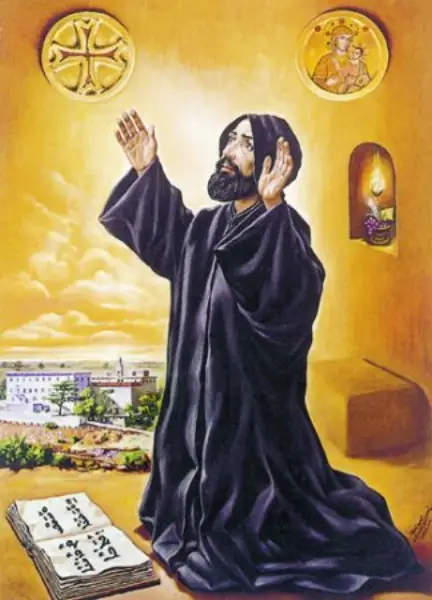
Overview
Nimatullah Kassab, bearing the byname Al-Hardini from his native village, served the Maronite Church as a Lebanese monk, priest, and scholar. Born Youssef Kassab in 1808 at Hardine, one of seven children of George Kassab and Marium Raad, he was educated at the monastic school of the Lebanese Maronite Order before entering the novitiate at Qozhaya in November 1828, taking the name Nimatullah, meaning the grace of God. He professed his vows on 14 November 1830 and was ordained a priest on Christmas Day 1833. Sent to the monastery of Saints Cyprian and Justina at Kfifan, he taught at the order's seminary and directed its seminarians, counting among his students the celebrated Charbel Makhlouf. He founded free schools at Kfifan and Bhersaf and served on his order's general council for most of the period from 1845 to 1858, and acted as Assistant Abbot General under appointment from the Holy See, though he refused to be named Abbot General. Severe with himself and famously patient with others, he died at Kfifan on 14 December 1858 after nearly two weeks of high fever. His intact body, discovered when his tomb was opened in 1864, drew lasting devotion, and he was beatified in 1998 and canonized in 2004.
The Complete Life
A Village Boy from Hardine
The future saint first saw the light in 1808 at Hardine, a village of the North Governorate of Lebanon, at that time within the Mount Lebanon Emirate. His parents George Kassab and Marium Raad raised seven children; Marium's own father had been a priest of the Maronite Church, so the boy grew up within a family already marked by clerical devotion. In boyhood Youssef studied at the monastic school of the Lebanese Maronite Order, attached to the Monastery of St. Anthony in the village of Houb, where the blend of learning and monastic discipline took root in him. He completed his studies there in 1822, and rather than return to a secular life he made his way to monastic life itself. In November 1828 he entered the novitiate of the order that had taught him, at the Monastery of St. Anthony in Qozhaya, and received the monastic name Nimatullah, a word meaning the grace of God. The name would prove prophetic of a life spent in quiet, generous service of his community and his Church.
§ Early life
Novice, Bookbinder, and Priest
When Nimatullah became a monk, the monastery's abbot set him the task of mastering bookbinding, a humble trade he accepted without complaint. His years of initial formation were marked by constant prayer; he sometimes spent whole nights in the monastery church before the Blessed Sacrament, a devotion that earned him the later description of being enamoured of the Eucharist. On 14 November 1830 he professed his religious vows, and was afterwards dispatched to the Monastery of Saints Cyprian and Justina at Kfifan in the Batroun District for advanced study ahead of ordination. That preparation concluded on Christmas Day 1833, when he was ordained a priest. Even in these early years his gifts bore fruit: he founded a free school at Kfifan and another later at Bhersaf, extending education to children who could not otherwise have obtained it. Study, craftsmanship, teaching, and above all prayer formed the fabric of his vocation, and each was offered as a single service to God within the community life he loved.
§ Monk
Teacher of Seminarians and Servant of the Order
Once a priest, Nimatullah was set to teaching in the order's seminary and given charge of the seminarians as their director, work that occupied the heart of his ministry. Among the students who passed under his instruction was Charbel Makhlouf, who would become the most famous member of the Lebanese Maronite Order and is now venerated throughout the Catholic Church. Nimatullah served on the general council of his order for most of the period between 1845 and 1858, and was appointed Assistant Abbot General by the Holy See, yet when the office of Abbot General was within reach he refused it, preferring obscurity to elevation. He founded a free school at Kfifan and another at Bhersaf, convinced that the poor should not be barred from learning. During his lifetime those who knew him already regarded him as a saint: they came asking for his prayers and even for blessed water for their land and livestock, and his very presence imposed respect, reverence, and solemnity on all who approached him.
§ Monk
Enamoured of the Eucharist, Mild to All Others
The spiritual character of Nimatullah rested on two poles: rigour toward himself and gentleness toward everyone else. He passed much of each day in prayer and sometimes spent the night in the monastery church, adoring the Blessed Sacrament. He practised severe penance upon his own body and soul, but toward his fellow monks he was a model of patience and forbearance, so strikingly lenient that he was reprimanded for it by his superiors; this censure he took quietly, counting it among the trials inherent in the monastic state. When one of his own brothers, who had become a hermit, urged him to seek a similar solitude, Nimatullah declined, answering that community life was the true test of a monk. His reputation for sanctity was accompanied by what contemporaries called the gift of prophecy, and he was known as a man of vision. Accounts tell of him warning students away from a monastery wall moments before it collapsed, and of saving the cows of Kfifan by insisting their unstable barn be emptied; in both cases the structures fell exactly as he foresaw, without harm to any living creature.
§ Miracles
The Saintly Death at Kfifan
In the winter of 1858 Nimatullah fell ill, and after nearly two weeks of high fever he died on 14 December at the Monastery of Saints Cyprian and Justina in Kfifan, aged about forty-nine. The reverence in which he had been held during his life only deepened after his death. When his grave was reopened in 1864 to transfer his remains, the monks were astonished to find his body uncorrupted, a discovery regarded as a sign of divine favour. Such was the devotion of the faithful that his remains were exposed to public veneration until 1927, when the investigative commission studying his possible canonization finished its labours; afterwards his body was placed in a small chapel. After his death many healings were attributed to his intercession: an Orthodox blind man named Moussa Saliba reported that the saint appeared to him in sleep and restored his sight, and a Melkite man, Michael Kfoury, whose wasted legs doctors had abandoned, dreamed of an old monk who gave him shoes and told him to walk, and awoke healed.
§ Death
From Local Cause to Canonization
Nimatullah's canonization cause began its local phase on 4 April 1929; Rome's Holy See gave it formal acceptance on 7 September 1978, proclaiming him Venerable. The decisive miracle concerned Andre Najm, who on 26 September 1987 prayed fervently at the grave at Kfifan, begging the saint for a drop of blood as he stood exhausted by illness. Najm asked to wear the monastic habit, was immediately cured, and cried out that he no longer needed transfusions; he never required one again, married in 1991, and later became a Maronite priest. In 1996 Bishop Khalil Abi-Nader obtained permission to open the investigation of this healing, and the Congregation for the Causes of Saints began its study that September. The five-member medical board unanimously accepted the cure as miraculous on 27 February 1997, the theological team followed on 9 May 1997, and the congregation's general assembly of twenty-four cardinals confirmed the miracle on 1 July 1997. The decree appeared on 7 July 1997, promulgated before Pope John Paul II; the same pontiff beatified Nimatullah on 10 May 1998 and canonized him on 16 May 2004, both in Saint Peter's Basilica.
§ Veneration
The Saint of Kfifan
Nimatullah Kassab endures in the memory of the Maronite Church as the Saint of Kfifan, a monk whose quiet fidelity produced a harvest far beyond his monastery walls. His shrine at the Monastery of Saints Cyprian and Justina remains a place of pilgrimage, where the faithful come as Moussa Saliba and Andre Najm once came, to pray at his tomb and ask his intercession. He is named patron of Beirut, a city that looks to him as a father in trial, and his feast is kept on December 14 throughout the Maronite Church. As a teacher he left an indelible mark: the seminarians he formed, chief among them Saint Charbel, carried his spirit into a whole generation of Lebanese monasticism. His free schools at Kfifan and Bhersaf foreshadowed the Maronite order's long commitment to education. Above all he stands as a witness that sanctity flourishes in the ordinary round of community life, and that a monk need not seek the desert to find God, since the true struggle, as he taught, lies in patient love of the brothers at one's side.
§ Veneration
Timeline
- 1808
Born Youssef Kassab at Hardine in the Mount Lebanon Emirate, one of seven children.
§ Early life
- 1822
Finished his studies at the monastic school run by the Lebanese Maronite Order at the Monastery of St. Anthony in Houb.
§ Early life
- Nov 1828
Entered the novitiate of the Lebanese Maronite Order at the Monastery of St. Anthony in Qozhaya, taking the name Nimatullah.
§ Early life
- 14 Nov 1830
Made his religious profession of vows.
§ Monk
- 25 Dec 1833
Ordained a priest on Christmas Day after higher studies at the Monastery of Saints Cyprian and Justina in Kfifan.
§ Monk
- 1845
Began serving on the general council of his order, a duty he fulfilled for most of the period to 1858, later as Assistant Abbot General by appointment of the Holy See.
§ Monk
- 14 Dec 1858
Died at the Monastery of Saints Cyprian and Justina in Kfifan after nearly two weeks of high fever.
§ Death
- 4 Apr 1929
The cause for his canonization began at the local level.
§ Veneration
- 7 Sep 1978
The Holy See formally accepted his cause and he was declared Venerable.
§ Veneration
- 10 May 1998
Beatified by Pope John Paul II at Saint Peter's Basilica in Rome.
§ Veneration
- 16 May 2004
Canonized by Pope John Paul II at Saint Peter's Basilica.
§ Veneration
The Record
- Major works
- Free school founded at Kfifan·Free school founded at Bhersaf·Teaching and direction of seminarians at the order's seminary in Kfifan
- Patron of
- Beirut, Lebanon
- Symbols
- Religious habit·Prayer rope
- Canonization
- Canonized by Pope John Paul II on 16 May 2004 at Saint Peter's Basilica, Vatican City.
Prayer
Bibliography
Show 6 sources
- Vatican News Service
- "Saint Nimatullah Hardini", Maronite Heritage
- "St. Nimatullah Kassab Al-Hardini, Enamored of the Eucharist", Zenit, May 16, 2004
- Index ac status causarum beatificationis servorum dei et canonizationis beatorum (in Latin). Typis polyglottis vaticanis. January 1953. p. 177
- "Saint Nimatullah Kassab al Hardini", Our Lady of Good Help, Maronite Catholic Church of Edmonton. Archived from the original on 2016-09-24
- Ciciliot, Valentina. Le pontificat dans l'époque contemporaine = the papacy in the contemporary age (1ère édition ed.). p. 182. ISBN 978-88-6969-239-0
Profile text adapted from the Wikipedia article, licensed CC BY-SA 4.0.
Pray with this saint every day
Save St. Nimatullah Kassab to your favorites, read the full profile, and get feast-day reminders in the Saints app.
Get the Saints AppFree on the App Store for iPhone and iPad