
died 432 (traditional date)·Feast September 16
St. Ninian
Apostle to the Southern Picts and bishop of Whithorn
Overview
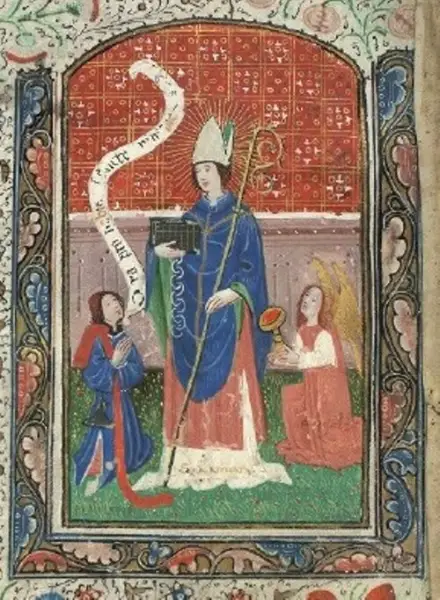
Ninian, a Christian saint whose earliest notice comes in the eighth century, worked as a pioneer missionary among the Picts of the land that is today Scotland, and has been honoured ever since as the Apostle to the Southern Picts. In parts of Scotland he is called Ringan, while northern England preserves the form Trynnian. His major shrine stood at Whithorn in Galloway, where he is associated with the Candida Casa, the White House, said to be among the first stone churches built among the Britons. According to the account of the Venerable Bede, he was a Briton instructed in Rome whose episcopal see was named for Saint Martin of Tours, and who preached to and converted the southern Picts before being buried at his base, called Ad Candidam Casam, in the province of the Bernicians. The later Life by Ailred of Rievaulx adds that he was of royal Christian blood, was consecrated a bishop in Rome, met Saint Martin, and dedicated his church upon learning of Martin's death. One strand of the story sends him to Ireland for his final days, his death falling in 432, a date long attached to his passing. Nothing is known of his teachings, and no unchallenged authority records the details of his life, yet his cult flourished across Scotland, northern England, and beyond, with his feast kept on September 16.
The Complete Life
A Briton Schooled in Rome
The Ninian of tradition was a Briton, and the earliest account of him, given by the Venerable Bede around 731, relates that he had been instructed in Rome, a thing most unusual for his time and land. Ailred of Rievaulx, writing his Life of the saint in about 1160, adds that his father was a Christian king, making the young Ninian a royal convert to the religious state rather than a child of obscurity. Ussher, whose elaborations must be handled with caution, even makes his mother a Spanish princess and tells of a father who sought to reclaim his son after consenting to his training for an ecclesiastical calling. Whatever the truth behind the layers of story, the tradition consistently presents a man formed at the centre of the Christian world before he returned to the fringes of it. Dates proposed for his birth rest on the traditional link with Saint Martin of Tours, who died in 397. In the fourth century the territory of the southern Picts, the people Ninian was held to evangelize, bordered British kingdoms south of the Mounth, the mountain line crossing Scotland between the Firths of Clyde and Forth.
§ Traditional story
Bishop and Friend of Saint Martin
According to Aelred's Life, Ninian was consecrated a bishop in Rome and, on his homeward journey, met Saint Martin at Tours. The two traditions join in a single picture: a Briton formed in the old capital of the Church and blessed by contact with the great soldier-bishop of Gaul. Aelred relates that Martin, at Ninian's request, sent masons to travel home with him, and that these craftsmen built a church of stone upon the shore, a material remarkable among the Britons, whose churches were commonly of wood. Bede records that Ninian built his church of stone and gave his see the name of Saint Martin of Tours. When word came that Martin had died, Ninian dedicated the new church in his honour, and the Latin name Candida Casa, the White House, passed into memory as the cradle of his mission. Ussher adds stranger flourishes, among them a wooden church raised with beams delivered by stags and built by a harper with no skill in architecture, and a bell that came from heaven to summon the saint's disciples together.
§ Aelred (c. 1160)
The Apostle to the Southern Picts
The work that fixed Ninian's title in history was his preaching to the southern Picts, the Pictish peoples living south of the Mounth. Bede states plainly that he preached to and converted them, and for this he is honoured as their apostle, with countless dedications across the old Pictish lands, the Scottish Lowlands, and northern England, where the memory of the old kingdom of Northumbria remains. His base, which Bede calls Ad Candidam Casam, lay in the province of the Bernicians, at Whithorn in Galloway, a name preserved in the Old English hwit ærn, meaning the same White House as the Latin. Aelred adds that a rich and powerful king, Tuduvallus, was converted by him, and that Ninian once travelled with his brother Plebia. By the time of Saint Patrick, apostate Picts are mentioned in his Letter to Coroticus, and the southern Picts, by 681, had become firmly Christian. The faith had reached Galloway by the fifth century and lasted into the sixth, and in 731 a bishopric was established at Whithorn under the Northumbrian Archbishop of York, the see that Bede's account of Ninian served to legitimize.
§ Bede (c. 731)
Death, Burial, and the Question of Ireland
The traditions disagree about how Ninian's earthly course ended. Bede says only that he was buried at his see, together with many other saints, and Aelred specifies that he died after converting the Picts and returning home, buried in a stone tomb beside the altar of his own church. Other strands of the tradition hold that he is buried at Whithorn, where his major shrine long stood and where Whithorn Priory keeps his memory today. Ussher, by contrast, wrote that Ninian left the Candida Casa for Cluayn-coner in Ireland and eventually died there, and Skene traces to Ussher's Life of Ninian the traditional date of his death, September 16, 432, though Skene judged the date without authority. One version adds that his father wished to regain him, that a smith named Terna and his son Wyn witnessed a miracle worked by the saint, and that he was granted lands to be called Wytterna. Uncertain as these accounts are, they converge on an old age of labour followed by an honoured burial, whether in the shadow of his own White House or across the Irish Sea.
§ Ussher (1639)
A Thousand Years of Dedications
Whatever the historians conclude about the man, the cult of Saint Ninian has never ceased to bear fruit. Churches bearing his name, tributes to the good works linked with him, stand scattered over the old Pictish territories, through the Scottish lands below the Clyde-Forth line, across Orkney and Shetland, and in stretches of northern England; most arose in the medieval era that followed Aelred's account. In Ireland, dedications stand in East Donegal and Belfast, and a spot once on the shore of Belfast Lough was known as St Ninian's Point, where the missionary was said to have landed from Scotland. Scottish heritage carried his name further still: St Ninian's Cathedral rises in Antigonish, Nova Scotia. In Scotland itself, September 16 is kept as his feast, and he is honoured in the Church of England and the Episcopal Church on the same day. The Highlands, strangely, hold few dedications save Kilninian and the Holy Spring of St Ninian on the Isle of Mull, while St Ninian's Cave at Glasserton remains a place of votive pilgrimage, and his bell, the Clog-rinny, survives as his emblem.
§ Dedications to St Ninian
Timeline
- 16 Sep 432
Traditional date of his death, attributed by Skene to Ussher's Life of Ninian and marked as without firm authority; one version holds he died in Ireland.
§ Ussher (1639)
- 731
Bede recorded Ninian in The Ecclesiastical History of the English People, the earliest surviving mention of the saint.
§ Traditional story
- 1160
Ailred of Rievaulx composed the Vita Sancti Niniani, drawing on Bede and a source in a barbarous language.
§ Traditional story
- 1639
James Ussher discussed Ninian in his Brittanicarum Ecclesiarum Antiquitates, adding influential traditions about the saint's later life.
§ Traditional story
- 1850
Perth's St Ninian's Cathedral, the earliest cathedral erected in Scotland since the Reformation, was dedicated to the saint.
§ Dedications to St Ninian
- 1932
St Ninian and Triduana's Church, a Roman Catholic church in Edinburgh, was constructed and dedicated to him.
§ Dedications to St Ninian
- 1959
Construction of St Martin and St Ninian, a Catholic church in Whithorn in the Diocese of Galloway, began; it was completed the following year.
§ Dedications to St Ninian
The Record
- Major works
- The Candida Casa at Whithorn·Conversion of the Southern Picts
- Patron of
- The Southern Picts·Whithorn and Galloway
- Symbols
- Episcopal insignia·The Bell of St Ninian (Clog-rinny)
- Canonization
- Pre-congregation; venerated as a saint in the Catholic Church, Eastern Orthodoxy, and the Anglican Communion.
Prayer
Bibliography
Show 7 sources
- Huddleston, G (1911). "St. Ninian". The Catholic Encyclopedia. New York: Robert Appleton Company
- O'Neill, Pamela. (2007). "Six degrees of whiteness: Finbarr, Finnian, Finnian, Ninian, Candida Casa and Hwiterne." JAMEA (2007) vol. 3. pp. 259-268
- Todd, James Henthorn (1864), "The Epistle on Coroticus", St. Patrick, Apostle of Ireland, Dublin: Hodges, Smith, & Co., p. 384
- Yorke, Barbara (2007), The Conversion of Britain: Religion, Politics and Society in Britain, 600-800, Harlow: Pearson Education Limited, p. 113, ISBN 978-0-582-77292-2
- Thomas Heffernan, Sacred Biography: Saints and their Biographers in the Middle Ages, Oxford University Press, 1992
- Koch, John T. (2005), "Ninian, St.", Celtic Culture: A Historical Encyclopedia, ABC-CLIO, p. 1358, ISBN 978-1-85109-440-0
- Bede 731:271, 273 Book III Chapter IV, When the nation of the Picts received the faith
Profile text adapted from the Wikipedia article, licensed CC BY-SA 4.0.
Pray with this saint every day
Save St. Ninian to your favorites, read the full profile, and get feast-day reminders in the Saints app.
Get the Saints AppFree on the App Store for iPhone and iPad