
c. 280s/290s – c. 320s/330s·Feast January 14
St. Nino
Equal to the Apostles and Enlightener of Georgia
Overview
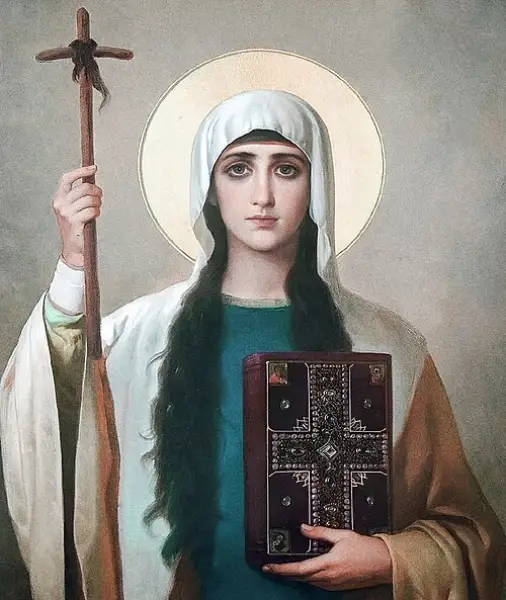
Saint Nino, also honoured as Nune, Nina, or Ninny, was the woman who preached Christianity in the Kingdom of Iberia within what is now Georgia, and whose preaching brought about the Christianization of that realm. Traditional accounts describe her as a member of a Greek-speaking Roman family from Kolastra in Cappadocia and a relative of Saint George. As a young woman she fled the persecution of Emperor Diocletian, received a vision of the Virgin Mary, and was given a grapevine cross with a command to carry the faith to Iberia. There she won converts through her teaching and her healings, converting Queen Nana and finally King Mirian III, who after being blinded on a hunting expedition recovered his sight by praying to Nino's God. Around 326 Mirian proclaimed the faith the religion of his realm, and Iberia thus took its place among the earliest of all Christian states. Nino preached among the Georgians until her death at Bodbe in Kakheti, where her tomb is still venerated at the Bodbe Monastery. She ranks among the most beloved saints of the Georgian Orthodox Church, and her grapevine cross remains an emblem of Georgian Christianity.
The Complete Life
A Family of Cappadocia
The origins of Saint Nino are preserved in outline rather than detail. Her ethnic background cannot now be established with certainty, but she was born in Cappadocia, a region of many peoples, and it is certain that she spoke both Greek and Hebrew. Tradition places her family at Kolastra and describes them as Greek-speaking Romans of standing. According to some accounts she came from an aristocratic house: her father, Zabulon, held high command in the Roman army under Maximian, and her mother, Susanna, appears in later recensions of her life as sister to the Patriarch of Jerusalem. Georgian church tradition adds that Nino was related to the Great Martyr Saint George, and some sources make him a friend of her father. When Nino was about twelve years old her parents resolved to give themselves wholly to God: they sold everything they owned and gave the money to the needy, then went up to Jerusalem, where the father entered monastic life while the mother devoted herself to nursing the ailing sisters. Their daughter was entrusted to a devout woman named Sarah Miafore, who lived near the church in Jerusalem and supervised the girl's upbringing in the holy city.
§ Early life
The Call and the Journey
Nino's vocation took shape in Jerusalem and in flight. She heard from a woman who had come from Ephesus that the Empress Helena intended to receive baptism, and the news kindled in her a longing to make her way to Constantinople, to stand before the Empress and speak there for God. The Patriarch gave the journey his blessing and placed a cross in her hands, and she departed with her Ephesian companion. For two years the pair remained at Ephesus under the roof of the noblewoman Hripsime, who under Nino's guidance converted together with forty members of her household. Persecution then scattered them: to escape Emperor Diocletian, Nino, Hripsime, Hripsime's nurse Gayane, and the other virgins fled towards the Caucasus, and the group was martyred in Armenia, Nino alone escaping to Kartli. Another tradition relates that she intended from the first to venerate the tunic of Christ preserved at Mtskheta, and that the Virgin Mary appeared to her in a vision, blessing her mission and handing her a cross made of grapevine, which Nino bound in her hair upon waking. At fourteen, other accounts say, she had already resolved to go and preach Christ in Kartli.
§ Early life
The Conversion of Iberia
Reaching the ancient Georgian kingdom through the Javakheti mountains, Nino first settled at Urbnisi, spending a month within the Jewish community to learn local customs, and quickly mastered the Georgian language, aided perhaps by the Armenian she had learned from her protector Sarah Miafore. Her preaching gathered disciples, among them Salome of Ujarma, Perozhavra of Sivnia, and Abiathar and Sidonia, and her work was marked by miraculous healings, notably that of Queen Nana, who became a Christian. King Mirian at first persecuted his wife's new faith and threatened to divorce her, but while hunting he was suddenly struck blind, and in darkness he prayed to the God of Nino, vowing to raise a cross and build a house of prayer if delivered. Light returned at once, the king was baptised as the first Christian ruler of Iberia, and in 326 he raised the faith of Christ to be the religion of the realm, and Iberia became, after Armenia, the second Christian state in the world. At the converts' petition Emperor Constantine sent priests to Kartli, the royal house and the people of Mtskheta were baptised at the meeting of the Aragvi and Mtkvari rivers, crosses were raised where idols had stood above Mtskheta, on Mount Tkhoti, and at Ujarma, and churches rose at Svetitskhoveli, Ninotsminda, Sioni, and Nekresi.
§ In Iberia
Bodbe and the Holy Death
Nino did not rest once the kingdom had turned to Christ. With priests and royal envoys at her side she pushed her preaching up into the hill country of eastern Georgia, so that the faith she had planted in the capital might take root among the remote districts as well. In her last years she withdrew to Bodbe in Kakheti, and it was there that she died, her work among the Georgians complete. Her death did not end her presence in the land. King Mirian moved at once to honour the woman who had converted him, beginning the construction of a monastery at Bodbe, and her tomb may be seen there in the churchyard to this day. The Bodbe Monastery remains the principal shrine of her cult, a place where Georgian pilgrims have kept vigil over the enlightener's grave for some sixteen centuries. The quiet conclusion of her life, in a hillside convent far from courts and capitals, belies its consequence: the kingdom she converted never returned to the old gods, and the church she founded grew into one of the most distinctive of the ancient Christian East.
§ Final Years
Veneration and Feast Days
The church's memory of Nino took formal shape early and has never faded. She is honoured as Equal to the Apostles and as the Enlightener of Georgia, venerated across the Eastern Orthodox, Catholic, and Oriental Orthodox traditions, and her cult was recognised in the ancient kingdoms of Iberia and Armenia where her work was remembered. Her commemoration is unusually rich in dates. The main feast falls on 14 January in the new calendar. Her entrance into Kartli is remembered on 19 May, dated by the old chronicles to the year 303, with the corresponding old-calendar observance on 1 June. Her parents Zabulon and Susanna are commemorated on 20 May, a general Georgian commemoration follows on 23 May, the Armenian church keeps her memory on 29 October, and an older Catholic observance falls on 15 December. Few saints of any land receive so many days of remembrance, a measure of how deeply the enlightener entered the affection of the Georgian people, for whom her name and her grapevine cross have become inseparable from Christian identity itself. Pilgrims still climb to Bodbe to stand at the tomb, and the multiple feasts carry her memory through the church's year from the depths of winter to the days of early summer, so that no season of Georgian Christian life passes without her intercession being asked.
§ Feast days
An Enduring Name
Nino's afterlife in Georgian and world Christianity has been constant. Deep in the Georgian countryside, Abbess Elizabeth, joined by two novices, brought the Phoka Convent of Saint Nino into being, who first lived in a house belonging to Patriarch Ilia II before moving in 1992 to the site of an eleventh-century church in order to restore it. In the United States, the Sacred Monastery of Saint Nina in Union Bridge, Maryland, established in September 2012 under the Patriarchate of Georgia's North American Diocese, carries her monastic tradition to the New World. Her hold on the Georgian imagination is measured most simply in names: No name is given more often to women and girls in Georgia today than Nino and its variants, borne by tens of thousands recorded by the Ministry of Justice and the name still chosen constantly for newborn daughters. Her grapevine cross stands beside the crosses of Saint George and Bolnisi among the chief symbols of the nation, and in 1997 her parents Zabulon and Susanna received canonization in their own right, completing the family whose obedience once set their small daughter on the road to Iberia.
§ Legacy
Timeline
- 303
Tradition records her entrance into Georgia, commemorated each year on the feast of her coming to Kartli
§ Feast days
- 326
King Mirian III makes Christianity the state religion of Iberia after his conversion through Nino's teaching
§ In Iberia
- 403
Rufinus composes the oldest surviving account of her life in his Latin Historia ecclesiastica
§ Sources
- 1992
The Phoka Convent of Saint Nino moves to the site of an eleventh-century church it is restoring
§ Legacy
- 1997
Her parents Zabulon and Susanna are canonised
§ Legacy
- Sep 2012
The Sacred Monastery of Saint Nina is established by Georgian Orthodox nuns in Union Bridge, Maryland
§ Legacy
In Their Own Words
After the church had been built with due magnificence, the people were zealously yearning for God's faith. An embassy was sent on behalf of the entire nation to the Emperor Constantine in accordance with the captive woman's advice. The foregoing events are related to him, and a petition submitted, requesting that priests be sent to complete the work that God had begun.
The Record
- Patron of
- Georgia
- Symbols
- Grapevine cross
- Canonization
- Pre-congregation; venerated by the Georgian, Russian, Eastern Orthodox, Catholic, and Oriental Orthodox Churches
Prayer
Bibliography
Show 7 sources
- Amiranashvili, Gulbadi (2025). Historical Chronology of Hagiography of Saint Nina and the Date of Which Kartli (Eastern Georgia) Was Converted to Christianity. Tbilisi: Logos. ISBN 978-9941-0-7454-7.
- Lang, David Marshall (1956). Lives and Legends of the Georgian Saints: Selected and Translated from the Original Texts. Second revised edition. Crestwood, New York: St. Vladimir's Seminary Press.
- Sauget, Joseph-Marie (1967). Nino. Vol. 9. Rome: Giovanni XXIII Institute of the Pontifical Lateran University.
- Chkhartishvili, M.; Kvlividze, N. V.; Shevchenko, E. V. (2018). Nina. Vol. 51. Moscow: Church-Scientific Center "Orthodox Encyclopedia".
- Farrugia, Edward G.; Ambros, Pavel (2010). Nino. Ed. Gaga Shurghaia. Olomouc: Refugium Velehrad-Roma.
- Wardrop, Margery (2006). Life of Saint Nino. Piscataway, New Jersey: Gorgias Press.
- Great Russian Encyclopedia. Vol. 23. Moscow, 2013, p. 55.
Profile text adapted from the Wikipedia article, licensed CC BY-SA 4.0.
Pray with this saint every day
Save St. Nino to your favorites, read the full profile, and get feast-day reminders in the Saints app.
Get the Saints AppFree on the App Store for iPhone and iPad