
died 1 September 673·Feast September 1
St. Nivard
Bishop of Reims and benefactor of Hautvillers Abbey
Overview
Nivard served as Bishop of Reims throughout the Merovingian era, presiding over the see from approximately 649 until his death in 673. Born into a noble Frankish family, he was brother-in-law to King Childeric II and received his education at the court of King Dagobert I in Metz before being ordained in the court of Clovis II. Nearly everything known of his episcopate comes from the Frankish priest and chronicler Flodoard and later ecclesiastical writers, who remembered him above all for generosity, considerable wealth, and a commitment to living modestly. He enlarged the estate of the church of Reims with dwellings, farmland, and bound laborers, and won from the crown exemption from particular levies. Near 650 he joined Berchaire in restoring Hautvillers Abbey, and in 664 he raised, from money of his own, the abbey of Saint-Basle de Verzy, plus numerous further churches and dwellings. Scholars also credit him with instituting a privilege recognizing the right of monks at Saint-Basle de Verzy and Hautvillers to elect their own abbot. He died on 1 September 673 and was buried at Hautvillers Abbey, where his relics are still held.
The Complete Life
A Nobleman of the Frankish Court
Nivard belonged to a Merovingian noble family of consequence, a circumstance that shaped the whole course of his life. His kinship tied him to the royal house itself; he was the brother-in-law of King Childeric II. Like other promising sons of the aristocracy, he was sent to be educated at the court of King Dagobert I in Metz, where the sons of Frankish magnates learned the arts of governance and the etiquette of power alongside their letters. From there he passed into the service of Clovis II and was ordained within the royal court, a path that joined ecclesiastical office to worldly advancement. The chronicler Flodoard, writing from Reims, preserves nearly all that is known of him, and later compilers such as those of the Gallia christiana drew on the same traditions. These sources describe a man converted early from the ambitions of the palace to a life of illustrious character, one who would carry the habits of generosity learned among kings into the government of a great metropolitan church. The great households of the Merovingian world expected such sons to serve both king and church, and Nivard's family was no exception. The schooling he received at Metz joined the inheritance of classical learning to the practical business of administering a kingdom, and the young nobleman moved easily among the great men of the realm.
§ Life
Shepherd and Builder of the Church of Reims
As bishop, Nivard governed the see of Reims through the reigns of Chlothar III, Childebert the Adopted, and Childeric II. Contemporaries remembered him primarily for generosity joined to modest living: though he possessed considerable wealth, he devoted it to the church rather than to display. Flodoard records with gratitude how he enriched the church of Reims, securing houses, lands, and slaves to expand its patrimony, and how he obtained a royal privilege of immunity that freed it from certain taxes. His building work extended beyond the metropolitan city. Around the year 650, together with St. Berchaire, he is credited with rebuilding Hautvillers Abbey above the Marne. In 664 he erected the abbey of Saint-Basle de Verzy with money from his own purse, together with more churches and dwellings. Most distinctively, historians of religious institutions attribute to him a singular grant of exemption guaranteeing the monks of Saint-Basle de Verzy and Hautvillers the freedom to choose their abbot for themselves, embedding freedom in the very structure of the communities he patroned. The monasteries of his foundation owed to this patronage not merely their lands but their liberty, a legacy that later generations at Reims recorded with particular gratitude. Few bishops of his century left so practical a mark on the material and spiritual life of their church.
§ Life
The Dream of the Dove and a Living Memory
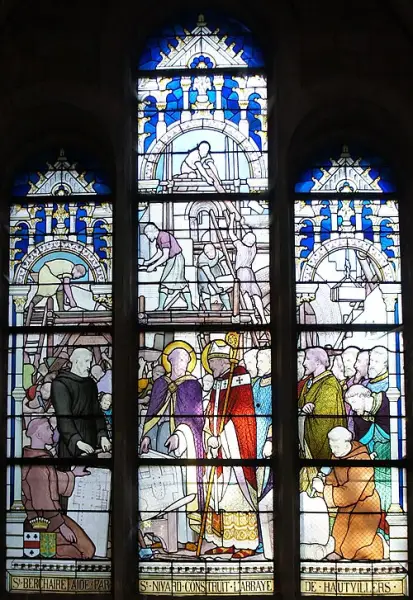
Nivard was venerated as a saint long before the Catholic Church instituted the modern investigations of the Congregation for the Causes of Saints, his cult arising naturally from the gratitude of the monasteries he had served. According to legend, he and St. Berchaire chose the site of Hautvillers Abbey after each had seen in sleep a dove come down from the sky and settle on a tree, an omen they took for the leading of the Holy Spirit. When Nivard died on 1 September 673, he was buried at the abbey he had helped rebuild, and his relics remain there still. Artists preserved the story in paint and glass: stained glass at Hautvillers depicts him with Berchaire, and an eighteenth-century canvas by Claude Charles shows the saint giving the plans of the monastery. Artists most often show him either raising the walls of Saint-Pierre d'Hautvillers with Berchaire or asleep beneath the heavenly bird. Folklore about him lived long in the region, and the fourteenth-century poet Eustache Deschamps played upon it in some of his narrative works. His feast is kept on 1 September.
§ Veneration as a Saint
Timeline
- 649
Presumed to have succeeded Lando as Bishop of Reims, though most sources place his service before 667.
§ Life
- 650
Credited with rebuilding Hautvillers Abbey alongside St. Berchaire.
§ Life
- 664
Erected, at his own cost, the abbey of Saint-Basle de Verzy, together with more churches and dwellings.
§ Life
- 1 Sep 673
Died and was buried at Hautvillers Abbey.
§ Life
In Their Own Words
been converted first in the king's court as a man of illustrious character
The Record
- Major works
- Rebuilding of Hautvillers Abbey·Foundation of the monastery of Saint-Basle de Verzy·Privilege of immunity and free abbatial election for his monasteries
- Symbols
- Depicted beside St. Berchaire building the abbey of Saint-Pierre d'Hautvillers·Dreaming of a dove descending from heaven
- Canonization
- Pre-congregation; venerated as a saint before the modern investigations of the Congregation for the Causes of Saints
Prayer
Bibliography
Show 5 sources
- Duchesne, Louis (1915). Fastes épiscopaux de l'ancienne Gaule, Tome III. Paris: E. de Boccard. pp. 84-85
- Sot, Michel. La fonction du couple saint évêque/saint moine dans la mémoire de l'Église de Reims au Xe siècle. In: Les fonctions des saints dans le monde occidental (IIIe-XIIIe siècle). Rome: École Française de Rome, 1991. pp. 225-240.
- Sainte-Marthe, Denis de (1751). Gallia christiana, in provincias ecclesiasticas distributa. Vol. 9: de provincia Remensi. Paris: ex Typographia regia. pp. 21-22.
- Holweck, Frederick George (1969). A biographical dictionary of the saints, with a general introduction on hagiology. Detroit: Gale Research Co. p. 746.
- Montalembert, Charles Forbes, Comte de (1896). The Monks of the West, from St. Benedict to St. Bernard. Vol. 2. J.C. Nimmo. p. 363.
Profile text adapted from the Wikipedia article, licensed CC BY-SA 4.0.
Pray with this saint every day
Save St. Nivard to your favorites, read the full profile, and get feast-day reminders in the Saints app.
Get the Saints AppFree on the App Store for iPhone and iPad