
5th – 6th century·Feast March 3 (also kept on 2 or 5 March in some calendars)
St. Non
Mother of Saint David, patron of Wales
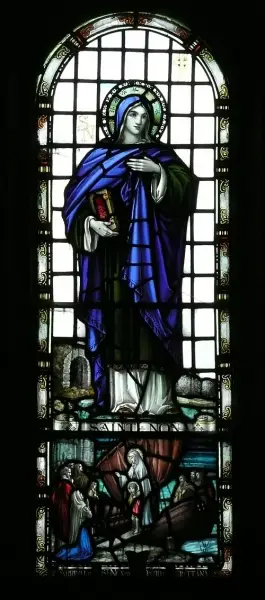
Overview
Saint Non, also called Nonna or Nonnita, is remembered by Christian tradition as the mother of Wales's patron saint, David. The chief source for her life is Rhigyfarch's Life of St David, written around 1095, which describes her as a nun at Ty Gwyn near Whitesands Bay in Pembrokeshire, though she may have taken the veil later as a widow. Tradition holds that she was violated by Sanctus, king of Ceredigion, and that the child of that violence was David, after whose conception Non lived a life of strict celibacy on bread and water alone. Portents surrounded her pregnancy and her delivery, which a storm made solitary except for the light that bathed the birthplace. Variations of her legend make her the daughter of the nobleman Cynyr of Caer Goch, the founder of a convent at Llanon, and a traveller to Cornwall who ended her days in a Breton convent. She died at Dirinon in Brittany, where her shrine survives, though an alternative legend gives her martyrdom at Bradstone in Devon.
The Complete Life
A Nun of Pembrokeshire
Whatever can be known of Non comes through the legend assembled for her son. Rhigyfarch, the Norman cleric whose father had governed the see of Saint David's for a decade, set down the Life of St David around 1095, and his account is the main source for the mother as well as the child. He describes Non as living the religious life at Ty Gwyn, the white house that stood close by Whitesands Bay in Pembrokeshire, though it is possible that she entered religious life only later, as a widow. Other traditions give her a different family origin, making her the daughter of Cynyr of Caer Goch, a nobleman of Pembrokeshire. Her name, in the forms Non, Nonna, and Nonnita, was ancient enough that later students observed how fittingly names meaning Holy and Nun might be imagined for the parents of a great saint. The historical woman behind the stories cannot now be recovered, but the tradition is unanimous in placing her in southwestern Wales in the fifth century, in the generation from which the patron saint of Wales emerged, and in honouring her from an early date as the mother through whom that grace came to the Welsh church.
§ Legend
Suffering and the Birth of David
The central story of Non's life is one of violence transformed. Tradition holds that she was raped, and that from that violation David was conceived; Rhigyfarch relates that she was piteously violated by one of the realm's princes, and he names the offender as Sanctus, king of Ceredigion, who came upon her while riding through Dyfed. After the conception Non remained celibate both before and after, and lived on bread and water alone. Signs gathered around her unborn child: a preacher discovered that he could not deliver his sermon while the unborn child was near, a sign readers took to mean that David would preach mightily in his turn. When a local ruler, possibly Vortiporius, learned of the pregnancy he feared the child's power and plotted to kill him at birth, but on the day of labour a great storm made travel impossible. Only the place where Non groaned in childbirth stood bathed in light, and her pain was so great that her fingers left marks on the rock she grasped, while the stone split asunder in sympathy. A church was afterwards raised on the spot, and the stone was hidden in the foundations of its altar.
§ Legend
Wells, Chapels, and Relics
The geography of Non's cult stretches across Wales, Cornwall, and Brittany. The place of David's birth is called Capel Non and is marked by the Chapel of St Non, beside which flows her holy well; nearby stand a retreat house and the chapel of Our Lady and Saint Non built in 1934, all of them an easy walk from the Pembrokeshire coast path. Churches in Devon, Ceredigion, and Carmarthenshire are likewise dedicated to her, and variations of her story place her bringing up David at Henfeynyw near Aberaeron and founding a convent at what is now Llanon, a village that keeps her name. Her relics were first venerated at Altarnun in Cornwall, where medieval glass above the altar may still depict her and where a well long served for the immersion of the insane in hope of cure, until the Reformation destroyed them. She is also the patron of Pelynt in Cornwall, where St Nonna's Holy Well survives. Her death came at Dirinon in Brittany, a short distance inland from Brest, and her grave in the parish church there can be seen to this day, though an alternative legend makes her a martyr killed by druids at Bradstone in Devon, where the church is dedicated to her.
§ Veneration
A Feast Kept Many Ways
Non's liturgical commemoration has never been reduced to a single date, a sign of a cult that grew locally rather than by decree. Her feast is given as 2 March by Mullins and by the eighteenth-century text of Browne Willis cited by Rees, while Nash Ford identifies 3 March as the date of her death, a date also recognised by Simpson. The 1995 revision of the Church in Wales calendar lists her under 5 March. At the parish of Pelynt, which keeps St Nonna's Holy Well, her feast is celebrated not in spring at all but on the second Sunday after Midsummer's Day. In the Roman Catholic Church she has no current liturgical commemoration: the 2004 Roman Martyrology omits her, and she is equally absent from the Roman Catholic calendar for Wales. She is nevertheless venerated in the Eastern Orthodox, Anglican, and Roman Catholic traditions as a saint of the early Welsh church, honoured wherever her wells and chapels survive, and remembered above all in the company of her son David, whose feast the Welsh keep with hers in the first days of March.
§ Veneration
Timeline
- 1095
Rhigyfarch writes the Life of St David, the principal source for Non's story
§ Legend
- 1934
A chapel dedicated to Our Lady and Saint Non is built near her birthplace and holy well
§ Veneration
- 1995
The revised calendar of the Church in Wales lists her under 5 March
§ Veneration
- 2004
She does not appear in the new edition of the Roman Martyrology, remaining outside the current Roman Catholic liturgy
§ Veneration
In Their Own Words
unhappily seized and exposed to the sacrilegious violence of one of the princes of the country
The Record
- Patron of
- Raped women·Pelynt, Cornwall
- Canonization
- Pre-congregation; ancient Celtic cult, never formally canonized and absent from the 2004 Roman Martyrology
Prayer
Bibliography
Show 8 sources
- Rees, Elizabeth (2003). An Essential Guide to Celtic Sites and their Saints. Burns & Oates, pp. 128-129, 145-146, 208-209, 224-225. ISBN 9781336210431.
- Farmer, David Hugh (2004). The Oxford Dictionary of Saints. Oxford University Press. ISBN 978-0-19-157952-3.
- Stanton, Richard (1892). A Menology of England and Wales. London: Burns & Oates, p. 99.
- Davies, Oliver (1999). "The Life of St. David by Rhigyfarch". Celtic Spirituality. Paulist Press, pp. 191-212. ISBN 9780809138944.
- Nash Ford, David (2001). "St. Non". Early British Kingdoms.
- Mullins, Daniel J. (2003). Early Welsh Saints. Carreg-Gwalch Press, p. 32.
- Simpson, Ray (2003). Saints of the Isles: A Year of Feasts. Kevin Mayhew, p. 105.
- Ferrar, John William (1920). The Saints of Cornwall. London: Society for Promoting Christian Knowledge, p. 32.
Profile text adapted from the Wikipedia article, licensed CC BY-SA 4.0.
Pray with this saint every day
Save St. Non to your favorites, read the full profile, and get feast-day reminders in the Saints app.
Get the Saints AppFree on the App Store for iPhone and iPad