
c. 305 – 374·Feast August 5
St. Nonna of Nazianzus
Matron of Cappadocia and mother of Gregory the Theologian
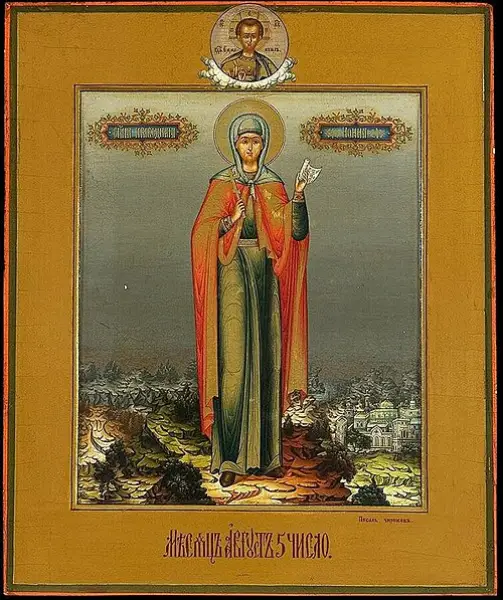
Overview
Nonna, matron of Nazianzus, belonged to the great Cappadocian church family: spouse of Gregory the Elder and mother to three canonized children, Gregory the Theologian, Caesarius, and Gorgonia. Her home stood in Cappadocia, an imperial Roman province occupying what is now Turkey's central plateau; her birth, at Nazianzus, fell around the year 305. After her marriage she won her husband to Christianity; he had been an adherent of the Hypsistarians, whose mixed Jewish-pagan cult adored Hypsistos, the supreme God, and through her patience and prayer he entered the Church and eventually served as its bishop. Nonna bore three children, each of whom was afterwards honoured as a saint, and the most famous of them, Gregory the Theologian, held her up to the ages as a model of Christian motherhood, writing that though in body she was but a woman, in spirit she was above all men. In 351 she fell gravely ill and seemed near death, but recovered after a dream in which her son handed her hallowed loaves bearing the cross. Her husband and two of her three children went before her in death; she herself died in 374. Her feast is kept on August 5, and she is invoked for the death of children and by information services.
The Complete Life
Born in the Cappadocian Heartland
Nonna was born around the year 305 in Nazianzus, a small city of Cappadocia, the inland province of the Roman Empire that lies in present-day central Turkey, near the modern town of Nenizi in Aksaray Province. She came of a pious family, and her faith would prove the defining force of her life. In marriage she was joined to Gregory of Nazianzus the Elder, a man who at that time did not share her Christianity: he belonged to the Hypsistarians, a Jewish-pagan sect whose adherents worshipped Hypsistos, the Most High God. Into that divided household Nonna brought her own unwavering devotion, and by her patience she accomplished what preaching alone could not, converting her husband to the Christian faith. The convert of her prayers would go on to serve as bishop of Nazianzus, and the marriage that began in religious asymmetry became one of the great Christian households of the fourth century, fruitful in children, in piety, and in the history of the Church.
§ Life
Mother of Three Saints
Nonna bore three children, and each of them was afterwards venerated as a saint: Gregory, whom the Church honours as Gregory the Theologian; Caesarius; and a daughter, Gorgonia. It is a distinction shared by few mothers in the history of Christianity, and it made her household at Nazianzus a nursery of holiness for the whole Cappadocian Church. Her most famous son championed her as a model of Christian motherhood and wrote of her in words that have kept her memory green for sixteen centuries: his father's worthy companion, no less gifted than he; sprung from a devout family yet outdoing them in devotion; frail in body alone, for her spirit towered over men; truthful in speech yet too modest to recount the deeds that honoured her; ruled throughout by the fear of God. Such was the testimony borne by the greatest rhetorician of his age to the woman who had formed him.
§ Life
Illness, Vision, and Recovery
Her son Gregory records a striking crisis of the year 351: Nonna was stricken gravely ill and seemed to stand at death's door. Gregory, headed elsewhere to call on a friend, diverted at once to her bedside, and by then she had begun to mend. She told him of a vision received in her extremity: she had beheld Gregory presenting her with hallowed loaves signed with the cross; from that hour her strength came back. The account, preserved by the son whose name she bore in her healing, reveals the texture of her spirituality, a Christianity of family intercession, of the cross traced over bread, and of confidence that the prayers of a mother and a son ascend together. It also shows the closeness of the bond between Nonna and the child whose eloquence would defend the divinity of Christ, a bond that neither distance nor danger ever loosened.
§ Life
A Long Life and a Blessed Death
Nonna lived to a great age for her turbulent century, closing her life in the year 374. Her final years carried the sorrows as well as the honours of a long matronhood, for she outlived her husband, Gregory the Elder, and two of her three children, standing at their bedsides as she had once stood at the font of her husband's conversion. The wife who had brought a Hypsistarian seeker to Christ now went ahead of most of her family into the presence of the God she had served. She died in the land of her birth, remembered in Nazianzus as the mother of its most famous son and honoured soon after by the whole Church. Her children's fame never eclipsed her own; Gregory the Theologian always spoke of his mother as his father's equal in virtue, and the Church took his praise as her verdict, enrolling the matron of Nazianzus among the saints of both East and West.
§ Life
Patronage and the Sisterhood of Saint Nonna
The memory of Nonna has grown in ways she could never have foreseen. In the Catholic tradition she is invoked for the death of children, a patronage born from her own experience of burying two of her three saints, and, more unexpectedly, she has been named patron of information services, a title traced to a 1998 study of her life by Catholics United for the Faith. In the Orthodox world her influence continues institutionally through the Sisterhood of Saint Nonna, an organization for wives of clergy that takes her as its model of the presbytera's vocation, the woman who stands beside a man of God and quietly sustains his ministry as she once sustained her bishop-husband. Artists have portrayed her alongside her family in the story of Cappadocian Christianity, and her feast on August 5 is kept in both the Roman Catholic Church and the Eastern Orthodox Church. For mothers, wives, and all who convert by prayer rather than argument, Nonna of Nazianzus remains the timeless example of holiness lived at home.
§ Life
Timeline
- 305
Born at Nazianzus in the Roman province of Cappadocia, in present-day central Turkey.
§ Life
- 351
Fell sick with a severe illness and seemed near death, but recovered after a vision of her son Gregory bringing her cakes marked with the cross and blessed.
§ Life
- 374
Died; her husband and two of her three children had gone before her.
§ Life
In Their Own Words
My mother was a worthy companion for such a man and her qualities were as great as his. She came from a pious family, but was even more pious than they. Though in her body she was but a woman, in her spirit she was above all men... Her mouth knew nothing but the truth, but in her modesty she was silent about those deeds which brought her glory. She was guided by the fear of God...
The Record
- Patron of
- Death of children·Information services
- Symbols
- Matron's dress of a Cappadocian Christian household
- Canonization
- Pre-congregation; venerated as a saint in both the Roman Catholic Church and the Eastern Orthodox Church.
Prayer
Bibliography
Show 4 sources
- Clark, Cat (1998-11-05). "Saint Nonna, Patron of Information Services" (PDF). Catholics United for the Faith. Archived from the original (PDF) on 2007-09-27
- Jones, Terry. "Nonna". Patron Saints Index. Archived from the original on 2007-03-22
- Dunbar, Agnes (1904). A Dictionary of Saintly Women. George Bell & Sons. pp. 108-109
- Rabenstein, Katherine (August 1998). "Nonna of Nazianzen, Matron". Saints O' the Day for August 5. Archived from the original on February 6, 2007
Profile text adapted from the Wikipedia article, licensed CC BY-SA 4.0.
Pray with this saint every day
Save St. Nonna of Nazianzus to your favorites, read the full profile, and get feast-day reminders in the Saints app.
Get the Saints AppFree on the App Store for iPhone and iPad