
c. 1080 – 1134·Feast June 6
St. Norbert of Xanten
Founder of the Premonstratensians and Archbishop of Magdeburg
Overview
Norbert of Xanten, also known as Norbert Gennep, led the see of Magdeburg as its archbishop and founded the Premonstratensian canons regular. The third son of a nobleman, he entered the world around 1080, he was groomed for an ecclesiastical career and held a comfortable canonry at St. Victor in Xanten and the post of almoner at the imperial court of Henry V. A lightning storm and a fall from his horse brought a profound conversion, after which he embraced a penitent life, resigned his benefice, sold his property for the poor, and took up the life of a wandering evangelist through the Rhineland, the Low Countries, and northern Gaul. Summoned by Pope Calixtus II to found an order in the Diocese of Laon, he established the Canons Regular of Prémontré on Christmas Day 1120, uniting the Rule of St. Augustine with Cistercian discipline. In 1126 Pope Honorius II appointed him Archbishop of Magdeburg, where his reforms drew several assassination attempts. He defended the Church's rights during the Investiture Controversy, supported Pope Innocent II against the antipope, and served as chancellor and adviser to Emperor Lothair II. He died in Magdeburg on 6 June 1134.
The Complete Life
Courtier of the Empire
Norbert was born around 1080 at Gennep in the Archbishopric of Cologne, the third son of a nobleman of the Holy Roman Empire. His parents destined him for an ecclesiastical career and gave him a careful education, and in due course he took the minor orders up to subdeacon. The course marked out for him was one of comfortable distinction rather than pastoral zeal: he obtained a canonry at the church of St. Victor in Xanten, and his abilities caught the eye of the imperial court. Holy Roman Emperor Henry V was impressed with the young man and appointed him almoner, placing him in charge of the distribution of the emperor's alms, an office of trust and visibility at the center of power. Norbert thus held worldly position and churchly office together, living the life of a courtier-cleric that so many reformers of the age condemned. Nothing in his first four decades suggested the radical conversion to come; he was, by every appearance, a career churchman of the imperial establishment, at home among the great men of the empire. In the Germany of his youth, the great conflict between emperor and pope over the right to invest bishops was still fresh, and the luxury of the imperial church was a scandal already provoking voices of reform. Norbert's family saw in him simply a promising careerist, and for many years he saw himself no differently.
§ Early life
The Lightning and the Turn to Penance
The turning point came suddenly. Riding one day, Norbert was hurled from his saddle when a flash of lightning terrified the beast; he read the accident as God's summons. Back at Xanten he embraced a life of strict penance and devotion. Grieved to the heart over his former worldliness, he gave himself to prayer, fasting, and physical mortification, and began to preach against the worldliness of the clergy around him. The other canons of St. Victor denounced him as an innovator at the Council of Fritzlar in 1118. In response, Norbert gave up his benefice, liquidated everything he owned, and handed the whole sum to the poor, severing himself from every tie of wealth and position. He visited Pope Gelasius II, who granted him permission to become an itinerant preacher. With his earliest companions he set out walking barefoot through the snows of midwinter; his own zeal seemed impervious to the cold, but his companions grew sick and died, a cost that shadowed the austerity of his new vocation. The change was total: the almoner of the emperor became a beggar for the poor of Christ, and the courtier of Henry V a pilgrim on the roads of Europe. Contemporaries found the spectacle unforgettable, and the story of the lightning and the fall passed quickly into his earliest biographies.
§ Early priesthood
Preacher of the Roads, Founder of Prémontré
Commissioned as a wandering preacher, Norbert journeyed through the Rhineland, the Low Countries, and northern Gaul, working wonders and confronting a demoralized clergy, lonely and often practicing concubinage. In Paris he saw the Canons of St. Victor and the ascetic ideals of William of Champeaux; at Clairvaux and Cîteaux he studied the Cistercian reforms and their Charter of Charity, lessons that would shape his own foundations. At the Council of Reims in October 1119, Pope Calixtus II asked him to found a religious order in the Diocese of Laon. On Christmas Day 1120, in a valley of the Forest of Coucy granted by the bishop of Laon and named Prémontré, he established the Canons Regular of Prémontré on the Rule of St. Augustine, tempered with Cistercian custom. Thirteen first disciples took vows; within a year they numbered forty. Houses soon spread through Germany, France, Belgium, and Hungary. In 1122 he instituted a Third Order for laypeople, and in Antwerp his preaching broke the eucharistic heresy of Tanchelm, earning him the title Apostle of Antwerp. His preaching drew both acclaim and hostility, for the corruption he attacked was entrenched, and not every bishop welcomed a freelance evangelist in his diocese. Yet the demand for his preaching outpaced opposition, and the pope's charge to found an order gave his itinerant zeal a permanent home.
§ Canons Regular of Prémontré
The Active Life Sheltered by Contemplation
Norbert's vision of religious life joined apostolic work to monastic interiority. For his canons he chose the Rule of St. Augustine, already common among communities of priests, and adapted customs of the Cistercians, more of which were later added by his successor Abbot Hugh of Fosse. The design of the community was deliberate: his priests preached and served in the active ministry of the world, and the abbey discipline existed to give them an ascetic and contemplative haven, so that their public labor would be nourished by common prayer and rigorous poverty. The earliest brothers sheltered in rude huts of timber and mud, pitched about the chapel of Saint John the Baptist like a military camp, until a greater church and monastery could be raised. When Norbert went to Cologne seeking relics for the new church, a dream, so the story runs, showed him the hiding place of the martyrs Ursula and Gereon and of those who suffered beside them. He counseled Count Theobald II of Champagne not to abandon the world but to marry and remain a faithful layman, investing him with the white scapular, a breadth of vision that embraced every state of life.
§ Canons Regular of Prémontré
Archbishop, Chancellor, and Defender of the Papacy
The year 1126 brought Norbert the archbishopric of Magdeburg from Pope Honorius II, and there he labored to apply the precepts of Prémontré to the reform of a lax and resistant cathedral chapter. His zeal for discipline was so unwelcome that several assassination attempts were made against him. He proved a steadfast defender of the Church's rights against secular power during the Investiture Controversy, and when the double election of 1130 split the papacy, Norbert supported Pope Innocent II and firmly resisted Antipope Anacletus II. In his last years he served as chancellor and adviser to the Holy Roman Emperor Lothair II, and it was Norbert who persuaded the emperor to lead an army to Rome in 1133 to restore Innocent to the papal throne. He died at Magdeburg on 6 June 1134, leaving behind an order already established across Europe and a reputation for fearless integrity in the collision of spiritual and temporal power. The work cost him dearly: the chapter he endeavored to reform resisted him to the point of violence, and his closeness to the imperial court drew criticism from those who wanted the German church free of royal entanglement. He bore both without slackening his course.
§ Archbishop of Magdeburg
Raised to the Altars
Devotion to Norbert grew swiftly among the canons whose order he had founded. He was canonized by Pope Gregory XIII on 28 July 1582 in Rome, and his statue was placed above the Piazza colonnade of St. Peter's Square, among the founders who overlook the great basilica. His memory is kept on 6 June, the day of his death at Magdeburg. His body became itself a token of the turbulent history of northern Europe: after his death, the cathedral canons and the canons of St. Mary's Abbey each claimed it, until Emperor Lothair III decreed burial in the Norbertine Abbey. When Martin Luther preached in Magdeburg in 1524 the city turned Protestant, and for a century the Abbey of Strahov in Prague sought to recover the founder's remains. Only after several military defeats of the emperor Ferdinand II did the abbot of Strahov succeed, and on 2 May 1627 the relics at last reached Prague, where they still lie today beneath glass in the form of a robed auto-icon. The canons of his order kept his memory with particular devotion, and his cult spread with the houses of Prémontré through the centuries that followed his death.
§ Veneration
A Order Without Borders
The Premonstratensian, or Norbertine, canons carry Norbert's foundation into the present. The order's houses now stretch from Europe to the United States, Canada, Britain, South America, Zaire, South Africa, India, and Australia, engaged in education, parochial ministry, university chaplaincy, and youth work, the modern continuations of the active apostolate joined to contemplative discipline that Norbert designed. His patronage extends over the Kingdom of Bohemia, now the Czech Republic, and over Magdeburg, and he is invoked by the faithful during childbirth for safe delivery. His image stands in prominent places of Catholic memory: on the colonnade of St. Peter's Square in Rome and among the statues of saints Norbert, Wenceslaus, and Sigismund on the Charles Bridge in Prague, in the heart of the Bohemia that honors him. St. Norbert College in De Pere, Wisconsin, houses the Center for Norbertine Studies, a scholarly memorial to a founder whose order of white canons still walks the line he drew between the cloister and the world. Few founders of the twelfth century left an institution so durable and so widely spread, and few combined so boldly the ideals of the cloister with service in the world.
§ Legacy
Timeline
- 1080
Born at Gennep in the Archbishopric of Cologne, the third son of a nobleman.
§ Early life
- 1118
Denounced as an innovator by the canons of Xanten when he preached against worldliness at the Council of Fritzlar.
§ Early priesthood
- Oct 1119
At the Council of Reims, Pope Calixtus II requested that he found a religious order in the Diocese of Laon.
§ Canons Regular of Prémontré
- 25 Dec 1120
Established the Canons Regular of Prémontré in the Forest of Coucy on Christmas Day.
§ Canons Regular of Prémontré
- 1121
The community at Prémontré had grown to forty members, who took their vows and formally founded the order.
§ Canons Regular of Prémontré
- 1122
Instituted the Third Order of St. Norbert by prescribing rules and investing Count Theobald II of Champagne with the white scapular.
§ Canons Regular of Prémontré
- 1125
The constitution of the order was approved by Pope Honorius II.
§ Canons Regular of Prémontré
- 1126
Appointed Archbishop of Magdeburg by Pope Honorius II, where his disciplinary reforms provoked several assassination attempts.
§ Archbishop of Magdeburg
- 1130
Supported Pope Innocent II and resisted Antipope Anacletus II in the schism following Innocent's election.
§ Archbishop of Magdeburg
- 1133
As chancellor and adviser to Emperor Lothair II, persuaded him to lead an army to Rome to restore Innocent II to the papacy.
§ Archbishop of Magdeburg
- 6 Jun 1134
Died at Magdeburg; both the cathedral canons and the canons of St. Mary's Abbey claimed his body.
§ Veneration
- 28 Jul 1582
Canonized by Pope Gregory XIII in Rome.
§ Veneration
- 2 May 1627
His body was brought to Prague by the abbot of Strahov, where it remains displayed in a glass-fronted tomb.
§ Veneration
In Their Own Words
We find examples of this in the dream He made known ... in the seven rays of light which appeared to St. Norbert, surrounding the head of the crucified Redeemer
The Record
- Major works
- Order of Canons Regular of Prémontré (Premonstratensians)·Third Order of St. Norbert·Abbey of Prémontré and its first church and monastery
- Patron of
- Patron of the Kingdom of Bohemia (now Czech Republic)·Invoked during childbirth for safe delivery·Patron of Magdeburg
- Symbols
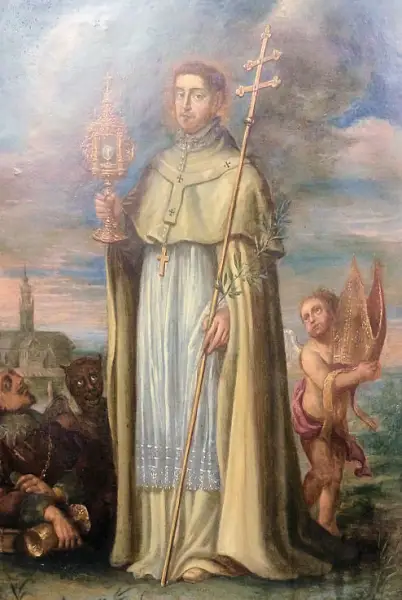
- Monstrance·Cross with two beams
- Canonization
- Canonized by Pope Gregory XIII on 28 July 1582 in Rome
Prayer
Bibliography
Show 6 sources
- Hoever, Reverend Hugo (1977). Lives of the Saints for Every Day of the Year. New York: Catholic Book Publishing Co. p. 224.
- "The priest whose asceticism killed three disciples". Catholic Herald. 9 June 2011.
- "Saint Norbert of Xanten". Norbertines of Saint Norbert Abbey, De Pere, Wisconsin.
- Kirkfleet (1916). History of Saint Norbert. pp. 149, 213-16, 299-300.
- Geudens, Francis Martin. "St. Norbert." The Catholic Encyclopedia. Vol. 11. New York: Robert Appleton Company, 1811.
- Kunkel, Thomas (11 May 2019). Man on Fire: The Life and Spirit of Norbert of Xanten. USA: St. Norbert College Press. ISBN 978-0-9851080-7-6.
Profile text adapted from the Wikipedia article, licensed CC BY-SA 4.0.
Pray with this saint every day
Save St. Norbert of Xanten to your favorites, read the full profile, and get feast-day reminders in the Saints app.
Get the Saints AppFree on the App Store for iPhone and iPad