
c. 1265 – 1313·Feast September 13
St. Notburga
Peasant saint of Tyrol, patroness of servants
Overview
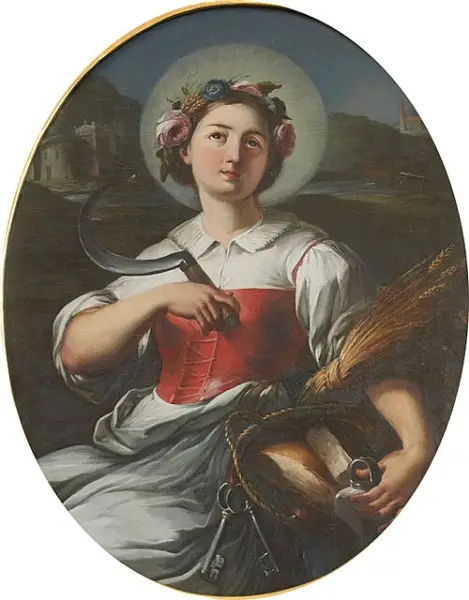
Notburga of Rattenberg, remembered also as Notburga of Eben, was a peasant saint of the Austrian Tyrol whose life ran from about 1265 to 13 September 1313. Born at Rattenberg on the Inn river, she worked as a cook in the household of Count Henry of Rattenberg and secretly fed the poor from her own portion when her mistress Ottilia ordered the leftovers to be given to the pigs. Dismissed for her charity, she entered the employ of a farmer at Eben am Achensee, stipulating that she be free for worship on the eve of Sundays and festivals; there her famous sickle miracle is said to have occurred when her master demanded she keep working in the field. When misfortune later struck Count Henry's estate, he rehired her, and the household prospered under her care. She died at Buch on 13 September 1313, in her forty-eighth year. Many lives of her have been composed, and artists show her with a scythe or an ear of corn. Pope Pius IX canonized her in 1862, and she remains a beloved patroness of servants, peasants, and rural youth.
The Complete Life
A Cook in the Count's Household
Notburga was born about the year 1265 at Rattenberg on the Inn river, in the Austrian Tyrol. Of peasant stock, she entered domestic service as a cook in the household of Count Henry of Rattenberg, where her competence and kindness soon marked her out. She possessed a tender charity for the poor: food that passed through her kitchen found its way, quietly and constantly, to those who had none. This generosity soon collided with the economy of the great house. Her mistress, Ottilia, ordered that any leftover food be cast to the pigs rather than given away. Notburga refused to abandon the poor, and so she took to setting aside part of her own meals, above all on Fridays, and bore it out to the hungry. According to her legend, her master once met her on the way and commanded her to show what she carried; she complied, and what met his eyes was only wood shavings where food should be, and vinegar where wine should be. Ottilia then dismissed her for her persistence, but soon fell dangerously ill, and Notburga remained to nurse her and prepare her for death.
§ Life
The Sickle Held Suspended
After leaving the count's service, Notburga went to work for a peasant at Eben am Achensee, and she made one condition before accepting the position: that she be permitted to leave for church on the evenings before Sundays and festivals. To this her master agreed, but the agreement was soon tested. One evening, as the hour of worship drew near, he urged her to keep working in the field with the rest of the harvesters. She answered by hurling her sickle high into the air with the words that have become her emblem, and the tool did not fall to earth but hung suspended, until her master gave way. The miracle made plain the principle of her life: that the claims of God stand above the demands of any employer. Her fame has been carried by this image ever since, and painters frequently show her with the sickle hanging miraculously in mid-air, a sign that labor has its limits and worship its rights. The story became one of the best-loved legends of the Alpine countryside, told wherever servants and laborers gathered, for it gave heavenly sanction to the humble claim of a working girl to her Sunday rest.
§ Life
Return, Death, and the Wagon Drawn by Oxen
In time, misfortune visited the house of Count Henry of Rattenberg, and he ascribed his difficulties to the dismissal of his holy cook. He rehired her, and the estate prospered under her renewed care, a restoration that contemporaries read as heaven's own verdict on her service. Notburga spent her final years in this second period at the count's household, respected by rich and poor alike. When death drew near, she gave her master a last instruction: that her body be set on a cart pulled by a pair of oxen and committed to the earth wherever the beasts came to a halt. The team hauled the cart from Buch, where she died on 13 September 1313, as far as the chapel of St. Rupert near Eben, and there the animals stopped, and there she was laid to rest. The shrine of Saint Notburga in the Chapel of Saint Rupert at Eben remains her principal shrine, and her venerated skeleton relic rests in the altar of the parish church of Eben am Achensee, where pilgrims have honored her for centuries. The people of the valley saw in the beasts' journey heaven's own choice of her resting place, and the chapel became a place of pilgrimage.
§ Life
Raised to the Altars
Devotion to Notburga, nourished for more than five centuries by the peasants and servants of the Tyrol and Bavaria, at last received the Church's solemn confirmation. On 27 March 1862, Pope Pius IX canonized her as a saint, in ceremonies at Saint Peter's Basilica in the Papal State, making her one of the great popular saints of the Alpine lands raised to the altars in the nineteenth century. Her feast is celebrated on 13 September, the anniversary of her death, though in some places it is kept on 14 September. Her cult belongs firmly to the working countryside: she was canonized not as a queen or a foundress but as a kitchen maid and field laborer, a fact that has made her veneration especially dear to farm workers, household servants, and rural communities. Her image spread widely through the Catholic Alpine world, appearing in parish churches, on glass and canvas, and in bas-relief, from Rattenberg and Eben to Styria, Slovenia, and Bavaria. Her elevation came by the same pontiff who canonized so many of the great nineteenth-century saints, and it confirmed a devotion that the peasants of Austria and Bavaria had kept alive for over five hundred years.
§ Veneration
The Sickle and the Ear of Corn
Notburga's iconography is among the most distinctive of any peasant saint. Artists ordinarily furnish her with an ear of corn, or with blossoms and a sickle; in many images the sickle hangs impossibly in mid-air, a memory of Eben. Many lives of her have been set down, and her likeness has been painted and carved across a remarkable range of places: the Baroque painting of her on Bled Island in northwestern Slovenia, a venerated skeleton relic robed in the altar of the parish church of Eben am Achensee, portraits by painters such as Eduard von Grützner now in the Augustinian Museum at Rattenberg, lithographs by Johann Nepomuk Kravogl, bas-reliefs on church portals in Styria, stained glass in German churches, and groupings of statues alongside saints Apollonia and the Virgin Mary in Slovenia. She is invoked as patroness of rural youth, of servants, and of peasants, and her story continues to speak for the right to rest, the dignity of humble work, and the priority of God over every master. Her feast, kept on 13 September, brings the harvest season to mind each year, and her sickle remains a sign to working people that the laborer's time belongs also to God.
§ Veneration
Timeline
- 1265
Born at Rattenberg on the Inn river, in the Tyrol.
§ Life
- 13 Sep 1313
Died at Buch, Austria, aged about forty-seven.
§ Life
- 27 Mar 1862
Canonized by Pope Pius IX at Saint Peter's Basilica.
§ Veneration
In Their Own Words
Let my sickle be judge between me and you
The Record
- Patron of
- Patron of rural youth·Patron of servants·Patron of peasants
- Symbols
- Ear of corn·Flowers and a sickle in her hand·Sickle suspended in the air
- Canonization
- Canonized by Pope Pius IX on 27 March 1862 at Saint Peter's Basilica
Prayer
Bibliography
Show 3 sources
- Ott, Michael. "St. Notburga." The Catholic Encyclopedia, Vol. 11. New York: Robert Appleton Company, 1911.
- "St. Notburga". FaithND.
- "Notburga von Rattenberg". fembio.org. Retrieved 2020-10-30.
Profile text adapted from the Wikipedia article, licensed CC BY-SA 4.0.
Pray with this saint every day
Save St. Notburga to your favorites, read the full profile, and get feast-day reminders in the Saints app.
Get the Saints AppFree on the App Store for iPhone and iPad