
c. 840 – 912·Feast April 6
St. Notker the Stammerer
Monk of Saint Gall, composer of sequences and biographer of Charlemagne
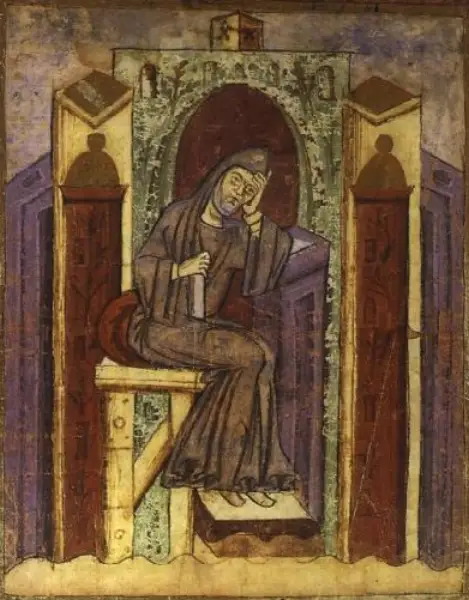
Overview
Notker the Stammerer, also called Notker Balbulus, belonged to the Benedictine community of the Abbey of Saint Gall, where he labored as composer, poet, and scholar from roughly 840 until his death on 6 April 912. Born near the abbey to a wealthy Alemannic or Swiss family, he entered the monastic school as a child and spent his whole life there, studying under the monks Iso and Moengal alongside his fellow composers Tuotilo and Ratpert, who together made Saint Gall a center of early medieval music. A lifelong stutter gave him his epithet. He became the abbey's master of the monastic school, taught the future bishop Solomon of Constance, served as librarian in 890 and master of guests in 892 and 894, and on occasion advised the emperor Charles the Fat. He is usually credited with the Liber Hymnorum, an influential collection of sequences completed in 884, and with the Gesta Karoli Magni, an early anecdotal biography of Charlemagne, as well as a martyrology and other works. He declined every offer of an abbacy, and died at Saint Gall on 6 April 912, remembered as one of the leading literary figures of the Early Middle Ages.
The Complete Life
A Child of the Thurgau at the Abbey School
Notker was born around the year 840 near the Abbey of Saint Gall, in what is now Switzerland. His family was wealthy and of Alemannic or Swiss descent, holding land at Jonschwil in Thurgau; a later biographer, Ekkehard V, claimed he was born at Heiligau, now Elgg in the Canton of Zürich, but the historian Gerold Meyer von Knonau rejected this and points instead to a birthplace near Jonschwil. From childhood Notker had a stutter, caused by the loss of his teeth in youth, and it gave him the Latin epithet Balbulus and the English name by which he is known. The musicologist Stefan Morent has set him beside Walafrid Strabo, who saw only imperfectly, and the limping Hermann of Reichenau, three impaired monks whose creative powers triumphed over their bodies. Notker started school at Saint Gall early in life and never left, spending the remainder of his days within the abbey that formed him. His teachers included the Swiss monk Iso and the Irish monk Moengal, whom Notker called Marcellus, and Grimald of Weissenburg, himself formed by Alcuin, may also have numbered among his instructors.
§ Life and career
Monk, Teacher, and Counselor of Emperors
The monastic school of Saint Gall, where Notker was taught alongside Tuotilo and Ratpert, shaped a remarkable generation: all three became teachers and composers at the abbey, making it an important center of early medieval music. Ekkehard IV's Casus monasterii Sancti Galli paints a lively picture of that school and of Notker's place in it. Though first and foremost a scholar, Notker carried practical responsibilities in the community, holding the office of librarian in 890 and that of master of guests in 892 and again in 894, and in time he became head of the abbey school. One of his pupils was Solomon, who occupied the see of Constance from 890 until his death in 912. Fame traveled far beyond the cloister: he was often called upon for counsel from outside the abbey, and on occasion he advised Charles the Fat, who visited Saint Gall from 4 to 6 December 883. Charles became the dedicatee of Notker's biography of Charlemagne. Ekkehard IV celebrated a man frail in body yet vigorous in mind, halting of tongue yet swift of intellect, a Spirit-filled vessel without peer in his age.
§ Life and career
The Book of Hymns and the Birth of the Sequence
Notker's most influential musical achievement was the Liber Hymnorum, the Book of Hymns, which he created during the late ninth century and completed in 884, dedicating it to Liutward, bishop of Vercelli. Its contents are melodies with newly written verses, arranged to follow the Church's year, and together they form a treasure of the earliest sequences, verses set to the long melodic flourishes of Gregorian chant so that they could be more easily remembered. In its preface Notker explained the inspiration: an antiphoner brought to Saint Gall from Jumièges Abbey soon after its destruction in 851, whose practice of setting words to the melodies freed him from childhood difficulties in recalling the melodiae longissimae. The oldest surviving sources of the work date from Notker's last years or shortly after his death. Other pieces came to bear his name with differing degrees of likelihood: a manuscript from the middle of the tenth century credits him with the sequence melody Ave beati germinis, while the melodies Frigdola and Occidentan, assigned to him by Ekkehard IV, seem older than Notker himself, and the hymn Media Vita was assigned to him in error in 1613.
§ Liber Hymnorum
A Vessel of the Holy Spirit
Notker's spirituality was that of a monk who never sought office beyond the walls of his abbey. Despite his renown, he never became abbot of Saint Gall, and he repeatedly declined offers of abbacy elsewhere, choosing the stability that Benedictine tradition prizes above advancement. His devotional mind is visible in his works: the Liber Hymnorum exists to carry the Scriptures and the liturgical year into memory and song, and his preface speaks with disarming honesty of a child struggling to hold the long chant melodies, solved by giving them words. His martyrology, arranged around the year 900, is an act of communion with the whole company of heaven, cataloguing the martyrs and saints with short biographies; in it he even corroborated a vision of St. Columba, in which the Irish abbot had seen through clairvoyance the destruction of a city near Rome, a story Notker connected with an earthquake that destroyed a city called new. Ekkehard IV's verdict captures the man's interior spirit: daring in the things of God, and possessed of the divine Spirit as few of his contemporaries were.
§ Martyrology
Last Years and Death at Saint Gall
Notker's final decades were spent in the unbroken rhythm of monastic life at Saint Gall, where he combined scholarship with the offices of librarian and master of guests and the care of the abbey's students. The oldest surviving manuscripts of his Liber Hymnorum come from his last years or from the years immediately after his death, evidence that his work was already being copied and treasured by his community as his life drew to a close. His literary ambition did not flag: around the year 900 he arranged his martyrology, a project so extensive that the single incomplete copy that survives may simply reflect a work he never finished, since it lacks entries for several stretches of the calendar. He also completed the Breviarium Regum Francorum, the Breviary of the Frankish Kings, begun by Erchanbert, and a Latin key explaining significative letters in Gregorian chant is attributed to him. He died at Saint Gall on 6 April 912, in the same abbey in which he had been schooled as a child, and was commemorated there annually on that date. To the end he remained what he had been from boyhood, a schoolman of the cloister, and the abbey buried him among its own.
§ Life and career
A Saint by Local Devotion and Papal Grant
Notker was never formally canonized in the later sense, yet his sanctity was acknowledged by papal authority in the age of the Renaissance. According to the sixteenth-century historian Henricus Canisius, Pope Leo X extended recognition of his cult to Saint Gall and the churches round about in 1512, and a year later to the Diocese of Constance; the Catholic Encyclopedia reads this grant as a beatification. Each 6 April his memory is celebrated at Saint Gall and elsewhere, and he is listed as beatified on that date in the Roman Martyrology of 2004. The English cleric John Donne caught the local character of his cult by calling him a saint kept privately, for a few parishes only. He is also venerated as a saint in the Eastern Orthodox Church. Within his own abbey his memory was cherished with something like family pride: later scholars of Saint Gall bore his name, with Notker Physicus and Notker Labeo known as Notker II and Notker III, keeping the first Notker first among the abbey's saints of learning. The papal grant of the early sixteenth century set the seal on a devotion that the monks of Saint Gall had maintained for six hundred years.
§ Legacy
Sequences and the Deeds of Charlemagne
Scholars have weighed Notker's double legacy in different scales. Alban Butler judged his sequences his most important achievement; Rosamond McKitterick judges that the Gesta Karoli Magni is what keeps his name alive: the anecdotal, two-book portrait of Charlemagne and his kin that tradition assigns to the pseudonymous Monk of Saint Gall. Rather than a continuous life it unfolds as moral tales; older critics scoffed at its legend and blundering, but scholarship since Matthew Innes has discerned beneath the humor a lucid design and firm convictions about how society, church, and politics ought to be ordered. Together with Solomon II, Notker is reckoned the most important writer educated at Saint Gall. His music has had a modern afterlife: in the mid-nineteenth century the Swiss scholar Anselm Schubiger became the first to put nearly all of Notker's surviving melodies into modern notation, and Stefan Morent brought out a practical modern edition of twenty sequences in 2017. Saint Gall, made illustrious by his songs and his stories, keeps his feast on 6 April. Monumental in both fields, his achievement made the abbey on the Steinach a name to conjure with in the history of Western music and of Carolingian letters alike.
§ Legacy
Timeline
- 840
Born near the Abbey of Saint Gall, probably at Jonschwil in Thurgau, to a wealthy family.
§ Life and career
- 851
The destruction of Jumièges Abbey inspired the antiphoner that Notker later said awakened his love of setting verses to melody.
§ Liber Hymnorum
- 4 Dec 883
Received the emperor Charles the Fat, who visited the Abbey of Saint Gall from 4 to 6 December and sought his counsel.
§ Life and career
- 884
Completed the Liber Hymnorum, his collection of sequences organized by the Church calendar and dedicated to Liutward, bishop of Vercelli.
§ Liber Hymnorum
- 890
Served as librarian of the Abbey of Saint Gall.
§ Life and career
- 892
Served as master of guests (hospitarius) of the abbey, holding the office again in 894.
§ Life and career
- 900
Composed his martyrology, a catalogue of the saints of which only a single incomplete copy survives.
§ Martyrology
- 6 Apr 912
Died at the Abbey of Saint Gall.
§ Life and career
- 1512
Pope Leo X granted Notker's sainthood for Saint Gall and nearby churches, extending it to the Diocese of Constance in 1513.
§ Legacy
In Their Own Words
delicate of body but not of mind, stuttering of tongue but not of intellect, pushing boldly forward in things Divine, a vessel of the Holy Spirit without equal in his time
he is a private Saint, for a few Parishes
The Record
- Major works
- Liber Hymnorum·Gesta Karoli Magni (De Carolo Magno)·Vita Sancti Galli·Martyrology (c. 900)·Breviarium Regum Francorum (completed from Erchanbert)
- Canonization
- Never formally canonized; sainthood granted by Pope Leo X in 1512 for Saint Gall and nearby churches, and in 1513 for the Diocese of Constance; listed as beatified in the Roman Martyrology (2004)
Prayer
Bibliography
Show 8 sources
- Thorpe, Lewis G.M. (1969). Einhard and Notker the Stammerer: Two Lives of Charlemagne. London: Penguin. ISBN 978-0-14-044213-7.
- McKitterick, Rosamond (2018) [1983]. The Frankish Kingdoms Under the Carolingians 751-987. Abingdon-on-Thames: Taylor & Francis. ISBN 978-1-317-87247-4.
- Julian, John (1892). A Dictionary of Hymnology. New York: C. Scribner's Sons. p. 812.
- McGowan, Joseph (2002). "Notker Balbulus (The Stammerer) (c. 840-912)". In Schulman (ed.). The Rise of the Medieval World, 500-1300: A Biographical Dictionary. Westport: Greenwood Press. ISBN 978-0-313-30817-8.
- Innes, Matthew (February 1998). "Memory, Orality and Literacy in an Early Medieval Society". Past & Present (158): 3-36.
- Butler, Alban (1999) [1756-1759]. Butler's Lives of the Saints. Vol. 4: April. Revised by Peter Doyle. London: Burns & Oates. ISBN 0-8146-2380-8.
- Hiley, David (2001). "Notker". Grove Music Online. Oxford University Press. doi:10.1093/gmo/9781561592630.article.20128.
- Kampers, Franz; Löffler, Klemens (1911). "Notker". Catholic Encyclopedia. New York: Robert Appleton Company.
Profile text adapted from the Wikipedia article, licensed CC BY-SA 4.0.
Pray with this saint every day
Save St. Notker the Stammerer to your favorites, read the full profile, and get feast-day reminders in the Saints app.
Get the Saints AppFree on the App Store for iPhone and iPad