
5th century·Feast July 6
St. Noyale
Celtic virgin martyr of Brittany and Cornwall
Overview
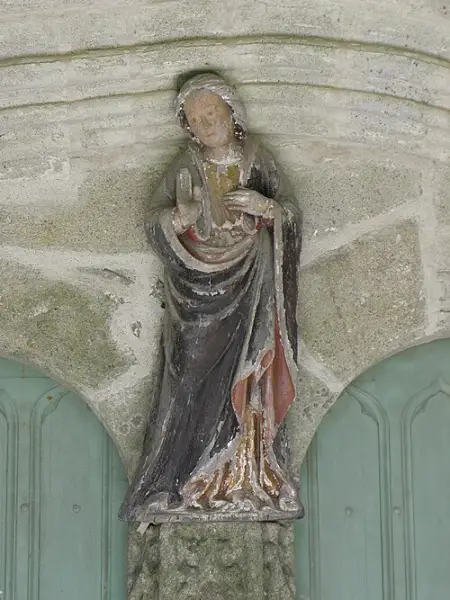
Noyale, also known as Noaluen, Nolwenn, or Newlyn, was a semi-legendary Celtic saint and virgin martyr of the fifth century, honored in both Brittany and Cornwall. She took part in the Celtic migration that poured into Brittany while Anglo-Saxon invaders overran England, and earlier hagiographers describe her as the daughter of a British king. Her legend follows the pattern of the cephalophore saints: when her father sought to marry her, she fled by sea with her nurse, sailing to the region around Vannes in Brittany. At Beignan a local lord also desired her hand, and when she refused him he beheaded her in his rage. The tale adds that the maiden lifted her severed head and, guided by her serving woman, made her way back to England. In Cornwall her memory lives at Newlyn East, where a fig tree said to have sprouted from her staff clings to the church's south wall, and a holy well close by is honored as the place of her passion. When the churchyard there was opened, a little stone figure of the saint bearing her own head came to light.
The Complete Life
A King's Daughter in a Troubled Age
The earliest hagiographers tell that Noyale was born in England, the daughter of a British king, though some traditions also describe her as Irish, and modern scholarship suspects she was one of the numerous Welsh settlers who crossed to Brittany in the wake of the Anglo-Saxon invasion. Her story belongs to the fifth century, the age in which Roman Britain was dissolving and new kingdoms, and new saints, were being formed on both sides of the Channel. She bears many names, a sign of devotion spread across lands and tongues: Noyala of Brittany, Noyala the White, Noaluen, Nolwenn, Newlyn, Neulina, and Newlina. Whatever the precise truth of her origins, the tradition unites in presenting her as a woman of royal blood who consecrated herself to Christ and refused every earthly marriage proposed to her, a resolution that would cost her her life. Her cult took deep root in both Brittany and Cornwall, the twin shores of the Celtic migration in which her story was treasured and retold. The Celtic Church moved easily between Wales, Cornwall, and Brittany, and the saints of one shore were honored on the others, so that Noyale's story belongs to a single maritime world rather than to any one kingdom.
§ Origins
Flight, Refusal, and Martyrdom
The legend of Noyale is typical of the fifth-century cephalophore saints, those martyrs said to have carried their own heads after death. Because her father, a king of England, sought her as a wife, she escaped by sea, crossing with her nurse to the coastlands near Vannes. There, at Beignan, a local lord likewise desired to make her his wife; her refusal so enraged him that he beheaded her on the spot. Here the story takes the marvelous turn beloved of Breton storytelling: the headless maiden raised her head and, her maid walking before her, set out toward England. Breton popular belief embroidered the crossing as well, recounting how the girl crossed the sea on a leaf with her nurse, and came on foot to Pontivy with the head cradled in her hands. At Newlyn East in Cornwall, the fig tree that clings to the church's south wall is credited to her staff, and the holy well beside the church was long venerated as the scene of her passion. Whether understood as history or as legend, the story gave the Bretons and Cornish a heroine of purity and courage, and the chapels raised in her honor kept the tale alive for a thousand years.
§ Legend
Memorial at the Corner of Two Seas
Noyale's cult endures on both sides of the Channel. In Brittany she is especially honored at the Chapelle Sainte-Noyale in Noyal-Pontivy, where a statue of the saint carrying her head recalls the legend; the chapel at Pontivy was remarkable in the eighteenth century for paintings on gold grounds depicting her fanciful story. In Cornwall she is the patroness saint of St Newlyn East, where a church is dedicated under her name and a little stone figure of the head-carrying saint came to light when the churchyard was dug. Her feast is kept on 6 July, with a celebration also observed on 27 April, and she is revered as a Pre-Schism Western saint of the Eastern Orthodox Church. Her story has even reached modern literature, finding reference in Ali Smith's novel Winter. Few saints span so wide a geography in memory: a princess of Britain, a martyr of Brittany, and a patroness of a Cornish village, joined by the sea routes of the Celtic world. In an age when the old holy wells and chapel saints of the Celtic west are rediscovered by pilgrims and scholars alike, Noyale stands among the most vivid figures of that inheritance.
§ Legacy
In Their Own Words
According to the popular belief in Brittany, unsupported by any evidence, Noyale or Noaluen was a maiden, who floated over to Brittany with her nurse on the leaf of a tree. She was decapitated in Beignan and walked to Pontivy holding her head in her hands.
The Record
- Patron of
- Patroness of St Newlyn East in Cornwall
- Symbols
- Carrying her severed head·Staff·Fig tree
- Canonization
- Pre-congregation; venerated from the earliest centuries in Brittany and Cornwall
Prayer
Bibliography
Show 6 sources
- Tristan Gray Hulse, The Land of Holy Wells – 3.
- Meyrick, J. A Pilgrim's Guide to the Holy Wells of Cornwall. Falmouth: Meyrick, 1982, p. 110.
- Hanrahan, Kathleen and Langdon, Mo. St. Noyala of Brittany, Virgin Martyr.
- Baring-Gould, Rev. Sabine. "S. Noyala, V.M." In: The Lives of the Saints, vol. 7: July – Part I. London: John C. Nimmo, 1898. pp. 137-140.
- Farmer, David. Oxford Dictionary of Saints. Oxford University Press, 1992, p. 534.
- Baring-Gould, S. and Fisher, John. Lives of the British Saints, IV. London, 1913. pp. 10-14.
Profile text adapted from the Wikipedia article, licensed CC BY-SA 4.0.
Pray with this saint every day
Save St. Noyale to your favorites, read the full profile, and get feast-day reminders in the Saints app.
Get the Saints AppFree on the App Store for iPhone and iPad