
c. 1150 – c. 1204·Feast December 6
St. Obitius
Knight Turned Oblate of Santa Giulia
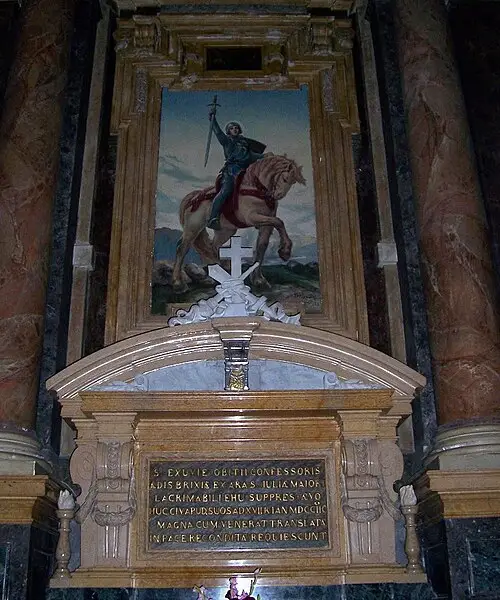
Overview
Obitius, remembered in Italian as Sant'Obizio, was a knight of Niardo in the Brescian valley who traded a soldier's life for one of poverty and penance at the end of the twelfth century. Born around 1150, the son of a knight who governed Valcamonica, he followed his father's calling: he married the countess Inglissenda Porro, raised four children, and fought in the wars between Cremona and Brescia. On 7 July 1191, at the Battle of Malamorte on the Oglio River, the bridge he was carrying collapsed under the weight of combatants and horses, and Obitius was thrown into the water. There, his legend relates, he was granted a terrifying vision of Hell. He escaped drowning and resolved to abandon his military career, a decision his family resisted until his determination won them over; two of his children later entered religious life. Living in complete poverty, penance, and prayer, he served a Benedictine convent and in 1197 was received as an oblate of the monastery of Santa Giulia in Brescia, where he spent the rest of his life in works of charity. Miracles were attributed to him. Buried with honor in the monastery church, he was approved as a blessed by Pope Clement VIII in 1600, and his relics are venerated today at Niardo.
The Complete Life
A Knight's Son of Valcamonica
Obitius was born at Niardo, in the province of Brescia, around the year 1150, tradition fixing his birthday at 4 February. His father, Gratiadeus, was a knight and the governor of Valcamonica, and the boy grew up in the class of men who served with horse and sword. Piety ran in the family alongside its military character. As a youth Obitius showed a special devotion to Margaret the Virgin, and displayed the image of that virgin martyr as his armorial device. His kin were bound to the local church in other ways as well: one uncle had founded two monasteries, and another kinsman had numbered Constantius of Perugia among his friends, who shared with Margaret the title of patron of Niardo. None of this, however, kept the young man from a worldly path. He became a knight in earnest, married the countess Inglissenda Porro, and raised four children — Jacopo, Berta, Margherita, and Maffeo. His military career prospered, and he took part in the wars fought between Cremona and Brescia, the rival cities of his region.
§ Obitius
The Bridge of Malamorte
The event that ended Obitius' soldiering came on 7 July 1191, at a place whose name means evil death. At the Battle of the Malamorte, on the Oglio River in Brescian territory, he was leading an army against the Bergamaschi. The enemy withdrew across a wooden bridge, and Obitius with his fellow knights pressed after them. The combined weight of the fleeing soldiers, the armored horsemen, and their horses broke the structure, and every combatant on it plunged into the river. In the water, his legend relates, Obitius was shown a terrifying vision of Hell. He fought free of the current and came out of the Oglio a different man, resolved to give himself wholly to the spiritual life. His family opposed the idea; a knight with a wife and four children could not simply walk away from his station. But his determination held, and in time it swayed them. The conversion reached into the next generation: his daughter Margherita became a nun, and his son Maffeo a monk, so that the house of the knight of Niardo gave to the Church not only its head but two of its children.
§ Conversion
Penitent and Oblate
The life Obitius took up after Malamorte was one of complete poverty, penance, and prayer. He put his sword aside and gave his strength instead to the service of a Benedictine convent, working for the sisters with the same energy he had spent in the field. His family's resistance, once overcome, left him free to draw nearer to monastic life, and in 1197 the community of the monastery of Santa Giulia in Brescia received him as an oblate — a layman attached to the monastery who shared its prayer without taking vows. There he passed the remainder of his days, performing various acts of charity and winning a reputation for holiness among the people of Brescia. Miracles were attributed to him in his lifetime and after it. The warrior who had once been the agent of his own terrifying vision became in memory the proof that such visions are sent to be obeyed: the man who had nearly drowned in the Oglio ended his life ashore, in the quiet round of monastic charity, and those who told his story judged that the second life honored God more than the first.
§ Conversion
Last Years and Burial
Santa Giulia remained Obitius' home for the rest of his days, and there, on 6 December, he died around the year 1204, after more than a decade among the oblates of the monastery. The community buried him with great honor in the monastery church of Santa Giulia at Brescia, a tribute to the esteem his penitent life had earned. The choice of burial in the church itself, rather than the cemetery, marked him out from the beginning as one whose memory the monks intended to keep. His feast came to be kept on 6 December, the day of his death, with a secondary observance on 4 February, the traditional day of his birth. From his tomb at Brescia his cult spread back to his native Niardo, where the parish never lost its attachment to its most famous son. In time that attachment would matter greatly: when the monastery that held his body came to its end, it was Niardo that demanded him back, and the knight who had left the valley to follow Christ was carried home in honor to the altar of the village church.
§ Conversion
Signs at the Tomb
The formal recognition of Obitius came by the confirmation of cult, the route by which the Church approves immemorial devotions. Its story begins at his tomb: news came in 1498 that the urn holding his relics had begun miraculously to issue water, and his remains were translated to the altar of Santa Giulia in consequence. The same phenomenon was reported again in 1553, more than half a century later, and Brescia's devotion to its penitent knight only grew. During the jubilee of 1600 the Vatican gave its approval to the cult, Pope Clement VIII confirming the veneration of the blessed of Niardo. This approval set the seal on two centuries of local observance and on the reports of wonder that had drawn pilgrims to his altar. The Church asked for none of the investigations a modern canonization would require; it found a cult alive among the people, attested by recurring signs and by a life remembered as one of genuine conversion, and it gave that cult its approbation in the holiest year of the Jubilee cycle.
§ Veneration
Frescoes and the Return to Niardo
Obitius' story found a painter in the generation after his papal approval. Between 1526 and 1527 Girolamo Romanino painted the story of the saint's life as a fresco cycle in the Brescian basilica of San Salvatore, giving the knight of Niardo a place in the great tradition of Lombard painting. The greater upheaval came at the close of the eighteenth century. In 1797, in the era of the Cisalpine Republic, the monastery of Santa Giulia was suppressed, and its church could no longer keep the saint it had housed for six hundred years. Niardo asked Brescia to return the relics of Obitius, and the request was granted; his remains are honored now at the chief altar of Niardo's parish church, in the village of his birth and of which he is patron. He is depicted as a warrior on horseback, the image of the man he was before 7 July 1191, and the pairing is the point of his cult: the memory of a soldier who met God in the water and served him afterward in poverty. His feast is kept on 6 December, with a second memory on 4 February.
§ Veneration
Timeline
- 4 Feb 1150
Born at Niardo, in the province of Brescia, son of the knight Gratiadeus.
§ Obitius
- 7 Jul 1191
At the Battle of Malamorte on the Oglio River, a collapsing bridge plunges him into the water, where he sees a vision of Hell.
§ Conversion
- 1197
Received as an oblate of the monastery of Santa Giulia in Brescia.
§ Conversion
- 6 Dec 1204
Dies at the monastery of Santa Giulia and is buried with honor in its church.
§ Conversion
- 1498
The urn holding his relics is reported to issue water miraculously; the relics are translated to the altar of Santa Giulia.
§ Veneration
- 1526
Romanino paints the fresco cycle of his life, the Storie di sant'Obizio, within Brescia's basilica of San Salvatore.
§ Veneration
- 1553
The miraculous flow of water from his relics is reported again.
§ Veneration
- 1600
His cult is approved by Pope Clement VIII in the jubilee year.
§ Veneration
- 1797
The monastery of Santa Giulia is suppressed, and Niardo claims his relics, which are placed in the parish church's main altar.
§ Veneration
The Record
- Patron of
- Patron of Niardo
- Symbols
- Depicted as a warrior on horseback
- Canonization
- Beatified by confirmation of his cult by Pope Clement VIII in the jubilee year 1600
Prayer
Bibliography
Show 1 sources
- Sant'Obizio da Niardo (in Italian).
Profile text adapted from the Wikipedia article, licensed CC BY-SA 4.0.
Pray with this saint every day
Save St. Obitius to your favorites, read the full profile, and get feast-day reminders in the Saints app.
Get the Saints AppFree on the App Store for iPhone and iPad