
c. 680 – c. 726·Feast October 23
St. Oda of Scotland
Blind princess turned hermitess of North Brabant
Overview
Saint Oda of Scotland was, according to her tradition, a woman of Scottish birth who became a holy recluse in what is now the Netherlands, dying around 726. Born blind, she was sent by her father on pilgrimage to Liège to pray at the grave of Saint Lambert, and while praying there she was miraculously cured, a healing recorded in the saint's eighth-century vitae. In gratitude she vowed her life to God. When her father later wished to arrange her marriage, she fled with her maid across the North Sea, made pilgrimage to Rome and to Monte Sant'Angelo sul Gargano, and prayed her way through villages of the Netherlands and Belgium until she settled at Venray. Driven from that place by magpies, she followed the birds to an open space in the forest, where villagers built her a hut. She lived there as a hermitess, shielding her shelter with bushes that miraculously grew overnight into a thick hedge, and resisting every attempt by her father to bring her home. After her death her dwelling became a place of pilgrimage, and the settlement that grew around it is the town of Sint-Oedenrode.
The Complete Life
Blindness and a Mother's Cure
Oda's story opens in Scotland around the year 680, where she is said to have been born with no sight at all. Her father, a man of standing, resolved to seek a cure at a distance and sent his daughter on pilgrimage to Liège, in the Low Countries, to visit the relics of Saint Lambert. While she prayed at the saint's grave her blindness was miraculously cured, an event recorded in the eighth-century vitae of the saint. The healing changed the direction of her life. In thanksgiving she vowed to dedicate herself wholly to God, and returned to Scotland with that purpose fixed. The thirteenth-century records of the noble Van Rode family, which preserve the later chapters of her story, describe a household that could not accept such a vow: her father began to arrange a marriage for her, as noble daughters of the age were expected to accept. Rather than surrender the dedication made at Lambert's tomb, Oda chose flight, and together with her maid she crossed the North Sea back to the continent, leaving her father's house and kingdom behind her forever.
§ Life
A Pilgrim's Wandering Road
The fugitive's road became a pilgrim's road. Oda journeyed to Rome and to the sanctuary of Monte Sant'Angelo sul Gargano in southern Italy, and then made her way north again, praying in village after village across the Netherlands and Belgium in search of a place to settle. She came at last to Venray, where she hoped to find quiet, but her rest was repeatedly broken by magpies, whose noise made the spot unendurable. When she fled the birds they guided her instead to an open patch of the woods close at hand, and the local people raised a hut there for her use, for it is just such a small manmade opening in woodland that the Dutch tongue calls a rode. Hoping to shield her poor dwelling against wind, hail, rain, and snow, and to keep it out of every passing eye, she set bushes round about it; by the next morning they had shot up into a dense hedge. Her father, still searching for his daughter, discovered her hiding place at last because she was still spending money minted in her native land, much as happened in the tale of Saint Dymphna, but when he tried to approach her hut the magpies drove him off again and again, until he abandoned the attempt and returned to Scotland without her.
§ Life
The Town in the Clearing
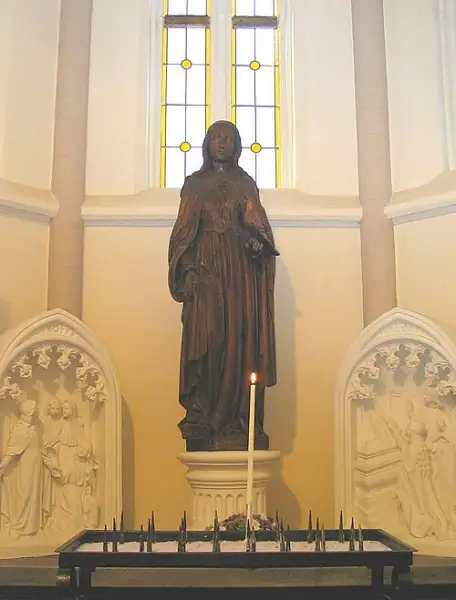
The hermitage in the forest outlived its inhabitant. Once Oda was dead, pilgrims began to seek out the lowly hut she had inhabited, and the Saint Oda's place in the woods grew into the town of Sint-Oedenrode in North Brabant, its very name preserving the memory of the woman who once hid there, since a rode in Dutch is a small clearing made in woodland. Her adopted town keeps her sign in its very colours: its own banner bears the same white saltire on blue as Scotland's. Within the town's Saint Martin Church pieces of her skull and teeth are preserved, and in the church's garden a chapel dedicated to Oda holds various statues and paintings of the saint. For centuries pilgrims made their way to her shrine seeking relief from sore eyes and from other illnesses of the head, the afflictions that connected them to the blind child of Scotland whose sight had been restored at a saint's grave. Artists dress her in a flowing blue robe that leaves one shoulder uncovered, put a staff or a book in her grasp, set a magpie upon her hand, and lay a crown at her feet in sign of the earthly kingdom she refused.
§ Veneration
Timeline
- 680
Is born in Scotland, according to tradition blind from birth
§ Introduction
- 726
Dies at her forest hermitage in the Netherlands after years as a recluse
§ Introduction
The Record
- Patron of
- Relief of sore eyes and ailments of the head
- Symbols
- Long blue gown with one bare shoulder·Staff or book·Magpie on her hand·Crown beneath her feet
- Canonization
- Pre-congregation; ancient local cult at Sint-Oedenrode honoured since the early middle ages
Prayer
Bibliography
Show 6 sources
- "The Orthodox Saints of Ireland & Scotland". Orthodox West Initiative.
- "5 lesser-known Scottish saints". The Scotsman, 12 June 2017.
- Realy, Margaret (11 October 2013). "Mystical Magpies and St. Oda". Patheos.com.
- Jongen, Ludo (1998). Heiligenlevens in Nederland en Vlaanderen. Amsterdam.
- "Oda of Brabant". Pravoslavie.
- "Flag of Sint-Oedenrode". North Brabant.
Profile text adapted from the Wikipedia article, licensed CC BY-SA 4.0.
Pray with this saint every day
Save St. Oda of Scotland to your favorites, read the full profile, and get feast-day reminders in the Saints app.
Get the Saints AppFree on the App Store for iPhone and iPad