
c. 662 – c. 720·Feast December 13
St. Odile of Alsace
Blind Abbess Who Recovered Her Sight
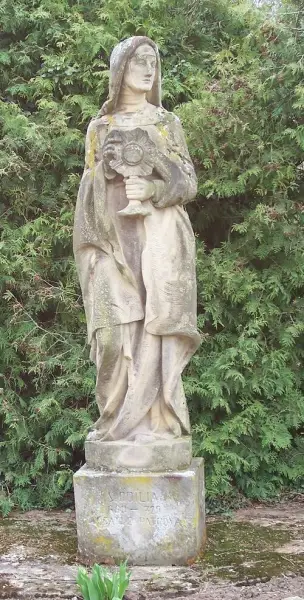
Overview
Odile of Alsace, also called Odilia or Ottilia, was born around 662 into the noble house of Etichon, Duke of Alsace, and became the founding abbess of Mont Sainte-Odile. The legend preserved in her early lives relates that she was born blind, and that her father refused to keep a child who was both a girl and handicapped; her mother, Bethswinda, had the infant taken to Palma, perhaps Baume-les-Dames in Burgundy, where peasants raised her. At the age of twelve she entered a nearby monastery, and there the itinerant bishop Erhard of Regensburg, guided by an angel, baptised her — whereupon her sight was miraculously restored. Her recall home so enraged her father that he accidentally killed his son Hughes; Odile revived the young man and withdrew again, hiding in a cave across the Rhine. Reconciliation came when she returned to nurse the ailing duke, who then founded the abbey of Hohenburg on the mountain in the Hochwald of Bas-Rhin for her, and there she ruled as abbess. A vision of St John the Baptist later directed her to a second foundation with a hospital at Niedermünster, at the mountain's foot. She died around 720, was recalled briefly to life by her sisters' prayers, and died a second time after receiving communion. Venerated from the ninth century onward, she was named patron of Alsace and of eye patients by Pope Pius VII in 1807.
The Complete Life
The Blind Child of a Duke
Odile was born the daughter of Etichon — called also Athich, Adalrich, or Aldaric — Duke of Alsace and founder of the Etichonid noble family, one of the great houses of the Frankish world. The ninth-century Life of Odilia relates that she came into the world blind, and her father wanted nothing to do with her: she was a girl, and she was handicapped. Her mother, Bethswinda, resolved to save the child. The infant was carried away to Palma, perhaps the place now called Baume-les-Dames in Burgundy, and there she was entrusted to peasants, who raised her far from her father's house and far from the knowledge of her birth. Whatever history underlies the tale — and the tenth-century Life that transmits it is judged to rest on an eighth-century account, though it cannot claim much historical validity — the story gave Alsace one of its defining figures: a child rejected for her blindness who became the mother of monasteries and the sworn patron of all whose sight is weak. The child nobody wanted grew up among strangers, and it was among strangers that her eyes were opened.
§ Biography
Baptism and Flight
When the girl was twelve, according to a tenth-century legend, she was taken into a nearby monastery. There the wandering bishop Erhard of Regensburg arrived, led — it was said — by an angel to the place where she lived, and he baptised her with the name Odile. At the water her blindness left her, and she saw the world for the first time. Her younger brother Hughes then had her brought home, and the sight of the daughter he had discarded enraged the old duke beyond measure. In his fury he struck at the boy who had defied him and killed his own son. Odile miraculously revived him, and then left home a second time, of her own will. She fled across the Rhine and hid in a cave — the sources place it either in the Musbach valley near Freiburg im Breisgau or at Arlesheim near Basel — where the cliff face, the legend says, opened to receive her. When Etichon tried to follow, falling rocks injured him, and he abandoned the pursuit. His daughter's God, it seemed, fought for her.
§ Biography
Abbess of the Mountain
The breach in the family closed through the old duke's sickness. When her father's health broke, Odile came back to nurse him, and he who had driven her out at last surrendered his resistance to his headstrong daughter. For her he founded the monastic community of Mont Sainte-Odile — Hohenburg Abbey — in the Hochwald of Bas-Rhin, and Odile became its abbess; he would be buried there himself. Her work did not stop at one foundation. Some years on, a vision of St John the Baptist pointed out to her the ground for a second house, Niedermünster, below the mountain, and there she built a monastery, complete with a hospital for the sick. In that house the head and an arm of St Lazarus of Marseille were displayed, until they were later transferred to Andlau. The pattern of her life had reversed itself entirely: the blind child hidden among peasants now governed two religious houses, cared for the sick with her own hands, and presided over the mountain that would bear her name forever. Fire would destroy the Niedermünster buildings in 1542, but her foundations endured in the veneration of centuries.
§ Biography
Light at the Font
The spirituality that the tradition ascribes to Odile centers on two gifts: sight restored, and the vision of what lies beyond death. Her baptism was her enlightenment in the most literal sense — the bishop Erhard, sent by an angel, gave her both her name and her eyes at the water of the font, and later generations read in that story the working of grace upon nature, the inner illumination that matters more than bodily sight. The visions attributed to her mark her as a woman who lived attentive to the unseen: John the Baptist showed her the site of Niedermünster, and at her death she was granted, according to her sisters, a sight of the beauties of the afterlife. Her practical charity kept that vision honest. She nursed the father who had persecuted her; she attached a hospital to her second monastery; and the wells and springs associated with her — the well of Niedermünster, the spring in the Musbach valley — were sought out for centuries by the sick, above all by those whose eyes were failing. Hers was a spirituality of opened eyes: mercy shown to the ailing body in expectation of the light that does not fail.
§ Biography
The Twice-Given Death
Odile died around the year 720 at the convent of Niedermünster, the second of her foundations. The account of her passing is among the strangest medieval hagiography preserves. Her sisters prayed without ceasing, and she came back from death; the community was not ready to lose her. But the abbess who came back had seen the other side, and after describing to them the beauties of the afterlife she had beheld, she took communion — the account says she received it by herself — and died again. The story sets the seal on the visionary character of her whole life: the woman whose eyes had been opened at baptism saw furthest at their closing. She was buried at Ste. Odile, on the mountain of her abbacy, and the government of Mont Sainte-Odile passed to her niece, Eugenia of Alsace, honored as a saint in her own right. The house of Etichon, which had received her with rejection, ended by giving the church of Alsace two abbesses on its altars, and the duke himself lay buried within his daughter's monastery.
§ Biography
Cult of the Patroness of Alsace
Odile's cult spread rapidly, and beyond France into Germany. From at least the ninth century — barely a hundred years after her death — the litanies of Freising, Utrecht, and Ratisbon were already naming her. Pilgrimage to her shrine was a constant habit of the people, and they were by no means confined to commoners: from Charlemagne onward, emperors themselves made pilgrimage in her honor, and Charlemagne granted immunity to the convent of Hohenberg, a privilege Louis the Pious officially ratified on 9 March 837. By the 1300s the movement to her shrine was mighty enough that her remains were divided among Corbie, Prague, and Einsiedeln, and she enjoyed particular devotion in Strasbourg. Her following drew strength above all from her care for those whose sight was dim or gone — a ministry of peculiar weight before spectacles existed. She had been accounted patron of Alsace and of eye patients from well before the sixteenth century, and in 1807 Pope Pius VII made that patronage official. No formal canonization was ever needed; the church ratified what nine centuries of pilgrims had already decided.
§ Veneration
The Mountain That Bears Her Name
Mont Sainte-Odile remains the heart of her memory, and the Dutch town of Sint Odiliënberg also keeps her name. Across Europe, churches, chapels, and institutes trace themselves to her: the pilgrim church in the Musbach valley near Freiburg, where a chapel stood by about 1300 and the present building was begun in 1503 and completed in the eighteenth century, its spring — its waters radon-bearing, wrongly thought good for the eyes — enclosed within the church from 1714, its cave renovated in 1780. Parishes and chapels invoke her from Bavaria to Indonesia, from Alsace to Baden-Württemberg and Switzerland, and Graz keeps a St. Odile's Institute for the Blind. In art she is shown as an abbess praying before an altar, or as a woman with a book on which two eyes lie; fine examples of the type survive from the fourteenth to the sixteenth centuries, and a sculpture in the Bavarian National Museum in Munich portrays her baptism. Even the larkspur is hers, prescribed in popular medicine as a cure for eye disease. A Life written about the tenth century, drawing on an eighth-century original, carried her legend — the hostile father, the dead brother revived — to every country of Europe.
§ Legacy
Timeline
- 662
Born into the Etichonid nobility of Alsace, daughter of Duke Etichon; tradition holds that she came into the world blind.
§ Biography
- 720
Dies at the convent of Niedermünster, returns to life at her sisters' prayers, and dies again after receiving communion.
§ Biography
- 9 Mar 837
Louis the Pious officially ratifies the immunity Charlemagne had granted to the convent of Hohenberg.
§ Veneration
- 1300
A pilgrim's chapel is built in the Musbach valley near Freiburg, where pilgrims had long venerated her.
§ Places dedicated to Saint Odile
- 1503
Work begins on the present pilgrim church near Freiburg, beside a spring believed to benefit the eyes.
§ Places dedicated to Saint Odile
- 1542
The buildings of Niedermünster burn down, though the well there continues to be credited with curing eye diseases.
§ Biography
- 1714
The spring in the Musbach valley is enclosed within the enlarged pilgrim church.
§ Places dedicated to Saint Odile
- 1780
The cave housing the spring is renovated and decorated in the ornate taste of the century.
§ Places dedicated to Saint Odile
- 1807
Pope Pius VII makes official her ancient patronage of Alsace and of patients with eye ailments.
§ Veneration
The Record
- Major works
- Mont Sainte-Odile Abbey (Hohenburg)·Monastery and hospital of Niedermünster
- Patron of
- the blind and partially sighted·good eyesight·Alsace, France
- Symbols
- Abbess praying before an altar·a woman with a book on which lie two eyes
- Canonization
- Pre-Congregation; proclaimed official patron of Alsace and eye patients by Pope Pius VII in 1807
Prayer
Bibliography
Show 7 sources
- Stracke, Richard (2015-10-20). "Saint Odile of Alsace: The Iconography". Christian Iconography.
- "Latin Saints of the Orthodox Patriarchate of Rome". www.orthodoxengland.org.uk. Retrieved 2024-12-07.
- "Sainte Odile – Patronne de l'Alsace – Fête le 14 Décembre". Reflexion Chrétienne. Retrieved 2025-12-03.
- "Saint Odilia of Alsace". Saints.SQPN.com. Retrieved 2012-07-14.
- Kirsch, Johann Peter. "St. Odilia." The Catholic Encyclopedia. Vol. 11. New York: Robert Appleton Company, 1911.
- Farmer, David Hugh (1997). The Oxford Dictionary of Saints (4th ed.). Oxford: Oxford University Press. ISBN 9780192800589.
- Nowacki, Franz (c. 1970). Wahlfahrtskirche St. Ottilien bei Freiburg im Breisgau. Freiburg: Herder.
Profile text adapted from the Wikipedia article, licensed CC BY-SA 4.0.
Pray with this saint every day
Save St. Odile of Alsace to your favorites, read the full profile, and get feast-day reminders in the Saints app.
Get the Saints AppFree on the App Store for iPhone and iPad