
c. 400 – 451·Feast July 18
St. Odilia of Cologne
Virgin Martyr of the Ursuline Company
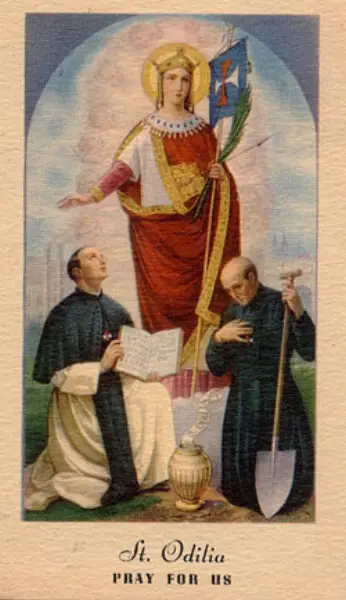
Overview
Odilia of Cologne — called also Odile or Ottilia — is a virgin martyr whose story reaches the present almost entirely through legend. Tradition sets her in the fourth century and calls her the child of a British ruler — the tale says a king. Joining the company of holy women that gathered around St Ursula, she traveled with them into Germany, whether, as one account has it, on pilgrimage to Rome, or, as another claims, in search of a place where they might settle and practice their faith in peace. At the gates of Cologne the party was intercepted by barbarians — Huns, in the form the legend takes in the story of St Ursula — and there Odilia and her companions were put to death for their faith. Her memory was kept at Cologne, and in 1287 she appeared in Paris to a brother of the Order of the Holy Cross, the Crosiers, asking that her relics be found; they were traced in Cologne and carried to the order's motherhouse at Huy in Belgium, with cures reported along the road. Today part of her relics rest in the Crosier shrine at Onamia, Minnesota, and parts are spread across the world. She is a patroness of the Canons Regular of the Order of the Holy Cross.
The Complete Life
A Princess Among Pilgrims
Legend preserves little of Odilia, but what it preserves places her in heroic company. Tradition sets her in the fourth century and calls her a princess of Britain, child of its ruler — the tale says a king. From that island she joined the band of young women, remembered as virgins consecrated to Christ, whose leader was St Ursula. With them she crossed into Germany, and the old accounts differ on the purpose of the journey: one makes the women pilgrims bound for Rome, another says they were seeking a place where they might settle and worship their faith without disturbance. Either way the company was a company of choice, women who had left country and kindred for conscience, and Odilia's place within it marks her as one who had embraced that same wandering vocation. The company's route brought them at last to the Rhine and to Cologne, the city where their journey would end and their memory would begin.
§ Legend
Martyrdom at the Gates
At the gates of Cologne the travelers were intercepted by barbarians — Huns, according to the shape the legend takes within the story of St Ursula — and Odilia perished there with her companions, martyred for the faith they would not abandon. The date the tradition assigns her is 451, within the era of the Hunnish ravages of Gaul, though the legend's details belong to narrative rather than chronicle, and few facts survive about her. What the martyrdom at the gates gave the church was a memory kept at Cologne itself, where her relics lay until the late thirteenth century. The city that had been the scene of the Company's death became the keep of their bodies, and Odilia, the British princess who had died far from her father's kingdom, slept in the soil of her adoption until a new chapter of her story opened in Paris.
§ Legend
The Crosiers' Patroness
Odilia's cult found its enduring form in 1287, when she appeared to a brother of the Order of the Holy Cross — the Crosiers — in Paris, and asked that her remains be sought out. Her remains were then located in Cologne and carried to the order's motherhouse at Huy in Belgium; along the road to Huy, various cures of infirmities were reported, the first fruits of a devotion that has lasted seven centuries. The Canons Regular of the Order of the Holy Cross took her for a patroness, and her feast, 18 July, is kept in their memory though the current universal calendar does not commemorate it. Her relics did not remain in one place: some are enshrined today at Onamia in Minnesota, where the Crosiers carried her name across the Atlantic, and others are spread worldwide. A martyr of whom legend records almost nothing thus became, by way of a vision in Paris, one of those rare saints whose body has crossed an ocean and whose cult spans continents.
§ Legend
Timeline
- 400
Tradition gives this as the year of her birth at Cologne.
§ Legend
- 451
Martyred at the gates of Cologne with the company of virgins around St Ursula.
§ Legend
- 1287
Appears in a vision to a Crosier brother in Paris; her relics are traced in Cologne and translated to Huy in Belgium, with cures along the way.
§ Legend
The Record
- Patron of
- Canons Regular of the Order of the Holy Cross
- Canonization
- Pre-congregation virgin martyr, venerated in the Roman Catholic Church from an early date
Prayer
Bibliography
Show 2 sources
- Herbers, Klaus (2012). Pilgerheilige und ihre Memoria (in German). BoD – Books on Demand. ISBN 9783823366843.
- Reyniers, Jeroen & Jim Moeglein, "The Relics of Saint Odilia Worldwide", in: Clairlieu. Tijdschrift gewijd aan de geschiedenis der kruisheren, 79, 2021.
Profile text adapted from the Wikipedia article, licensed CC BY-SA 4.0.
Pray with this saint every day
Save St. Odilia of Cologne to your favorites, read the full profile, and get feast-day reminders in the Saints app.
Get the Saints AppFree on the App Store for iPhone and iPad