
c. 962 – 1049·Feast May 11
St. Odilo of Cluny
Archangel of the Monks, Father of All Souls
Overview
Odilo of Cluny, fifth abbot of the great Burgundian monastery, led Cluny for some fifty-four years and made it the most influential religious house in western Europe. Born around 962 into the nobility of Auvergne, he was a frail child, partially paralyzed until — the story runs — he crawled to the altar of a wayside church and rose to his feet at Our Lady's intervention. Educated at the seminary of St. Julien in Brioude and trained in canon law, he took the habit at Cluny in 991 at twenty-nine years of age, became coadjutor to Abbot Mayeul before his probation was even finished, and in 994 succeeded him. His abbacy, marked by an extraordinary gentleness of rule, transformed western monasticism: the Benedictine Rule displaced older customs, thirty abbeys had taken Cluny for their mother house, and the reforming movement ran from Burgundy across Provence, Auvergne, and Poitou into much of Italy and Spain. Odilo secured Cluny's freedom from every bishop but the pope, fought simony and uncanonical marriage, promoted the Truce of God amid the anarchy of feudal warfare, and counseled the emperors Henry II and Conrad. His most far-reaching act was the institution of All Souls' Day on 2 November, soon adopted by the whole Western church. Fulbert of Chartres called him the Archangel of the Monks. He died on 1 January 1049 at Souvigny, praying for the souls in purgatory.
The Complete Life
The Child at the Church Door
Odilo came into the world around 962, a child of the illustrious nobility of Auvergne. His father was Berald de Mercoeur, his mother Gerberga, a woman whose faith shaped the family: widowed, she took the veil at the convent of St. John in Autun. The household was large — eight brothers and two sisters — and it furnished the church with religious as readily as the world with nobles, for one sister married while the other became an abbess. Odilo himself began life in weakness. As a small boy he was partly paralyzed, and the family's servants had to move him about upon a stretcher. One day, while the household traveled, they stopped at a church, and the child was left with the luggage at the door. The door stood open. Odilo felt himself called to crawl toward the altar, and he dragged himself across the floor of the church to reach it. Twice he tried to stand; twice he failed; on the third attempt he succeeded, and found he could walk around the altar. The family believed the unnamed malady had been cured through the intervention of Our Lady, and from that hour the abbot-to-be belonged to her.
§ Early life
From Brioude to Cluny
The boy who had been healed at an altar grew into a youth of marked devotion to the Virgin Mary, the patroness of his recovery. Still very young, he began his studies at the seminary of St. Julien in Brioude, where he trained himself into a specialist in canon law — a study that would serve him all his life in the defense of his monastery's liberties. The decisive turn came through friendship. William of Dijon, the celebrated Cluniac abbot and reformer, persuaded the young canonist to embrace the monastic life at Cluny itself. In 991, at twenty-nine, Odilo entered the abbey. His superiors saw in him at once a man for government: before his year of probation had even ended he was named coadjutor to Abbot Mayeul, and shortly before Mayeul's death in 994 he was made abbot and received holy orders. A man of small stature and insignificant appearance, he carried within him an immense force of character. The student of church law had become, almost overnight, the ruler of the monastery that was about to become the conscience of western Christendom.
§ Early life
The Gentle Ruler of Cluny
Fifty years of government set Odilo's stamp on Cluny and through Cluny on the whole of monastic Europe. His rule was famous above all for its gentleness: it was his custom to say that of two extremes he preferred to offend by tenderness rather than by an over-rigid severity, and he showed mercy without calculation, even to those whom everyone else pronounced unworthy of it. Yet softness of manner concealed steel. Under his abbacy Cluny erected a magnificent monastery building, substituted the Rule of St. Benedict for the domestic Rule of Isidore, and encouraged learning so far that Odilo set the monk Rodolfus Glaber to writing a history of the times. He threw the full weight of Cluniac influence against simony, concubinage, and the uncanonical marriages of the laity. To keep reformed houses from sliding backward he bound them to Cluny itself, appointing every prior and receiving the profession of every monk in his own name. By the end of his tenure thirty abbeys had accepted Cluny as mother house, King Robert II of France had allied himself with the reform party, and Fulbert of Chartres had found the only title worthy of him: Archangel of the Monks.
§ Odilo’s abbacy
Mercy for the Living and the Dead
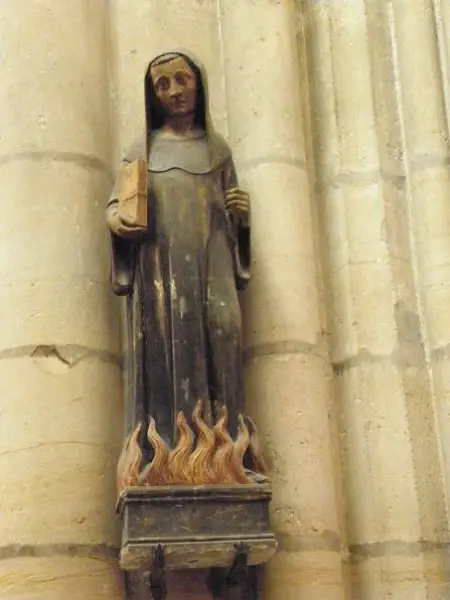
Odilo's spirituality joined Marian devotion, ascetic discipline, and a compassion that refused every boundary, including the boundary of death. His tenderness toward the Virgin, who had healed him in childhood, bore institutional fruit when he urged upon the faithful the formal practice of consecrating themselves to the Mother of God. Asceticism marked him for life: he kept his fasts and penitential practices into extreme old age and weakness, and on his last visit to Rome he passed his days praying in the churches and giving alms to the poor. But the act that carried his name through the centuries was his invention of a day for the dead. According to one tale, a pilgrim thrown by a storm onto an island had there seen the souls in purgatory suffering the flames of purification, and on his return begged Father Odilo to set aside a day of prayer for the departed. Odilo founded at Cluny the yearly keeping of a commemoration for every soul of the faithful departed, marked with alms, prayers, and sacrifices, and decreed that those who asked a Mass for their dead should make an offering for the poor — binding almsgiving, fasting, and prayer for the suffering souls into a single work of mercy. All Souls' Day, kept on 2 November, passed from Cluny into the whole Western church.
§ All Souls’ Day
The Last Road
Odilo had often visited Rome, and that last visit coincided with a papal election and an imperial coronation. Day after day he passed in prayer from church to church, almsgiving as he went, and confessed his wish to die in the holy city. Setting out instead for Cluny, he suffered a fall from his horse not far from Rome, and the injury forced his return to the city, where the grief felt for the aging abbot filled the city; Masses rose for his recovery, and the pontiff came in person to his sickbed. He remained until Easter and then took the road again, resolving to visit every house Cluny had reformed. The tour brought him as far as Souvigny Priory, where his strength failed and he had to stop. By Christmas he could no longer walk the monastery except carried in men's arms. In the chapel of St Mary, at prayer — as he had prayed all his life — for the souls in purgatory, when death came to him during the night of the New Year, 1049, at the age of eighty-seven. Miracles, including healings, were soon reported from his tomb.
§ Death
Saint of the Whole Church
Odilo was buried in Souvigny Priory, where he had died, and the veneration of a saint gathered around his grave almost at once. In 1063 Peter Damian undertook the process of his canonization and composed a brief life of the abbot, for the most part abstracted from the writing of Jotsald, a monk of Odilo's own who had gone with him on his journeys. The church he left behind venerated him on every side: his feast, formerly kept at Cluny on 2 January, came to be celebrated there on 19 January, in Switzerland on 6 February, and elsewhere on 11 May. The Eastern Orthodox churches number him among the saints of the undivided church as well. His patronage followed naturally from his great work of mercy: he is the patron of the souls in purgatory, and in Berwyn, Illinois, the parish of Saint Odilo bears the official designation of the National Shrine of the Souls in Purgatory. The revolutionaries of 1793 burned his relics, together with those of Abbot Mayeul, on the altar of the fatherland — but a devotion that had reshaped the church's calendar could not be burned with them.
§ Veneration
The Peace of Christendom
Odilo's influence outlasted him in three great works: the reformed monastery, the tamed battlefield, and the day of the dead. The reforming movement he headed went out from Cluny over Burgundy, Provence, Auvergne, and Poitou, winning much of Italy and Spain, and its example crossed into England, where the monastic renewal of Dunstan, Æthelwold of Winchester, and Oswald of Worcester went forward under Cluniac influence. His defense of monastic liberty established the principle that a monastery owes its allegiance to Rome alone: he went to Rome in 997 to secure Cluny's status, obtained from Gregory V in 998 the abbey's complete freedom from the diocesan bishop, and in 1024 saw the privilege extended to every dependent Cluny house — while the dispute with Bishop Gauzlin of Mâcon, begun in 1025, ended with the pope decreeing automatic excommunication for any bishop who entered a Cluniac monastery uninvited. His promotion of the Truce of God suspended private war on solemn seasons and gave medieval Europe its first working discipline of public peace. And his All Souls' Day became the inheritance of every Catholic parish on earth. He is said to have shaped even the pilgrimage road to Santiago, which ran past the Cluniac houses — a saint whose reach extended to the ends of the known world.
§ Reform
Timeline
- 962
Born into an illustrious noble family of Auvergne, son of Berald de Mercoeur and Gerberga.
§ Early life
- 991
Enters the monastery of Cluny at the age of twenty-nine, persuaded by William of Dijon.
§ Early life
- 994
Made Abbot of Cluny shortly before the death of his predecessor Mayeul.
§ Odilo’s abbacy
- 994
Wins from the Synod of Ansa a statement excommunicating anyone who attacks Cluniac property.
§ Monastic autonomy
- 997
Travels to Rome to secure the legal status of Cluny.
§ Monastic autonomy
- 998
Obtains from Pope Gregory V Cluny's complete freedom from the diocesan bishop.
§ Monastic autonomy
- 1004
Attends Henry II's coronation as King of Italy and persuades the king to spare the rebels of Pavia.
§ Monastic autonomy
- 1006
During a great famine, melts the sacred vessels and sells the emperor's golden crown to feed the hungry.
§ Odilo’s abbacy
- 1014
Present in Rome at the imperial coronation of Henry II, having spent months at the emperor's side.
§ Monastic autonomy
- 1024
The exemption from diocesan control is extended to all dependent Cluny abbeys and priories.
§ Monastic autonomy
- 1025
Dispute with Gauzlin, bishop of Mâcon, over the ordination of Cluniac monks begins; the pope ultimately condemns Gauzlin's position.
§ Monastic autonomy
- 1026
Intercedes again for the defeated rebels of Pavia, this time with Emperor Conrad II.
§ Monastic autonomy
- 1030
Institutes the commemoration of All Souls' Day on 2 November at Cluny and its monasteries.
§ All Souls’ Day
- 1046
Present in Rome at the coronation of Henry III.
§ Monastic autonomy
- 1 Jan 1049
Dies during the night at Souvigny Priory, in St Mary's chapel, praying for the souls in purgatory.
§ Death
- 1063
Peter Damian undertakes the process of his canonization and writes a short life of the abbot.
§ Veneration
- 1793
French revolutionaries burn his relics, together with those of Abbot Mayeul, on the altar of the fatherland.
§ Veneration
In Their Own Words
I would rather be mercifully judged for having shown mercy, than be cruelly damned for having shown cruelty.
Very well, oh brother, Christ Himself deigned to come and meet His servant. In the hour of my death He pointed out to me a fierce and terrible figure which, standing in a corner, would have terrified me by its huge monstrosity had not its malignancy been annulled by His presence.
The Record
- Major works
- Life of the Empress Adelaide·Short biography of Abbot Mayeul·Sermons on the feasts of the ecclesiastical year·Hymns and prayers·Letters
- Patron of
- souls in purgatory
- Canonization
- Venerated as a saint soon after his death; the process was undertaken by Peter Damian in 1063
Prayer
Bibliography
Show 8 sources
- Glaber, Rodulfus (1989). Rodulfi Glabri Historiarum libri quinque. Oxford: Clarendon Press; New York: Oxford University Press. ISBN 978-0-19-822241-5.
- Smith, Lucy Margaret. The Early History of the Monastery of Cluny. Oxford University Press, 1920.
- Löffler, Klemens. "St. Odilo." The Catholic Encyclopedia. Vol. 11. New York: Robert Appleton Company, 1911.
- Monks of Ramsgate. "Odilo". Book of Saints, 1921.
- Butler, Alban. "Saint Odilo, or Olon, Sixth Abbot of Cluni". Lives of the Fathers, Martyrs, and Principal Saints, 1866.
- McNally, Terrence (2009). What Every Catholic Should Know about Mary. ISBN 1-4415-1051-6. pp. 76–78.
- Moeller, Charles. "Truce of God." The Catholic Encyclopedia. Vol. 15. New York: Robert Appleton Company, 1912.
- Watkin, William Ward. "The Middle Ages: The Approach to the Truce of God", The Rice Institute Pamphlet, Vol. XXIX, No. 4, October, 1942.
Profile text adapted from the Wikipedia article, licensed CC BY-SA 4.0.
Pray with this saint every day
Save St. Odilo of Cluny to your favorites, read the full profile, and get feast-day reminders in the Saints app.
Get the Saints AppFree on the App Store for iPhone and iPad