
c. 878 – 942·Feast November 18 (Benedictines: May 11)
St. Odo of Cluny
Second Abbot of Cluny and Monastic Reformer
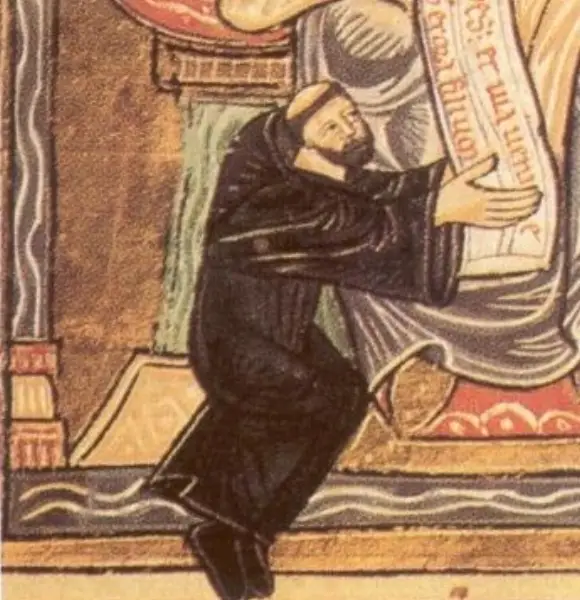
Overview
Odo of Cluny, the second abbot of the great Burgundian monastery of Cluny, was the driving force of the tenth-century monastic reform that reshaped religious life in western Europe. Born around 878 to a noble family of the Loire country, he served as a page at princely courts, became a canon of Saint Martin of Tours, and studied philosophy and theology in Paris before abandoning a comfortable canonical career for the strict Benedictine life at Baume under Abbot Berno. When Berno died in 927, Odo, reluctantly, took charge of Cluny and its sister houses. For the next fifteen years he traveled constantly, restoring the Rule of Saint Benedict to monasteries across France and Italy, often against armed resistance, under a papal privilege that made him a kind of roving reformer. He restored Saint Paul's Outside the Walls in Rome, sent disciples to Monte Cassino and Subiaco, and taught his monks a charity so generous that in one year food was given to more than seven thousand people in need. To his followers he also imparted a love of learning, music, and silence; his own works include moral essays, a life of Saint Gerald of Aurillac, an epic poem on the Redemption, and hymns in honor of Saint Martin. He died at Tours on 18 November 942, and he is credited with initiating the annual commemoration of all the faithful departed that became the feast of All Souls.
The Complete Life
A Noble Child of the Loire
Odo was born around 878, the child of Abbo, lord of the lands of Deols near Le Mans, and of his wife Arenberga. The biography later written by his disciple John of Salerno recounts that the couple had long been childless, and that on Christmas Eve Abbo prayed to Our Lady to obtain the gift of a son. When the boy was born, his grateful father entrusted him to the Church of Saint Martin in Tours, and in time both parents entered monasteries, as did his brother Bernard. Odo's childhood was spent among the great of the world rather than in the cloister. While still a child he was sent to the court of Fulk the Good, Count of Anjou, and afterward he became a page in the household of William the Pious, Duke of Aquitaine, remaining there several years. Amid the spectacle of aristocratic life he formed a devotion that would mark him permanently: a particular attachment to Mary under the title Mother of Mercy, the invocation by which he addressed her for the rest of his days. The boy who had been begged from the Mother of Mercy grew up with a sense that his life had been given, not owned, and that sense would one day pull him out of the courts of princes.
§ Early life
From Canon to Monk
At nineteen Odo was tonsured a canon of the church of Saint Martin in Tours, whose tomb was then counted among the holiest places in western Christendom. For six years his studies embraced the classic authors, the patristic writers, verse, and music. Then in 901 he went to Paris to complete his theological formation, spending four years on philosophy under Remigius of Auxerre. Back in Tours he adopted a strict and ascetic way of life, and his unease with the canons around him deepened. He would later say that the wealth brought by pilgrims had spoiled the monks of Saint Martin's, that they had abandoned their Rule, and that the religious there no longer attended the nightly office for fear of dirtying their fine shoes. Reading the Rule of Saint Benedict, he was confounded by the distance between its maxims and his own life, and he resolved to become a monk. His patron, the Count of Anjou, refused consent, so Odo spent almost three years in a solitary cell with one companion, practicing penance. At last he resigned his canonry and slipped away to the monastery of Baume in the diocese of Besançon, carrying nothing but about a hundred volumes. Abbot Berno clothed him in the habit; later, pressed by obedience, he accepted priesthood from Bishop Turpio of Limoges, wrote his Collationes at the bishop's request, and became superior of Baume's abbey school.
§ Church of St Martin, Tours
The Reformer of Monasteries
When Berno died in 927 his congregation of six houses was divided, and Odo found himself abbot of Deols, Massay, and Cluny, though only under threat of excommunication did he accept election. His government began amid hardship: Cluny's church was still unfinished, money was short, and Berno's other heir attempted to seize the monastery by force until Pope John X intervened with the king. The pattern of Odo's next fifteen years was set by movement. He reformed Romainmôtier, Saint Michael's at Tulle, and Saint-Géraud at Aurillac, and in 930 he went, at King Rudolf's request, to Fleury, where monks met him with spears and swords; after a three-day standoff he rode toward them on his donkey, and they laid down their arms. In 931 a privilege of Pope John XI authorized him to reform the monasteries of Aquitaine, northern France, and Italy, to unite abbeys under his supervision, and to receive monks from unreformed houses at Cluny. Between 936 and 942 he crossed the Alps repeatedly, restoring Saint Paul's Outside the Walls as his Roman headquarters, rebuilding houses with the backing of Alberic II, sending his disciple Baldwin to Monte Cassino, and extending reform to Subiaco, Naples, Salerno, Benevento, and Pavia. Once forty robbers surrounded him on a road; he walked on singing psalms, and their leader, who would later become his disciple, turned them away.
§ Reforms of other monasteries
Austerity and Kindness
The spirituality Odo taught joined uncompromising discipline to a warmth that startled those who expected only severity. His customary teaching was that the name of monk belongs only to one who truly loves and strictly keeps silence, without which, he held, for the commerce of a soul with God. Yet the silence of Cluny was interrupted by generosity: in a single year the monastery distributed food to more than seven thousand people in need, and Odo bade his monks believe that at paradise's gates the blind and the lame stand as porters, and he reproved any brother who treated a beggar harshly and bidding him imagine repaying that beggar at heaven's gate. His lifelong devotion to Saint Martin of Tours shaped his prayer; he begged Martin's help for every problem of the monastery, and he told of the saint's promise that money would come to the unfinished church, which was followed days later by a gift of three thousand gold solidi. He loved music and wrote hymns and antiphons in Martin's honor, and he kept a habit, noticed by his biographer, of asking the children he met on the road to sing for him and giving them a small token in return. Pope Benedict XVI, summing up his character, observed that his rigorous austerity concealed a deep and heartfelt goodness.
§ Cluny
Death at Tours
In 942 a peace was finally made in Rome between Alberic and his stepfather Hugh of Lombardy, whom Odo had twice been called upon to mediate between. Soon afterward he fell ill, and sensing that death was near, he determined to return to Gaul. The journey home ended where his spiritual life had begun: he stopped at the monastery of Saint Julian in Tours to keep the feast of Saint Martin, the saint whose canonry he had worn as a young man and whose patronage he had invoked all his life. Fever took him there, and after a lingering sickness he died on 18 November. His pen did not rest even then; as he lay dying he wrote a hymn in Martin's praise. Burial followed in the church of Saint Julian, a tomb that became a place of honor, though centuries later the Huguenots burned most of his remains. His commemoration was kept on 18 November, the day of his death, while the Benedictines observe it on 11 May, and he is numbered among the great abbots of Cluny alongside Maiolus, Odilo, and Hugh. The man who had rebuilt houses across two countries died quietly in the town of the saint he had loved since boyhood, finishing in song a life that had been carried, more than once, by psalmody through danger.
§ Death of Odo
Veneration
Odo was never formally canonized by a pope; he belongs to the ancient company of saints raised by the common voice of the Church. His cult took root at once among the monks of his congregation, who preserved his memory through the Vita written by his disciple John of Salerno, the single contemporary biography of his life. In time his name entered the sanctoral calendars of both the Catholic Church and the Eastern Orthodox Church, which commemorates him with the West on 18 November and keeps a corresponding date of 1 December on its own calendar. Within Catholic observance his main feast falls on 18 November, the anniversary of his death at Tours, while the Benedictine order keeps his memory on 11 May; he is also honored on 29 April or 11 May in the joint commemoration of the four great abbots of Cluny, Odo, Maiolus, Odilo, and Hugh, the line of rulers under whom the monastery became the school of European monastic life. Popular devotion, especially in the region of his native Loire, associated him with the needs of farmers and musicians, seeking his intercession for rain in time of drought and counting him a patron of those who serve God with song. His bones, mostly destroyed at Tours in the wars of religion, left no great shrine; his cult rests on his works and his reputation.
§ Veneration
Legacy
Odo's achievement outlasted him in institutions, in devotion, and in letters. The Cluniac observance he established became the model of monasticism for more than a century, and the houses he reformed in turn reformed and founded others, spreading a single vision of the Rule from Limoges to Normandy to the valleys of Italy; Cluny itself grew wealthy and influential under the protection of popes and princes that he had secured. To him is traced the practice, adopted by the monasteries of the congregation, of a yearly commemoration of every faithful departed, observed on the morrow of All Saints, the custom from which the universal feast of All Souls eventually grew. As a writer he left a commentary on the Moralia of Gregory the Great, three books of Collationes, severe and forceful moral essays, sermons, an epic poem on the Redemption called the Occupatio, a biography of Saint Gerald of Aurillac, three hymns, and twelve choral antiphons in honor of Saint Martin of Tours, and some scholars have added to this list the earliest surviving treatise of polyphonic music, the Musica enchiriadis. Pope Benedict XVI has presented him to the modern Church as the energetic yet lovable medieval abbot, enthusiastic about reform, whose incisive action nourished both his monks and the lay faithful of his age, a reformer remembered above all for goodness.
§ Writings
Timeline
- 878
Born near Le Mans to Abbo, lord of Deols, and to his wife Arenberga
§ Early life
- 901
Travels to Paris to complete theological studies, including philosophy under Remigius of Auxerre
§ Church of St Martin, Tours
- 909
Resigns his canonry and secretly enters the monastery of Baume, bringing about a hundred volumes
§ Church of St Martin, Tours
- 910
Abbot Berno leaves Baume with some monks to found Cluny Abbey
§ Cluny
- 927
On Berno's death, accepts election as abbot of Cluny, Deols, and Massay after the bishop threatens excommunication
§ Cluny
- 930
Reforms Fleury Abbey, facing armed monks in a three-day standoff before they submit
§ Reforms of other monasteries
- 931
Pope John XI grants a privilege empowering him to reform monasteries in Aquitaine, northern France, and Italy
§ Reforms of other monasteries
- 936
Comes first to Rome and begins reviving monastic life in central Italy with Alberic II's support
§ In Italy
- 937
Visits Rome and is given the Basilica of Saint Paul Outside the Walls
§ Introduction
- 18 Nov 942
Dies at the monastery of Saint Julian in Tours after a lingering sickness, during the feast of Saint Martin
§ Death of Odo
In Their Own Words
When he who has served thee thus, comes himself seeking entrance from thee at the gates of paradise, repay him in like manner.
Why do ye marvel, oh brothers? Know ye not that the water feared to touch the life of the saint?
[H]e was austere, but above all he was good...
The Record
- Major works
- Collationes, three books of moral essays·A commentary on the Moralia of Pope Gregory I·A biography of Saint Gerald of Aurillac·Occupatio, an epic poem on the Redemption·Three hymns and twelve choral antiphons in honor of Saint Martin of Tours·Several sermons
- Patron of
- Musicians·For rain, against drought
- Canonization
- Pre-congregation; venerated by the Catholic Church and the Eastern Orthodox Church
Prayer
Bibliography
Show 6 sources
- Brockett, Clyde; Huglo, Michel (2001). "Odo of Cluny". Grove Music Online. Oxford: Oxford University Press. doi:10.1093/gmo/9781561592630.article.20255. ISBN 978-1-56159-263-0.
- "Butler's Lives of the Saints – Saint Odo, Abbot of Cluny". CatholicSaints.Info. Retrieved 2025-12-23.
- Smith, Lucy Margaret. The Early History of the Monastery of Cluny. Oxford University Press, 1920.
- "General Audience of 2 September 2009: Saint Odo of Cluny". www.vatican.va. Retrieved 2025-12-23.
- John of Salerno, Vita sancti Odonis, II, 5: PL 133, 63.
- Huglo, Michel (2001). "Odo of Cluny". In Sadie, Stanley; Tyrrell, John (eds.). The New Grove Dictionary of Music and Musicians (2nd ed.). London: Macmillan. ISBN 978-1-56159-239-5.
Profile text adapted from the Wikipedia article, licensed CC BY-SA 4.0.
Pray with this saint every day
Save St. Odo of Cluny to your favorites, read the full profile, and get feast-day reminders in the Saints app.
Get the Saints AppFree on the App Store for iPhone and iPad