
died c. 855·Feast June 12 (July 18 on some calendars)
St. Odulf
Frisian Missionary and Canon of Utrecht
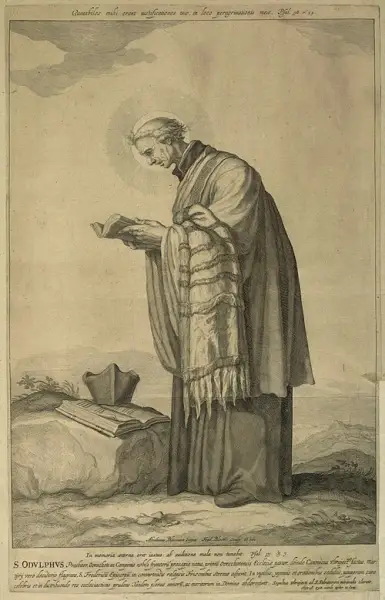
Overview
Odulf, whose name appears in many forms including Odulph, Odulfo, and Odulphus, was a ninth-century monk, priest, and Frisian missionary who died in 855. Born in Brabant of noble French parents, he showed early gifts for learning and piety, was ordained priest, and served as curate at Oresscoth in his home region. His life turned when Saint Frederic, the missionary bishop, persuaded him to join the hard work of evangelizing and reforming the fierce Frisians, a labor in which his biographers say he showed extraordinary patience, meekness, zeal, and charity through uncounted fatigues. Prayer and contemplation sustained him through continual labors and austerities, and his life records predictions of events that happened long after his death. In old age he settled at Utrecht, where he died a canon of the cathedral on 12 June, having refused all indulgence to the end and redoubled his labors as death approached. His feast day was observed with solemn ceremony at Utrecht and at Staveren. In 1034 his relics were translated to Evesham Abbey in England, where they were placed alongside those of Saints Ecgwine and Wigstan, and the miracles reported at his intercession drew crowds of pilgrims to the abbey for centuries.
The Complete Life
A Noble Calling
Odulf came into the world in Brabant, the child of noble French parents, and the first portrait his biographers draw is of a youth marked by innocence of manners and remarkable progress in learning and piety. Educated and devout, he was ordained to the priesthood and given charge of souls as curate of Oresscoth, in the Brabant country, where the record leaves him for a time in ordinary pastoral work. The decisive turn came through another man's persuasion. Saint Frederic, who shepherded the mission to the northern peoples, pressed him with urgent entreaties to leave the comforts of his birth and upbringing for the greater glory of God, and to stand beside him as a strenuous helper in the reform of the fierce Frisians' way of life. Odulf consented, and the consent cost him everything a nobleman's son might have expected of life. The account of his mission speaks of incredible fatigues undergone in that undertaking, and of heroic patience, meekness, zeal, and charity proved amid a people long resistant to the gospel. His biographer is clear about the source of his endurance: prayer and contemplation sustained and refreshed his soul amid unending toil and austerities, and from that hidden well he drew the strength his work demanded.
§ Butler's account
Missionary to the Frisians
The field of Odulf's apostolate was Frisia, the coastal country of the northern Low Countries, whose peoples had a reputation among their neighbors for fierceness and resistance to the faith. Working as the assistant of Saint Frederic, he gave himself to the reform and conversion of that region through the first half of the ninth century, and the medieval records group him with the long line of monks and missionaries who carried Christianity into the Low Countries in that age. His name appears in the early English hagiographical lists as well: he is recorded in the Secgan hagiography, in the medieval hagiography of Saint Ecgwine, and in the Ave presul gloriose psalter, where he is linked with Oda of Canterbury, as well as in the Chronicon Abbatiae de Evesham. These notices, scattered though they are, show that his fame crossed the Channel. The substance of his mission, as his life tells it, was not deeds of power but endurance: fatigues beyond counting, patience under hostility, and a charity that instructed and exhorted the people toward the divine love and the contempt of earthly things. Alongside the work, his biographers record that several wonderful predictions of things that happened long after his death are preserved in his life, signs they took of the prophet's spirit resting on the missionary.
§ Lives
Old Age and Death
When his missionary strength was spent, Odulf withdrew to Utrecht, the seat of the northern mission, and there he lived out his last years, dying as a canon of the cathedral. Old age did not soften his discipline. The story of his death insists that to the very end he permitted himself no indulgence and never let his zeal for labor slacken; as the end drew near he only quickened his step, knowing this to be the Christian's wage, and fearing that sloth and faintness of heart might forfeit the crown he had contended for. His fasting, his vigils, his constant prayer, his almsgiving, and his zeal for instructing the people seemed to gather strength with his years. At last, seized with a fever, he foretold his final moment with joy, earnestly exhorted his brethren to fervor, commended himself to their prayers, and undertook, by the divine mercy, to remember them always before God. So he left this life in the ninth age of the Church on 12 June, and on that day his festival was afterwards kept with great solemnity at Utrecht and at Staveren, the Frisian town where his missionary labors had been remembered longest.
§ Butler's account
Veneration
Odulf's sanctity was recognized by the common assent of the Church in the Low Countries long before any formal process existed; he is numbered among the saints of the pre-congregation era. His memorial was kept on 12 June, though some calendars assign it to 18 July, and the observance of his feast at Utrecht and Staveren was marked, in the words of his early biographer, with great solemnity. Devotion to him was not confined to the places of his labor. The medieval English records that mention him, from the Secgan lists to the chronicle of Evesham Abbey, show that his cult had crossed into Anglo-Saxon and later English piety, where he was remembered among the missionary saints of the Germanic mission. In later centuries several churches and chapels bore his name, testimony to the spread of his veneration through the Netherlands and beyond. Scholars of his cult have had to untangle it from confusing cases; the Bollandists and others wrongly attributed to him the Olofs-Kapel at the New Bridge in Amsterdam, whereas that chapel was in fact erected by Danish sailors in memory of Saint Olaus, king and martyr of Norway. Such corrections, made by careful antiquarians, belong to the ordinary work of distinguishing the true memory of the saint from legend.
§ Butler's account
Relics and Remembrance
Odulf's most enduring shrine was made in England. In 1034 his relics were translated to Evesham Abbey in Worcestershire, one of the great monasteries of the Anglo-Saxon Church, where they were laid to rest with those of Saints Ecgwine and Wigstan. The translation was no accident of politics; it reflected a deliberate policy of the abbey's twelfth-century leadership, for Abbot Ælfweard occupied himself with increasing Evesham's prestige and purchased the relics of Saint Odulf to enrich the abbey's treasury of the holy. The investment bore fruit in pilgrimage: word of the many wonders worked through the saint's intercession brought throngs of pilgrims to Evesham, and Odulf took his place among the honored confessors whose tombs gave the abbey its renown. His memory was preserved in a network of medieval texts, from the Secgan hagiography and the hagiography of Saint Ecgwine to the psalter verse that paired him with Oda of Canterbury, and modern students of the saints have continued to record his life in the standard dictionaries, where he stands as a monk, a Frisian missionary, and a canon of Utrecht who died in 855. Several churches and chapels still carry his name, keeping alive the memory of the noble-born Brabantine who gave his learning and his strength to the conversion of the north.
§ Monks of Ramsgate account
Timeline
- 12 Jun 855
Dies at Utrecht as a canon of the cathedral, on the day his feast was afterwards kept
§ Butler's account
- 1034
His relics are translated to Evesham Abbey, where pilgrims come to his tomb because of reported miracles
§ Monks of Ramsgate account
The Record
- Canonization
- Pre-congregation; venerated from the early medieval period, feast kept at Utrecht and Staveren
Prayer
Bibliography
Show 6 sources
- Butler, Alban (1799). The Lives of the Primitive Fathers, Martyrs, and Other Principal Saints. J. Moir. pp. 252–253.
- St. Augustine's Abbey, Ramsgate (1921). The Book of Saints: A Dictionary of Servants of God Canonized by the Catholic Church. London: A. & C. Black, Ltd. p. 205.
- Hornby, Emma; Maw, David Nicholas, eds. (2010). Essays on the History of English Music in Honour of John Caldwell. Boydell & Brewer. ISBN 9781843835356.
- Searle, William George. Onomasticon Anglo-Saxonicum: A List of Anglo-Saxon Proper Names from the Time of Beda to that of King John. Cambridge University Press, 2012. Page 363.
- The Oxford Dictionary of Saints. Oxford University Press.
- Mullins, E. L. C. (1958). Texts and Calendars I: An Analytical Guide to Serial Publications. Royal Historical Society Guides and Handbooks No. 7. London: Royal Historical Society.
Profile text adapted from the Wikipedia article, licensed CC BY-SA 4.0.
Pray with this saint every day
Save St. Odulf to your favorites, read the full profile, and get feast-day reminders in the Saints app.
Get the Saints AppFree on the App Store for iPhone and iPad