
c. 995 – 1030·Feast July 29
St. Olaf Haraldsson
King and Martyr, Patron Saint of Norway
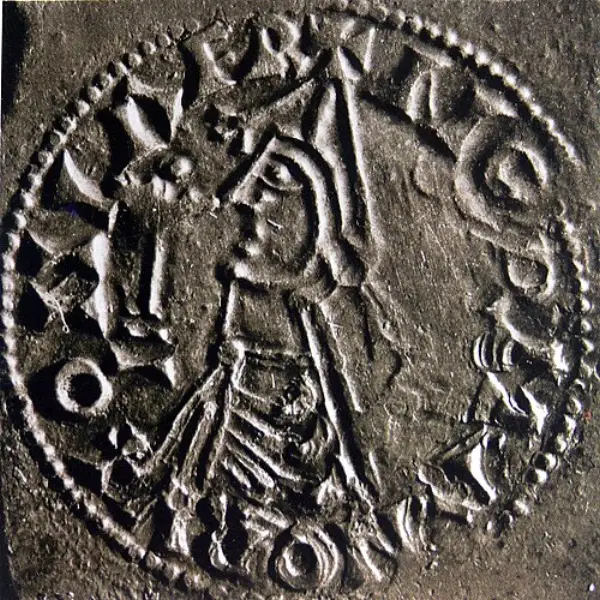
Overview
Olaf Haraldsson, remembered as Saint Olaf, Olaf the Holy, and Olaf the Stout, was King of Norway from 1015 to 1028 and died a martyr's death at the Battle of Stiklestad on 29 July 1030. The son of Harald Grenske, a petty king of Vestfold, he spent his youth as a Viking commander in the Baltic, Finland, England, and Normandy, and was baptized at Rouen before returning home to claim the throne. He defeated Earl Sweyn at the Battle of Nesjar in 1016 and for a time held more power than any Norwegian king before him, founding the town of Borg and striving to root Christianity in the inland districts. Discontented nobles brought Cnut the Great's power against him, and he died in exile-driven reconquest, struck down by men of his own country. Within a year Bishop Grimketel declared him a saint; miracles were reported at his grave, his remains were enshrined in Nidaros Cathedral above his burial place, and Pope Alexander III confirmed his cult in 1164. Honored as Rex Perpetuus Norvegiae, the eternal king of Norway, he became the nucleus of Norwegian national identity, the patron of farmers, sailors, and merchants across the Norse world, and the saint whose axe still appears in Norway's coat of arms.
The Complete Life
A King's Son of Ringerike
Olaf was born around 995 at Ringerike; his parents were Åsta Gudbrandsdatter and Harald Grenske, a Vestfold petty king who died before his son's birth. Through his father's line the later sagas traced him back to King Harald Fairhair, the unifier of Norway, making him a great-great-grandson of the founder of the Norwegian kingdom in the male line. His mother remarried Sigurd Syr, and among her other children was Harald Hardrada, who would one day reign as king of Norway himself. The petty kings of Ringerike kept old claims touching the high kingship, and the region stood in long-standing tension with the earls of Hlaðir, so Olaf grew up in a world of contested authority and warlord politics. The sources agree that he was raised in the Norse pagan religion and converted to Christ in early adulthood, though the exact moment and manner belong to saga rather than chronicle. What is certain is that while still a teenager he put out to sea: the Baltic first, then Denmark, and at last England, amassing the experience of arms and command that would underpin his whole career. The boy of Ringerike became one of the most formidable Viking commanders of his generation before he ever claimed a throne.
§ Background
Viking Commander and Christian
The saga accounts of Olaf's years abroad, though hard to verify, paint a coherent picture of a warrior earning his reputation. In 1008 he landed on the Estonian island of Saaremaa, where the islanders yielded at first to his demands, then raised an army amid the talks and fell upon him; Olaf prevailed. About the same time he sailed to the southern coast of Finland and fought the Battle at Herdaler, where he and his men were ambushed in the woods, lost many companions, and escaped to their boats through rising storm. He is said to have fought beside Thorkell the Tall in the siege of Canterbury in 1011, and skaldic poetry credits him with a successful seaborne assault that brought down London Bridge, perhaps in 1014, in the fighting that returned London and the English crown to Æthelred the Unready and expelled the Danes under Cnut. Somewhere in these years his vocation turned from plunder to kingship with a Christian purpose. On the way home he wintered in Normandy with Duke Richard II, an ardent Christian ruler, and before leaving he was baptized in Rouen's pre-Romanesque cathedral of Notre-Dame by Robert the Dane, archbishop of Normandy, the brother of the duke. He came back to Norway in 1015 a baptized man with a kingdom in his sights.
§ Reign
King of Norway
Olaf regarded it as his calling to gather Norway into a single realm, much as Harald Fairhair had once done. Landing home in 1015 he proclaimed himself king, winning the backing of the five petty kings of the Uplands; in 1016 he defeated Earl Sweyn of Lade, hitherto the de facto ruler of the country, at the Battle of Nesjar. He founded the town of Borg at the falls of Sarpsfossen, crushed the southern petty kings, broke the power of the aristocracy, and extended his lordship to the Orkney Islands, and raided Denmark with success. Through the lawspeaker Þorgnýr he made peace with King Olof Skötkonung of Sweden, was for a time engaged to that king's daughter Ingegerd without approval, and in 1019 married Astrid Olofsdotter, the king's illegitimate daughter, by whom he had a daughter, Wulfhild. Within a few years he wielded more power than any of his predecessors. His Christian work was bound up with this consolidation: he brought bishops from England, Normandy, and Germany, carried by most accounts the missionary bishop Grimketel in his household, strove to enforce the faith in the inland districts where the old ways held firmest, and is credited, on the evidence of the obscure Kuli stone, with codifying Christianity as the legal religion of Norway in 1024. In 1026 he fought at the Battle of the Helgeå, but the tide of Norwegian politics was turning against him.
§ Reign
The King's Faith
The nature of Olaf's Christianity has been argued over by modern historians, and honesty about him requires holding both sides of the picture. Traditionally he stands as the driving force, with his godfather Olaf Tryggvason, behind Norway's final conversion; yet most scholars now hold that the Christianization of the country owed less to him than legend allowed, for the coastal regions had known the faith long before, nearly all Norway's rulers since Håkon the Good had been Christians, and no permanent sees were established until around 1100. The skaldic verses attributed to Olaf himself never speak of Christianity at all. Modern historians generally agree that he was inclined to violence and brutality, and that like many Scandinavian kings he used the Christian religion to strengthen the monarchy and centralize control; Anders Winroth has portrayed Scandinavia's conversion instead as a gradual assimilation, the peoples taking on Christian practices one by one across time. Yet the record also shows a ruler who tried to bring the faith to the interior where it was least known, whose legal arrangements for the church of Norway stood high in the esteem of clergy and people, and who, in the words of later devotion, sealed that mixed and violent kingship with a martyr's blood. His sainthood, whatever the ambiguities of his life, encouraged the widespread adoption of Christianity among Scandinavia's Norsemen.
§ Christianising
Exile and Stiklestad
The end of Olaf's reign came quickly. In 1029 the Norwegian nobility, seething with discontent, threw their support behind an invasion by King Cnut the Great of Denmark, and Olaf was driven into exile. He lingered awhile in the Swedish province of Nerike, where tradition claims he baptized many of its people, and went on to Kievan Rus. When Cnut's Norwegian regent, Jarl Håkon Eiriksson, was lost at sea in 1029, Olaf seized the chance to win back his kingdom. With military and logistical support from the Swedish king Anund Jacob, he sought to evade the Danish king's formidable fleet in the Øresund by traveling across the mountains of Jämtland to strike at Nidaros, the Norwegian capital. He never reached it. On 29 July 1030 he fell at the Battle of Stiklestad, and against him in the field stood men of his own from central and northern Norway; he was about thirty-five years old in the cause he had set his heart on. Cnut ruled Norway for five years afterward through his son Svein and Ælfgifu, whose regency grew so unpopular that when Olaf's son Magnus the Good laid claim to the throne, they were driven out. The grave of Olaf at Nidaros has been untraceable since 1568, lost amid the Lutheran iconoclasm of 1536–37.
§ Reign
Saint and Eternal King
Olaf's elevation to the altars was swift. In that age a saint was recognized by local bishops and their people, for the formal papal canonization process was not yet customary. Bishop Grimketel, the English missionary bishop who had probably been the only one of Olaf's imported bishops left in the country at his death, stood behind the translation and beatification of the king on 3 August 1031, a year and five days after Stiklestad. Olaf swiftly became Norway's patron saint, and the cult that grew around him unified the country and consolidated its Christianization. Miracles were reported early: the skald Þórarinn loftunga's Sea-Calm Poem, composed about 1030–1034, already praises the holy king and lists wonders attributed to him, among them a slain sea serpent still shown on a cliffside and the blind man who recovered sight on the day of the king's death by rubbing his eyes with hands stained with his blood. An office for Olaf survives in the Leofric collectar from around 1050 in England, where his cult first left liturgical traces; Adam of Bremen, writing around 1070, mentions pilgrimage to his shrine at Nidaros. In 1164 Pope Alexander III confirmed the local canonization, and Olaf took the title Rex Perpetuus Norvegiae, the eternal king of Norway. He is venerated by Catholics, Orthodox, Lutherans, and Anglicans alike.
§ Saint Olaf
Legacy
Few medieval figures have left a longer shadow than Olaf. His body was enshrined in Nidaros Cathedral, raised above the place of his burial, and pilgrims arrived from every corner of the Norse world; churches were dedicated to him across Norway, Sweden, Iceland, Finland, Estonia, the Faroe Islands, and England, where St Olave's Church in York is named in the Anglo-Saxon Chronicle for 1055. With the Mother of God he was patron of the Varangian chapel in Constantinople, and he is called the last saint venerated by both Western and Eastern Christendom before the Great Schism. Folk memory made him a slayer of trolls and giants, a healer whose springs broke from the ground where his body had rested, and a patron of farmers, fishermen, sailors, and Hanseatic merchants; his red beard and temper were borrowed, scholars think, from the god Thor, whose features his medieval image absorbed. His dynasty's cult became the model for Scandinavia's Christian kingships. In Norway he remains omnipresent: Olsok is kept on 29 July, the axe of his martyrdom stands in the royal coat of arms and the arms of the Church of Norway, the Order of St. Olav was founded in 1847, and the Pilgrim's Way to Nidaros Cathedral has been revived. In Normandy, where he was baptized, he is honored as the Normans' patron, and Rouen keeps an arm bone of the saint in its cathedral crypt.
§ Folklore
Timeline
- 995
Born at Ringerike, the son of Harald Grenske and Åsta Gudbrandsdatter
§ Background
- 1008
Lands on the Estonian island of Saaremaa and wins a battle after the Osilians attack during negotiations
§ Reign
- 1008
Fights the Battle at Herdaler on the Finnish coast, escaping an ambush in the woods with heavy losses
§ Reign
- 1011
Takes part alongside Thorkell the Tall in the siege of Canterbury
§ Reign
- 1014
Skaldic poetry credits him with the seaborne attack that brought down London Bridge, aiding Æthelred against the Danes
§ Reign
- 1015
Returns to Norway, declares himself king, and wins the support of the petty kings of the Uplands
§ Reign
- 1016
Defeats Earl Sweyn at the Battle of Nesjar, becoming the effective ruler of Norway
§ Reign
- 1019
Marries Astrid Olofsdotter, the illegitimate daughter of King Olof Skötkonung of Sweden
§ Reign
- 1024
The codification of Christianity as Norway's legal religion is attributed to his reign, based on the hard-to-read Kuli stone
§ Conversion of Norway
- 1026
Fights in the Battle of the Helgeå
§ Reign
- 1029
Norwegian nobles back Cnut the Great's invasion, and Olaf is driven into exile
§ Reign
- 29 Jul 1030
Killed at the Battle of Stiklestad while attempting to win back his kingdom
§ Reign
- 3 Aug 1031
Bishop Grimketel stands behind his translation and beatification at Nidaros, one year after his death
§ Saint Olaf
- 1164
Pope Alexander III confirms Olaf's local canonization, making him a recognized saint of the Catholic Church
§ Introduction
In Their Own Words
[A] long process of assimilation, in which the Scandinavians adopted, one by one and over time, individual Christian practices.
The Record
- Major works
- Christian legal code for Norway attributed to his reign·Skaldic verses attributed to him in the Oldest Saga of St. Olaf·Founding of the town of Borg, later known as Sarpsborg
- Patron of
- Norway·Faroe Islands·Normans·Farmers, fishermen, sailors, and merchants of the Hanseatic League
- Symbols
- Axe·Crown
- Canonization
- Beatified by Bishop Grimketel in 1031; canonized by Pope Alexander III in 1164
Prayer
Bibliography
Show 7 sources
- Bagge, Sverre (2010). "Warrior, King, and Saint: The Medieval Histories about St. Óláfr Haraldsson". The Journal of English and Germanic Philology. 109 (3): 281–321. doi:10.5406/jenglgermphil.109.3.0281.
- Bagge, Sverre (2010). From Viking stronghold to Christian kingdom: state formation in Norway, c. 900–1350. Copenhagen: Museum Tusculanum Press, University of Copenhagen. ISBN 978-87-635-0791-2.
- Winroth, Anders. The Conversion of Scandinavia. New Haven: Yale University Press, 2012.
- Kunin, Devra, trans. A History of Norway and The Passion and Miracles of the Blessed Olafr. London: Viking Society for Northern Research, 2011.
- Lindow, John. "St. Olaf and the Skalds." In: DuBois, Thomas A., ed. Sanctity in the North. Toronto: University of Toronto Press, 2008. 103–27.
- Larsen, Karen. A History of Norway. Princeton University Press: Princeton, 1948. pp. 95–101.
- Astås, Reidar (1993). "Óláfr, St.". In Pulsiano, Phillip (ed.). Medieval Scandinavia, an Encyclopedia. NY and London: Garland. p. 446. ISBN 0-8240-4787-7.
Profile text adapted from the Wikipedia article, licensed CC BY-SA 4.0.
Pray with this saint every day
Save St. Olaf Haraldsson to your favorites, read the full profile, and get feast-day reminders in the Saints app.
Get the Saints AppFree on the App Store for iPhone and iPad