
fl. 5th century·Feast June 29
St. Olcán
Bishop of Armoy and Disciple of Saint Patrick
Overview
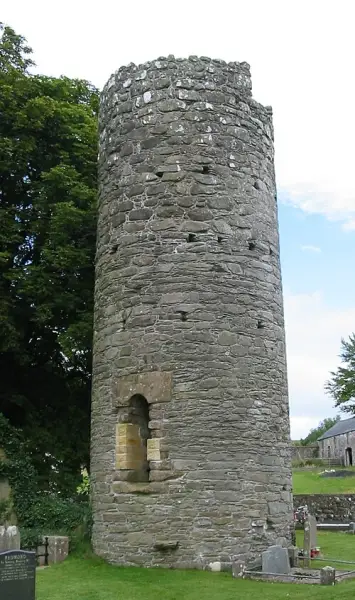
Olcán was an early Irish saint of the Dál Riata, a disciple of Saint Patrick and the founder and bishop of the monastery at Armoy in northeast County Antrim. Tradition preserves a remarkable account of his beginning: his mother, a woman who had come from across the sea, died after his birth, and the infant lay seven days beside her body before Saint Patrick found him on the hill of Drumbolcan, Rasharkin, though another telling places the discovery near Armoy itself. Patrick baptized him, and one later manuscript claims that his mother was the saint's own sister. Olcán was ordained at Dunseverick Castle on the north coast and sent to study in Gaul, returning to serve as a bishop in Ireland, consecrated around 474 when Patrick's see at Armagh was long established. His church at Armoy stood in the territory of the Dál Riata, and Patrick's grant to him of a share in the relics of Saint Peter and Paul, recorded by Tírechán, shows the weight the mission placed on that alliance. In time the fortunes of the dynasty declined, and the lands of Armoy were seized and reassigned to other saints. Olcán was reputedly buried at Cranfield Church on Lough Neagh in earth brought from Rome, and his memory endures in the well he blessed, in the round tower at Armoy, and in the devotion of County Antrim.
The Complete Life
A Child of Providence
The story of Olcán's earliest days reads like a page from the lives of the foundling saints of Ireland. His mother, a woman who had come from over the sea, died after giving birth to him, and for seven days the baby lay beside her body before anyone came upon him. The hill of Drumbolcan at Rasharkin is named as the place of that discovery, though another tradition holds that he was found in the district around Armoy, where he would one day build his church. The finder was Saint Patrick himself, who baptized the child into the faith he was planting across Ireland. A sixteenth-century manuscript, the Martyrology of Salisbury, goes further and claims that Olcán's mother was Patrick's own sister, which would make the bishop the apostle's nephew by blood. From such uncertain beginnings came a considerable destiny. Patrick ordained him at Dunseverick Castle on the north coast of Antrim, and then sent him across the sea to study in Gaul, so that the foundling of Drumbolcan received the formation of the continental church. He returned to Ireland and was consecrated bishop around 474, at a time when Patrick himself had long been established at Armagh, standing among the first generation of native bishops to govern an Irish church.
§ Life
Armoy and the Dál Riata
Olcán's field of labor was the northeast of County Antrim, where he founded his monastery at Armoy in territory held by the Dál Riata, the dynasty whose future would lie across the water in Argyll and Scotland. The neighboring lands belonged to other ruling houses, the Cruithni held the southern and western districts of present-day Antrim together with west County Down, and the Dál Fiatach holding west Down, so the church of Armoy stood on a political frontier. The sources show how much the Patrician mission staked on him. Tírechán, writing in the seventh century, relates that Patrick granted Olcán a share of the prized relics of Saint Peter and Paul, together with relics of other saints, an act the historian reads as proof of how much Patrick and his community looked for from Olcán, and of the alliance binding them to the Dál Riata. The alliance proved fragile. The fortunes of the Dál Riata in Ireland declined as their destiny shifted to Scotland, and the church that had depended on their protection became vulnerable to dispossession. The Tripartite Life tells how the Armoy lands were taken away and reassigned to Saints Mac Nisse of Connor and Senán—likely the Senán of Láthrach Briúin. The remains of a round tower at the edge of Armoy village still mark the place of his foundation.
§ Olcán and the Dál Riata
The Well of Cranfield
The last traditions of Olcán gather at Cranfield Church, whose thirteenth-century ruins stand on the northern shore of Lough Neagh at Churchtown Point in County Antrim. There he was reputedly buried, laid to rest in earth that had been brought from Rome, an honor that linked the bishop of a remote Irish shore to the apostolic city whose faith he had served. At Cranfield his memory settled around a well. The saint was said to have blessed it with healing properties, and the gypsum crystals within it, known locally as amber pebbles, were credited with their own power: they were believed to protect women in childbirth, to keep fishermen from drowning, and to guard homes from fire and burglary, and emigrants leaving for America in the nineteenth century swallowed them for a safe passage across the Atlantic. Popular belief held that each 29 June, the saint's feast, the waters of the well would overflow, and that the amber pebbles would then rise to the surface. The healing practice has carried on to the present: those who come bathe the afflicted part of the body with a rag dipped in the well, pray, and tie the rag to one of the trees beside it, trusting that as the cloth decays the affliction will disappear.
§ Olcán's Well
Feast and Devotion
Olcán belongs to the saints of Ireland's first Christian generation, honored by the undivided memory of the Irish Church rather than by any process of canonization; his feast is kept on 29 June, the ancient feast of the apostles Peter and Paul, whose relics Patrick had entrusted to his keeping. The date ties his cult to the deepest stratum of Irish devotion, and his memory has remained fixed to the places of his life and death: the hill of Drumbolcan, the round tower at Armoy, and the shore of Lough Neagh where he was buried. Around his feast day the devotion of the people took the form of the stations, the ancient round-based pilgrimage that flourished at Cranfield until the first half of the nineteenth century. In its heyday the pattern drew hundreds, perhaps thousands, of pilgrims from the lough shore of Antrim, Londonderry, and Tyrone, who came between May Eve and 29 June to perform the rounds: seven circuits of the ruined church and seven of the well, counted with small stones and prayers, barefoot and slow, ending with the waters of the saint's well. A form of devotion that has almost vanished elsewhere in Ireland survived at his shrine into living memory, a measure of how deeply the bishop of Armoy was held in the affection of his country.
§ The Stations
Legacy
The legacy of Olcán is written less in documents than in landscape and custom. His monastery at Armoy made the village a center of the earliest church in the northeast of Ireland, and the stump of its round tower still stands at the edge of the settlement, one of the surviving monuments of the age of the first bishops. His burial place at Cranfield became one of the great devotional sites of the lough shore, where the well he blessed sustained centuries of healing pilgrimages and where the practice of the stations endured until the 1800s, leaving the trees beside the church covered still with ribbons and strips of cloth from those who come to pray. The traditions attached to his name preserved a chain of memory from the Patrician mission through the medieval sources, from the Tripartite Life's account of the seizure of his lands to Tírechán's record of the relics of Peter and Paul entrusted to him, evidence that modern historians of the Irish Church have used to reconstruct the politics of Patrick's alliance with the Dál Riata. In modern times his name was given to St Olcan's High School in Randalstown (County Antrim), joined afterwards with Antrim's St Malachy's High School to create St. Benedict's High School, so that the founder of Armoy continued to watch over the education of the people of his county.
§ Legacy
The Record
- Major works
- Founded the monastery at Armoy, County Antrim
- Patron of
- Armoy, County Antrim
- Canonization
- Pre-congregation; ancient Irish cult, feast kept on 29 June
Prayer
Bibliography
Show 4 sources
- Charles-Edwards, T.M. "Ulster, saints of (act. c. 400–c. 650)". Oxford Dictionary of National Biography. Oxford University Press, September 2004; online edition, January 2007.
- "St. Olcan's Well". Kickham's Creggan GAC.
- "Religious Beliefs". Lough Neagh Heritage Project.
- BBC Northern Ireland profile.
Profile text adapted from the Wikipedia article, licensed CC BY-SA 4.0.
Pray with this saint every day
Save St. Olcán to your favorites, read the full profile, and get feast-day reminders in the Saints app.
Get the Saints AppFree on the App Store for iPhone and iPad