
c. 890 – 969·Feast July 11
St. Olga of Kiev
Equal-to-the-Apostles Ruler and Baptizer of Rus'
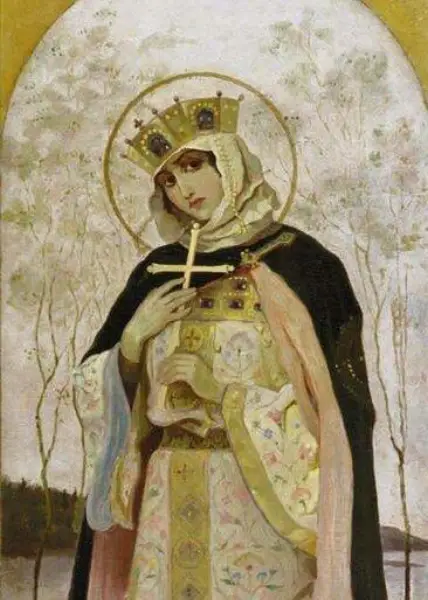
Overview
Olga (born between c. 890 and 925; died 11 July 969), baptized as Helena, governed Kievan Rus' as regent for the boy Sviatoslav between 945 and 957, the first woman ever to hold rule over the Rus'. Of Varangian origin and born at Pleskov or nearby Vybuty, she married Prince Igor I of Kiev, son of Rurik, and bore him the heir Sviatoslav. After the Drevlians murdered Igor in 945 while he sought a second tribute, Olga took power in the name of her three-year-old son and crushed the rebellion in a celebrated and brutal sequence of reprisals, ending with the burning of their capital Iskorosten. As ruler she reformed the tribute system, established trading posts, hunting grounds, and administrative centers that helped bind the realm together, and held Kiev during the Pecheneg siege of 968. In the 950s she journeyed to Constantinople and was baptized, taking the name Helena — the most powerful Rus' convert of her century. She urged her son toward Christianity without success, obtained bishops from Emperor Otto I, built churches, and died in 969. Her grandson Vladimir completed what she began, and she is venerated as Equal to the Apostles.
The Complete Life
A Varangian Bride of the Rurikids
Olga's birthdate is unknown, falling somewhere between 890 and 925. The Primary Chronicle records her as of Varangian stock, born at Pleskov — modern Pskov — or at the nearby settlement of Vybuty. Of her life before marriage almost nothing is known. Igor I of Kiev took her as his wife; he was the son and successor of Rurik, whose dynasty would hold the eastern Slavic lands for centuries; the historian Alexey Karpov judges that she can have been no more than fifteen at her wedding. Igor had grown up under the guardianship of Oleg, who had conquered the neighboring tribes and fixed the capital at Kiev, giving the realm the name Kievan Rus' — a territory reaching into what are now Russia, Ukraine, and Belarus. Olga bore Igor the heir Sviatoslav. Around the family's story moved the Drevlians, a neighboring tribe that had joined Rus' campaigns against Byzantium but withheld tribute after Oleg's death. In 945 Igor rode to their capital Iskorosten to force payment; conceded once, he turned back with a small escort for more, and the Drevlians killed him — bound between bent trees and ripped apart, if Leo the Deacon's telling is to be believed.
§ Early life
Regent and Avenger
Igor's death left a three-year-old heir and a widowed princess who now became the first woman to rule Kievan Rus'. The Drevlians, emboldened, proposed that she marry Prince Mal, her husband's killer. Her answer was a trap within a trap. She had the first twenty envoys carried in their boat to her court — an honor they took for a palanquin — and buried them alive in a trench; to the next party of distinguished men she offered a bathhouse and set it aflame; at the funeral feast for Igor she let her guests drink themselves senseless and had them slaughtered, five thousand by the Chronicle's count. When the survivors shut themselves in Iskorosten, she besieged the city for a fruitless year, then demanded of every household a trifling levy: three pigeons and three sparrows apiece. Sulphur bound to the birds sent them home in fire; the city burned house by house, and the fleeing people were killed or enslaved. It is a terrifying legend, and historians doubt much of it, but it fixed her image forever: a ruler of iron whom no affront to her house would go unanswered.
§ Drevlian Uprising
Lawgiver and Builder of the Realm
Ruling with the support of army and people, Olga proved a state-builder as well as an avenger. She changed the system of tribute gathering, the poliudie, in what is called the first legal reform recorded in Eastern Europe, and made tribute regular. Traversing the land of Dereva with her son and retinue, she established laws, trading posts, and hunting reserves; she set hunting lodges where birds of prey were caught for shipment to Byzantium, and founded pogosti — centers of trade that also served as administration — along the Msta and Luga rivers. This network helped centralize rule, furthered the cultural unification of the Rus' people, and began the marking of national boundaries. During Sviatoslav's long campaigns she held Kiev itself, residing at Vyshgorod with her grandsons, and in 968, when the Pechenegs besieged the city, she saw to its defense. She also declined every offer of remarriage. Whatever the Chronicle's chroniclers intended, the figure that emerges is of a sovereign who understood that a realm is held less by terror than by roads, posts, laws, and the loyalty of those who administer them.
§ Governance
Baptism at Constantinople
In the 950s Olga traveled to Constantinople to the court of Emperor Constantine VII, an episode preserved in three disagreeing sources: the Book of Ceremonies, Skylitzes' Synopsis of Histories, and the Primary Chronicle. The Book of Ceremonies records her reception with an entourage of merchants and a priest named Gregory but mentions no baptism; Skylitzes says briefly that she came after her husband's death, was baptized, and returned home devout; the Chronicle tells the fullest tale — that the emperor, finding her fair and wise, wished to marry her, and that Olga asked him to baptize her himself, knowing that his spiritual fatherhood would bar the marriage. When he renewed his suit, she answered that a godfather could not wed his goddaughter, and the emperor conceded that she had outwitted him. She was christened Helena, after the mother of Constantine the Great. Scholars debate whether she was already a Christian before the journey — likely baptized at Kiev around 955 — but the substance is secure: the most powerful person of Rus' had joined the church, taking the name of the empire's first Christian empress.
§ Conversion
The Last Years in Kiev
Home from Constantinople with the Patriarch's blessing, Olga urged her son to be baptized; Sviatoslav refused, saying that his followers would laugh at him if he accepted, though he undertook neither to hinder nor to harass anyone who wished to convert — a concession the Chronicle treats as decisive for the faith's future in the Rus' lands. Undeterred by his refusal, she built churches in Kiev, Pskov, and elsewhere, keeping the Christian party alive around her person, and turned westward as well: in 959 seven Latin sources record her embassy asking Emperor Otto I to appoint a bishop and priests for her nation. Adalbert of Magdeburg reached Kiev in 961 only to be driven out by pagan allies of her son, and the Russian historian Boris Akunin reads the two-year gap between invitation and arrival as evidence of a bloodless coup in which the pagan party prevailed and pushed the old princess into the background. In 969, ailing after the Pecheneg siege, she persuaded Sviatoslav — already bound for the Danube — to remain with her until the end; three days later she died. Sviatoslav, though no Christian himself, honored her final request: her priest Gregory performed the last rites, and she was buried without the ritual pagan feast, mourned by her son, her grandsons, and all the people of the realm.
§ Death
Equal to the Apostles
When Olga died it seemed her Christianizing work had failed; her grandson Vladimir completed it, adopting Christianity for the realm in 988. The Primary Chronicle hails her as the forerunner of the Christian land, gleaming amid the unbaptized like a jewel in filth, the first of the Rus' to reach God's kingdom. The date of her canonization is uncertain, but John Fennell argues it most likely came in 1284, when Metropolitan Maxim summoned a council alongside Vladimir's glorification, and the following year the metropolitan was recorded teaching the news of their canonization through the Russian lands. A fifteenth-century manuscript relates how Vladimir opened his grandmother's grave, discovered the body uncorrupted, and gave it rest in a wooden coffin within the Church of the Tithes. In 1547, nearly six centuries after her death, the Russian Orthodox Church officially named her a saint, equal to the apostles — the honorific Isapóstolos reserved for those who brought a nation to the font. Her feast falls on 11 July, the day of her death, with additional synaxaria among the saints of Volhynia, Kiev, and Pskov.
§ Sainthood
Memory Across the Lands of Rus'
Olga is venerated across the East Slavic world — in the Orthodox churches of Russia and Ukraine, in the Greek Catholic churches, among Byzantine-rite Lutherans, and among Western Catholics in Russia — as patron of widows and of converts, titles drawn from her own story. A sarcophagus recovered in 1826, during digging at the Church of the Tithes, was attributed to her; it went first to the Historical Museum, afterwards to St. Sophia Cathedral. Monuments, churches, and cathedrals bear her name from Kiev and Lviv to Pskov, Moscow, and Vladimir; there is an Olga bridge and a chapel in Pskov, whose airport took her name in 2019, and parishes and cathedrals of Saints Volodymyr and Olha in Chicago, Winnipeg, Windsor, and Woodville in South Australia. Ukraine established the Order of Princess Olga in 1997, and her streets run through most Ukrainian cities. Modern writers point to her as evidence that a woman could govern firmly and decisively, and historians still debate how much of the avenger's legend is chronicle art — while the dawn she kindled, as the Chronicle sang, has never gone out.
§ Legacy
Timeline
- 945
Igor is murdered by the Drevlians at Iskorosten while seeking a second tribute
§ Early life
- 945
Assumes the regency for her three-year-old son Sviatoslav, becoming the first woman to rule Kievan Rus'
§ Regency
- 945
Crushes the Drevlian rising, ending with the burning of their capital Iskorosten
§ Drevlian Uprising
- 955
Likely baptized in Kiev, ahead of a second christening in Constantinople
§ Interpretation of the sources
- 957
Visits Emperor Constantine VII at Constantinople and is baptized there, taking the name Helena
§ Conversion
- 959
Sends envoys to Holy Roman Emperor Otto I asking for a bishop and priests for her people
§ Relations with the Holy Roman Emperor
- 961
Adalbert of Magdeburg arrives in Kiev as missionary bishop but is expelled by Sviatoslav's pagan allies
§ Relations with the Holy Roman Emperor
- 968
Defends Kiev during the Pecheneg siege while her son campaigns afar
§ Governance
- 11 Jul 969
Dies of illness in Kiev shortly after the siege, asking for a Christian burial without the pagan feast
§ Death
- 988
Her grandson Vladimir officially adopts Christianity, completing her Christianizing work
§ Sainthood
- 1240
Her tomb in Kiev, preserved for over two centuries, is destroyed by the Mongol armies of Batu Khan
§ Death
- 1547
The Russian Orthodox Church formally names her a saint, equal to the apostles
§ Sainthood
In Their Own Words
Olga was the precursor of the Christian land, even as the day-spring precedes the sun and as the dawn precedes the day.
How can you marry me, after yourself baptizing me and calling me your daughter? For among Christians that is unlawful, as you yourself must know.
The Record
- Major works
- Reform of the tribute system (poliudie)·Network of pogosti — trading and administrative centers along the Msta and Luga rivers·Churches built in Kiev, Pskov, and elsewhere
- Patron of
- Widows·Converts
- Symbols
- Cross·Church
- Canonization
- Date uncertain, possibly 1284; officially glorified as Equal to the Apostles by the Russian Orthodox Church in 1547
Prayer
Bibliography
Show 5 sources
- Cross, Samuel Hazzard; Sherbowitz-Wetzor, Olgerd P. (1953) [1930]. The Russian Primary Chronicle, Laurentian Text. Cambridge, Massachusetts: The Mediaeval Academy of America.
- Craughwell, Thomas J. (2006). Saints Behaving Badly: The Cutthroats, Crooks, Trollops, Con Men, and Devil-Worshippers Who Became Saints. Doubleday. ISBN 978-0-385-51997-7.
- Plokhy, Serhii (2015). The Gates of Europe: A History of Ukraine. New York: Basic Books.
- Raffensperger, Christian; Ostrowski, Donald (2023). The Ruling Families of Rus: Clan, Family and Kingdom. London: Reaktion Books. ISBN 978-1-78914-745-2.
- Vernadsky, George (1948). A History of Russia. Vol. II: Kievan Russia. Yale University Press.
Profile text adapted from the Wikipedia article, licensed CC BY-SA 4.0.
Pray with this saint every day
Save St. Olga of Kiev to your favorites, read the full profile, and get feast-day reminders in the Saints app.
Get the Saints AppFree on the App Store for iPhone and iPad